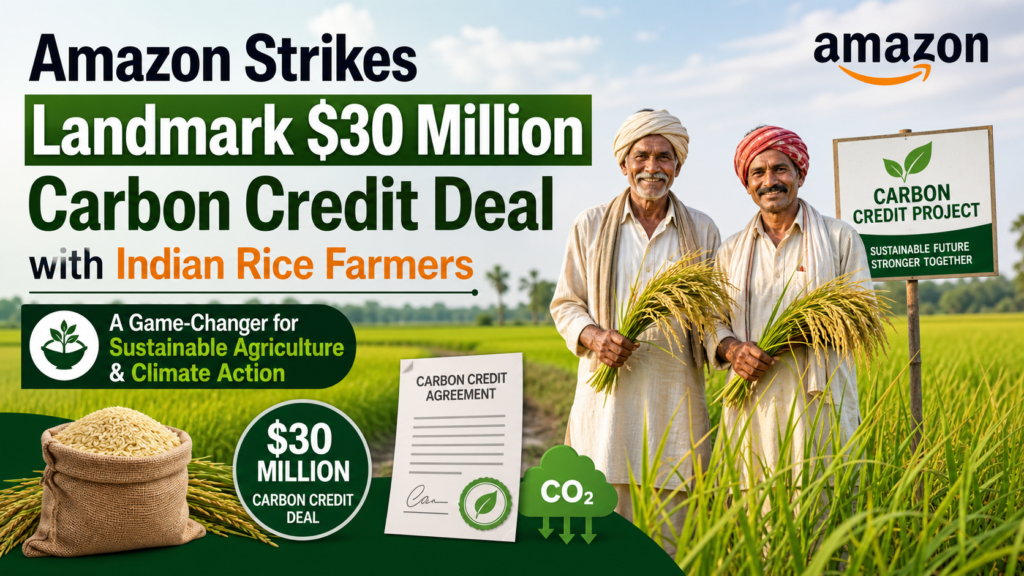

Here is something you probably did not expect to read today: Amazon — yes, the same company that delivers packages to your doorstep — has just made one of the most significant climate investments in Indian agriculture. And the heroes at the centre of this story are not tech engineers or Wall Street investors. They are rice farmers.
In a deal that is being described as a first of its kind in India, Amazon has committed $30 million — roughly ₹280 crore — to purchase carbon credits generated by over 13,000 smallholder farmers spread across 35,000 hectares of farmland. The partner making this happen on the ground is the Good Rice Alliance, a collective supported by Bayer, Singapore-based Temasek, and Shell’s nature-based solutions wing.
So what exactly is a carbon credit — and why should farmers care?
Think of a carbon credit as a tradeable certificate that says: “We reduced or absorbed one metric tonne of carbon dioxide from the atmosphere.” Companies like Amazon, which have committed to net-zero targets, buy these credits to offset their emissions. In exchange, the people who generate those reductions — in this case, Indian farmers — get paid.
The initial phase of this deal alone will cover over 685,000 metric tonnes of CO₂-equivalent reductions. For context, that is roughly the annual emissions of a small city.
Why rice farming specifically? It is a bigger climate problem than most people realise
This is where it gets interesting. Traditional paddy farming — where fields are kept continuously flooded — releases significant amounts of methane, a greenhouse gas far more potent than CO₂ in the short term. Globally, conventional rice cultivation contributes around 8 to 10 percent of all methane emissions from agriculture. India, the world’s largest rice producer, sits uncomfortably high on that list.
The Good Rice Alliance is training farmers in a set of smarter, lower-emission techniques. These include Alternate Wetting and Drying — where fields are periodically allowed to dry out rather than staying permanently flooded — and Direct Seeded Rice, which skips the water-intensive transplanting stage altogether. These methods do not just cut methane. They also reduce water usage and, in many cases, maintain or even improve crop yields.
For farmers operating on thin margins, the carbon income is a genuine game-changer. It is an additional revenue stream on top of what they already earn from selling rice — essentially getting paid twice for the same land.

Why this deal is bigger than just Amazon buying carbon offsets
Carbon markets in India have largely been driven by renewable energy projects — solar, wind, and biomass. Agriculture, despite being a major source of emissions, has rarely featured in these conversations. One reason is that measuring and verifying emission reductions from farming is technically complex and expensive.
This deal signals that the problem has become solvable at scale. It demonstrates that corporate climate money can flow directly into the hands of smallholder farmers — not through charity, but through a market mechanism that rewards verified environmental performance.
We have seen similar moves from Microsoft in soil carbon projects and Meta in forestry. But a rice-focused deal of this size, targeting one of India’s most critical crops, is genuinely new territory.
What it means for India’s agricultural future
India has been trying to position itself as a serious player in global climate finance. Deals like this one strengthen that ambition. They also do something arguably more important: they give farmers a financial reason to adopt better practices, rather than relying purely on government mandates or subsidies.
If this model scales — and there is good reason to believe it can — Indian farmers could become key contributors to the country’s climate targets while simultaneously improving their own livelihoods. Lower input costs, better water efficiency, extra carbon income, and improved soil health over time. The incentives are aligned in a way that purely policy-driven approaches rarely manage.
The bottom line
Amazon’s $30 million investment is not just a corporate ESG checkbox. It is a meaningful test of whether big tech’s climate money can reach the people who are actually closest to the land — and the emissions.
If it works the way the Good Rice Alliance intends, India’s rice belt could quietly become one of the world’s most important carbon sinks. And the farmers tending those fields? They would have earned it.