
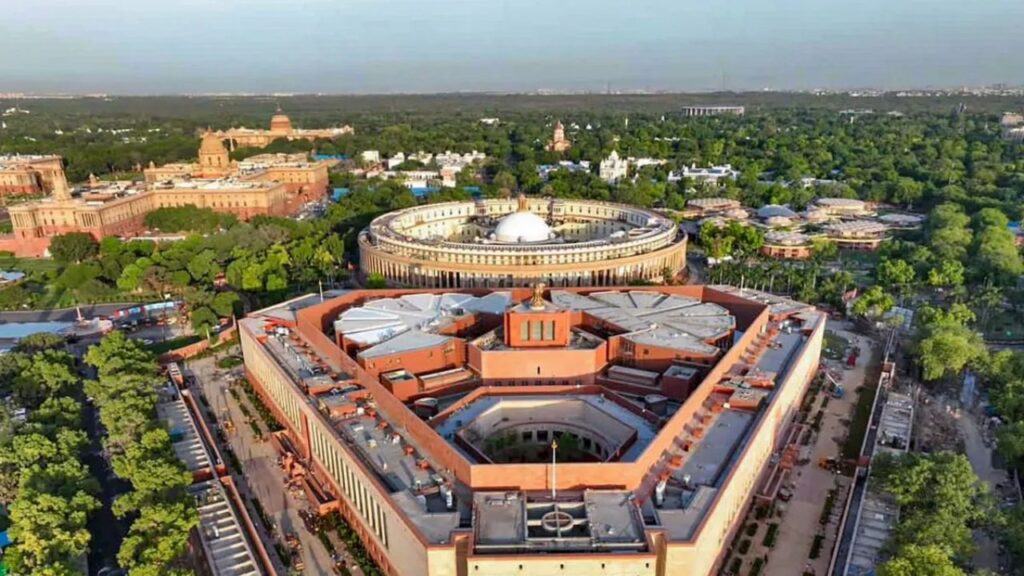

The Central government has lined up a series of significant economic reform bills for introduction and consideration during the Monsoon Session of Parliament, reflecting its focus on strengthening the financial system, improving the business environment for micro and small enterprises, and updating regulatory frameworks.
According to the tentative legislative and financial business agenda circulated by the Ministry of Parliamentary Affairs, the Income-tax (Amendment) Bill, 2026 and the Micro, Small and Medium Enterprises Development (Amendment) Bill, 2026 are among the major economy-related legislations scheduled for introduction. In addition, the Foreign Contribution (Regulation) Amendment Bill, 2026, which is already pending in the Lok Sabha, has been listed for consideration and passage during the session.
The Monsoon Session commenced on July 20 and is scheduled to continue until August 13, with a brief break for Independence Day celebrations before Parliament reconvenes, if required.
Income-tax Amendment Bill to Replace Ordinance
One of the key legislative proposals is the Income-tax (Amendment) Bill, 2026, which seeks to replace an Ordinance currently in force.
According to the government’s legislative agenda, the Bill has been designed to deepen India’s sovereign debt market, attract stable global capital inflows and improve liquidity in the financial system. The proposed legislation comes against the backdrop of heightened global economic uncertainty, driven by geopolitical tensions, rising crude oil prices and ongoing disruptions in international supply chains.
By strengthening the legal framework governing taxation related to sovereign debt investments, the government aims to make India’s government securities market more attractive to long-term foreign investors. A deeper and more liquid bond market is expected to improve the government’s ability to raise funds efficiently while enhancing overall financial market stability.
The proposed amendments are also intended to encourage sustained foreign participation in India’s debt market, helping diversify the investor base and reduce dependence on short-term capital flows during periods of global volatility.
MSME Amendment Bill Targets Ease of Doing Business
Another major legislative proposal is the Micro, Small and Medium Enterprises Development (Amendment) Bill, 2026, which seeks to modernise the MSME Development Act, 2006 in line with the evolving needs of the sector.
The government has stated that the proposed amendments are aimed at creating a more business-friendly and trust-based regulatory ecosystem for MSMEs while improving ease of doing business.
One of the key objectives of the Bill is to strengthen mechanisms for addressing delayed payments to micro and small enterprises—a long-standing challenge affecting cash flow and business sustainability for smaller firms.
The legislation also proposes to provide stronger legal backing for the enforcement of arbitral awards involving micro and small enterprises, thereby improving the effectiveness of dispute resolution mechanisms.
In addition, the Bill seeks to give state governments greater flexibility in determining the composition of the Micro and Small Enterprises Facilitation Councils (MSEFCs). This flexibility is expected to enable states to establish more Facilitation Councils, allowing disputes related to delayed payments to be resolved more efficiently and reducing the burden on existing bodies.
The reforms are expected to strengthen the institutional framework supporting MSMEs while promoting faster resolution of commercial disputes.
FCRA Amendment Bill Listed for Passage
The government’s legislative agenda also includes the Foreign Contribution (Regulation) Amendment Bill, 2026, which was introduced in the Lok Sabha on March 25, 2026.
The Bill has now been listed for consideration and passing during the Monsoon Session. While the detailed provisions will be debated in Parliament, the legislation forms part of the government’s broader effort to update the regulatory framework governing foreign contributions received by eligible organisations and entities.
Busy Legislative Session Ahead
The inclusion of these important bills signals the government’s intent to push ahead with structural economic reforms during the current session of Parliament.
The proposed measures cover a wide spectrum of policy priorities, including strengthening financial markets, enhancing investor confidence, improving the business climate for MSMEs and refining regulatory governance.
With Parliament set to deliberate on these and several other legislative proposals over the coming weeks, the Monsoon Session is expected to play a significant role in shaping India’s economic and regulatory landscape for the years ahead.

Author: Shivam
Shivam Dwivedi is a senior journalist with extensive experience in research-driven journalism, policy communication, and multi-platform storytelling. His areas of interest include international relations, defence, science & technology, education, urban development, agriculture, spirituality, and environmental sustainability. His work focuses on in-depth analysis, public discourse, and impactful narratives across governance and development sectors, with a strong commitment to the Sustainable Development Goals (SDGs). Contact: [email protected]