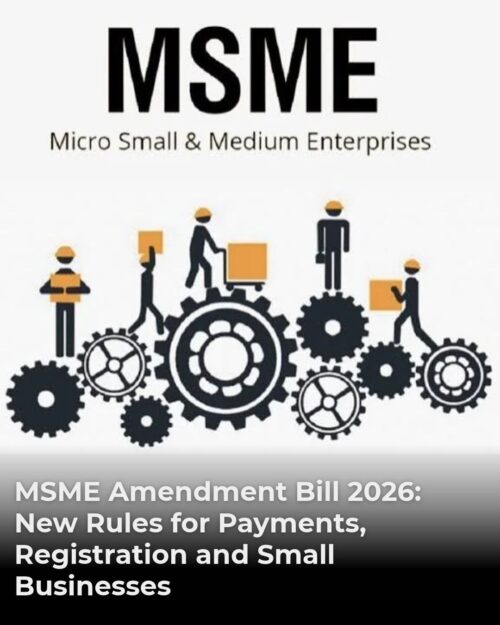

MSME Amendment Bill 2026:- The Micro, Small and Medium Enterprises (MSME) sector is set to receive important regulatory changes under the MSME Development (Amendment) Bill, 2026. Passed by Parliament in August 2026, the Bill aims to make it easier for small businesses to operate, access financial support and resolve payment-related disputes.
The amendment updates the Micro, Small and Medium Enterprises Development Act, 2006, to meet the changing needs of India’s growing MSME sector. Its key focus areas include improving payment systems, simplifying registration, strengthening dispute resolution and reducing compliance-related difficulties for businesses.
MSMEs play a major role in India’s economic growth by supporting manufacturing, generating employment and contributing to exports. According to the Economic Survey 2025-26, the sector contributes 31.1 per cent to India’s GDP, 35.4 per cent to manufacturing output and 48.58 per cent to total exports.
As of August 2026, around 9.16 crore MSMEs were registered on the Udyam platform, providing employment to more than 40 crore people. With the growing use of digital technology and online business platforms, the government aims to create a more supportive business environment for these enterprises.
MSME Amendment Bill 2026:- New MSME Classification System
One of the important changes under the MSME Development (Amendment) Bill, 2026, is the revision of the MSME classification system.
Under the earlier MSMED Act, 2006, enterprises were classified mainly on the basis of investment in plant, machinery or equipment. The amended framework includes both investment and annual turnover as the basis for classification.
This change aims to provide a more comprehensive system for identifying micro, small and medium enterprises and aligning their classification with business growth.
MSME Amendment Bill 2026:- Free and Voluntary MSME Registration
The Bill also proposes to make the MSME registration process simpler.
Earlier, specific registration requirements applied to medium enterprises involved in manufacturing, while registration was voluntary for other MSMEs.
Under the amended provisions, filing the memorandum will be free and voluntary for all MSMEs. The Central Government will notify a national digital platform for registration, while state governments can also introduce their own digital platforms.
MSMEs registered through these platforms may also become eligible for benefits under various state government schemes.
This move is expected to encourage more small businesses, particularly informal enterprises, to become part of the formal economy.
MSME Amendment Bill 2026:- TReDS to Improve Payments to MSMEs
Delayed payments remain one of the biggest challenges faced by small businesses. The new amendment aims to address this problem by strengthening the use of the Trade Receivables Discounting System (TReDS).
Under the Bill, all Central Public Sector Enterprises (CPSEs) will be required to settle invoices for goods and services purchased from MSMEs through the TReDS platform.
State governments may also make TReDS compulsory for their public sector enterprises and other notified organisations.
TReDS is an electronic platform that helps MSMEs receive early payments by allowing them to discount their unpaid invoices through financiers.
The value of invoices discounted through the platform increased from ₹40,000 crore in 2022-23 to ₹3.47 lakh crore in 2025-26, showing its growing importance in improving access to working capital.
MSME Amendment Bill 2026:- Faster Resolution of MSME Payment Disputes
The amendment also focuses on making the dispute resolution process faster and more effective.
State governments will have the power to establish multiple Micro and Small Enterprises Facilitation Councils (MSEFCs). They can also provide these councils with the required infrastructure, digital facilities and trained staff.
The Bill introduces specific timelines for mediation and arbitration:
- Mediation must be completed within 90 days from the date fixed for the first appearance.
- If mediation fails, the matter must be referred for arbitration within 30 days.
- The arbitral award must be issued within 90 days after the completion of pleadings.
The Central Government may also establish an online system for conducting mediation and arbitration.
These measures are expected to reduce delays and help MSMEs recover their pending payments more quickly.
MSME Amendment Bill 2026:- Stronger Protection for MSME Suppliers
The Bill introduces additional provisions to protect MSME suppliers during legal disputes.
Under the existing framework, a buyer seeking to challenge an order or award issued by the Facilitation Council must deposit 75 per cent of the awarded amount.
The amended provisions allow courts to direct the payment of a reasonable portion of the deposited amount to the MSME supplier while the case is pending.
If an application challenging a decree, award or order remains pending for more than six months, courts must direct payment of at least 50 per cent of the awarded amount to the MSE supplier.
The amendment also provides that mediated settlement agreements and arbitral awards can be recovered as arrears of land revenue. This will allow the recovery process to be carried out through the District Collector, Deputy Commissioner or another notified authority.
MSME Amendment Bill 2026:- Simplification of Penalties and Compliance
Another important feature of the MSME Amendment Bill is the decriminalisation of certain compliance-related offences.
Earlier, some violations, including providing incorrect registration information and failing to report unpaid MSME dues in annual accounts, attracted criminal penalties.
The amended framework replaces several criminal provisions with a system of warnings and financial penalties.
For incorrect information, businesses will receive a warning for the first instance, followed by penalties for subsequent violations. Similarly, failure to disclose unpaid dues will attract a warning initially, followed by penalties and fines for repeated violations.
This approach aims to reduce unnecessary legal pressure on businesses while maintaining accountability.
MSME Amendment Bill 2026:- Digital Platforms to Support MSME Growth
The government’s wider digital initiatives will also support the implementation of these reforms.
The Udyam Registration Portal provides MSMEs with free, paperless and online registration. The Udyam Assist Platform helps bring informal micro enterprises into the formal economy, including eligible businesses that do not have GST or Income Tax registration.
The Online Dispute Resolution (ODR) Portal, launched in June 2025, provides a digital platform for resolving delayed payment disputes, including smaller claims.
Additionally, 161 Micro and Small Enterprises Facilitation Councils have been established across states and Union Territories to address payment-related disputes.
MSME Amendment Bill 2026:- A Step Towards Stronger MSMEs in India
The MSME Development (Amendment) Bill, 2026, aims to create a more business-friendly environment for India’s small enterprises. By improving payment systems, simplifying registration, introducing time-bound dispute resolution and reducing compliance burdens, the government seeks to address several long-standing challenges faced by MSMEs.
The success of these reforms will depend on effective implementation, stronger digital infrastructure and coordination between central and state governments.
With MSMEs contributing significantly to India’s GDP, manufacturing and exports, these changes could help small businesses improve their financial stability, expand operations and become more competitive in domestic and international markets. Read more:- MSME India International Trade Fair 2026: Northeast Entrepreneurs Get National Market Exposure at India International Trade Fair 2026