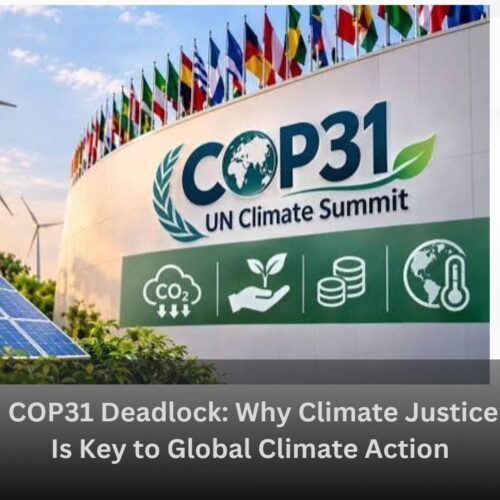


Climate justice:- The latest United Nations climate summit, COP31, held in Antalya, Turkey, ended without a major agreement on some of the world’s most important climate issues. The summit, which was expected to focus on turning climate promises into real action, instead exposed deep disagreements between developed and developing countries.
The negotiations continued for more than 40 hours beyond the November 20 deadline, making it the longest-ever COP meeting. However, countries failed to reach a common position on fossil fuel reduction and financial support for nations most affected by climate change.
The disagreement highlighted a major challenge in global climate negotiations: balancing environmental responsibility with economic development and climate justice.
Climate justice:- Disagreement Over Fossil Fuels and Climate Finance
One of the main reasons behind the COP31 deadlock was disagreement between two influential negotiating groups.
Saudi Arabia and other oil-producing countries opposed including a clear commitment to move away from fossil fuels. On the other hand, the European Union supported stronger action on fossil fuels but did not offer equally strong commitments on financial assistance for developing nations.
A major concern was the removal of a proposed $120 billion annual target for climate adaptation finance from the final negotiated draft.
Developing countries need financial support to deal with rising temperatures, floods, droughts, storms and other climate-related challenges. They argue that wealthier nations, which have contributed more to historical greenhouse gas emissions, should take greater responsibility for providing climate funding.
The lack of agreement on financial support, along with differences over fossil fuels, increased tensions between developed and developing countries.
Climate justice:- Why Climate Justice Matters
Climate justice is based on the idea that every country should contribute to climate action according to its responsibility and financial capacity.
Developing countries face a difficult situation. They need to expand their economies, create jobs, improve infrastructure and provide affordable energy to their populations. At the same time, they are increasingly exposed to the effects of climate change.
Many of these countries have contributed less to historical global emissions but face serious consequences from extreme weather events.
Financial assistance is therefore important for building climate-resilient infrastructure, developing renewable energy projects and protecting vulnerable communities.
Climate finance also needs to be predictable, accessible and sufficient. Without proper funding, developing nations may struggle to meet climate targets while maintaining their development priorities.
Climate justice:- Previous Climate Summits Also Faced Challenges
The COP31 deadlock is not the first major setback in international climate negotiations.
Similar difficulties emerged at COP6 in The Hague in 2000 and COP15 in Copenhagen in 2009. Both meetings failed to deliver the expected outcomes.
However, international negotiations gradually regained momentum, eventually leading to the Paris Agreement in 2015.
Today, the situation is more urgent. Rising global temperatures and increasingly frequent extreme weather events are making the effects of climate change harder to ignore.
The goal of limiting global warming to 1.5 degrees Celsius above pre-industrial levels is also becoming increasingly difficult to achieve.
The next climate summit, COP32, is expected to take place in Addis Ababa, Ethiopia, in 2027. Countries will face pressure to turn existing commitments into practical action while protecting the basic principles of the UN climate framework.
Climate justice:- India’s Role in Global Climate Negotiations
India has an important role to play in bringing developed and developing countries closer together.
During COP31, India stressed that developed countries must fulfil their existing climate finance commitments. At the same time, New Delhi expressed its willingness to work with different countries to find solutions that balance climate action with development needs.
India’s position is based on the principle that climate policies should recognise the different economic conditions and responsibilities of countries.
Although fossil fuels will continue to remain part of India’s energy mix for some time, the country has made progress in expanding clean energy. India has also achieved its Paris Agreement clean energy target ahead of schedule.
For India, investing in renewable energy and reducing dependence on carbon-intensive energy sources can bring several benefits. These include improved energy security, stronger industrial competitiveness and new opportunities in green technology.
Climate justice:- Need for Stronger Global Cooperation
The outcome of COP31 shows that climate negotiations cannot succeed through environmental commitments alone. Countries also need trust, financial cooperation and a fair approach to sharing responsibilities.
Developed nations must provide meaningful financial support, while developing countries need opportunities to pursue sustainable economic growth.
Restoring climate justice to the centre of international discussions will be important for breaking the current deadlock.
The world needs more than promises and declarations. It needs practical solutions, reliable funding and cooperation that delivers measurable results.
A successful global climate strategy must protect the environment while ensuring that developing nations are not forced to choose between economic progress and climate responsibility. Also More:- COP31 collapse and India climate policy:- Impact on India’s Climate Policy and Climate Finance