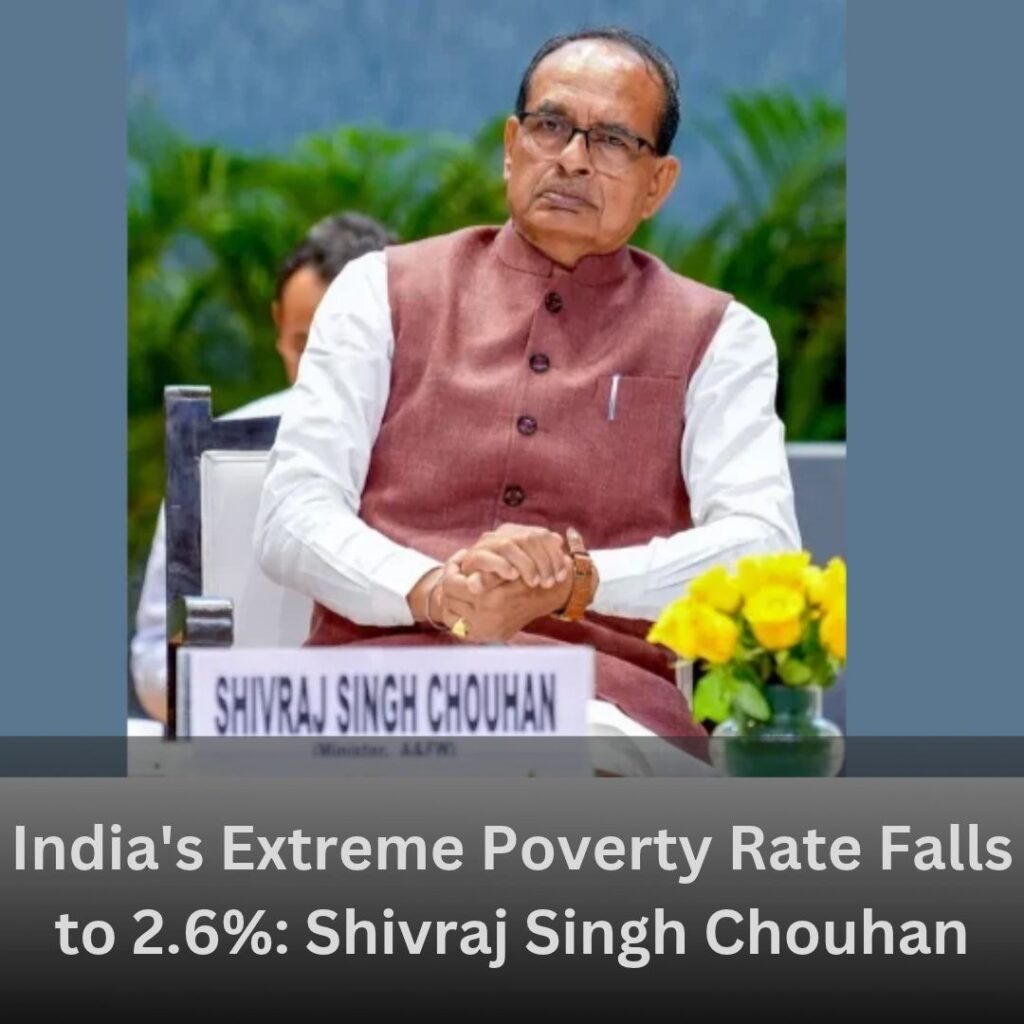

India’s extreme poverty rate:- India has made significant progress in reducing extreme poverty, with the poverty rate falling from 27.1 per cent to 2.6 per cent, according to Union Agriculture and Rural Development Minister Shivraj Singh Chouhan. He said nearly 500 million people have moved out of poverty, marking an important development in the country’s social and economic progress.
Speaking at a workshop organised at the Dr Ambedkar International Centre, New Delhi, Chouhan referred to a recent World Bank report to highlight India’s progress in poverty reduction. He said the achievement reflected the combined efforts of government departments, welfare programmes and officials working towards rural development and improving people’s living conditions.
However, the minister stressed that reducing poverty was only one part of the challenge. The government’s next priority should be to ensure that people who have moved above the poverty line do not fall back into poverty. He also called for continued efforts to improve the living conditions of families who are still struggling financially.
India’s extreme poverty rate:- Government Focuses on Long-Term Poverty Reduction
Chouhan said that the progress made in poverty reduction should encourage government departments to work with greater responsibility. He highlighted the importance of coordination between different ministries and departments in implementing development programmes.
The workshop brought together officials from several important departments, including Agriculture and Farmers’ Welfare, Rural Development, Land Resources, and Agricultural Research and Education. Union Ministers of State Bhagirath Choudhary and Kamlesh Paswan also participated in the programme.
Appreciating the contribution of government employees and officials, Chouhan said their work had played an important role in the country’s development. He told the gathering that government employees had done more than simply prepare and implement schemes; they had contributed directly to nation-building.
During the event, the minister also stepped down from the stage and sat among the officials to listen to their suggestions and views. His interaction highlighted the importance of teamwork, communication and participation in improving the delivery of government programmes.
India’s extreme poverty rate:- India’s Agriculture Sector Records 4.45% Growth
Along with poverty reduction, the Agriculture Ministry highlighted the country’s progress in agricultural production and rural development.
According to the ministry, India’s agriculture sector recorded a decadal growth rate of 4.45 per cent. This is higher than the growth rate of approximately 3 to 3.5 per cent recorded during the Green Revolution period.
Agricultural production has also increased significantly over the years. India’s foodgrain production reached 376.56 million tonnes, while horticulture production stood at 386.91 million tonnes.
These figures highlight the growing contribution of agriculture to India’s economy and food security. Higher agricultural output also supports farmers, strengthens food availability and creates opportunities across the rural economy.
The government has continued to focus on improving agricultural productivity, supporting farmers and encouraging modern farming practices.
India’s extreme poverty rate:- PM-KISAN and Other Schemes Support Farmers
The Agriculture Ministry also highlighted the role of various government initiatives in supporting farmers and strengthening rural livelihoods.
Under the Pradhan Mantri Kisan Samman Nidhi (PM-KISAN) scheme, more than Rs 4.66 lakh crore has been disbursed to eligible farmers. The scheme provides direct financial assistance to farmers, helping them meet some of their agricultural and household expenses.
Other important initiatives include crop insurance programmes, agricultural credit facilities and the promotion of natural farming. These measures aim to reduce farming risks, improve access to financial resources and encourage sustainable agricultural practices.
The government has also supported the establishment of 10,000 Farmer Producer Organisations (FPOs). These organisations help farmers work collectively, improve their bargaining power, access markets and strengthen their business opportunities.
Digital initiatives such as AgriStack are also part of the government’s efforts to modernise the agricultural sector. These initiatives aim to improve agricultural data management and support better access to information and services for farmers.
India’s extreme poverty rate:- Stronger Rural Development Remains a Priority
The discussions at the workshop highlighted the connection between poverty reduction, agricultural development and rural welfare. Agriculture continues to be an important source of livelihood for millions of Indian families, making rural development essential for inclusive economic growth.
The government now faces the challenge of maintaining the progress achieved in poverty reduction while ensuring better opportunities for farmers and rural households.
With continued investment in agriculture, financial support, digital infrastructure and welfare programmes, the focus remains on improving rural incomes and creating sustainable livelihood opportunities.
The reported decline in extreme poverty to 2.6 per cent represents an important milestone. However, ensuring that the benefits of economic development reach every section of society will remain a major priority in India’s development journey. Read more :- India Netherlands Cooperation Expands in Agriculture, Water Management and Green Energy