
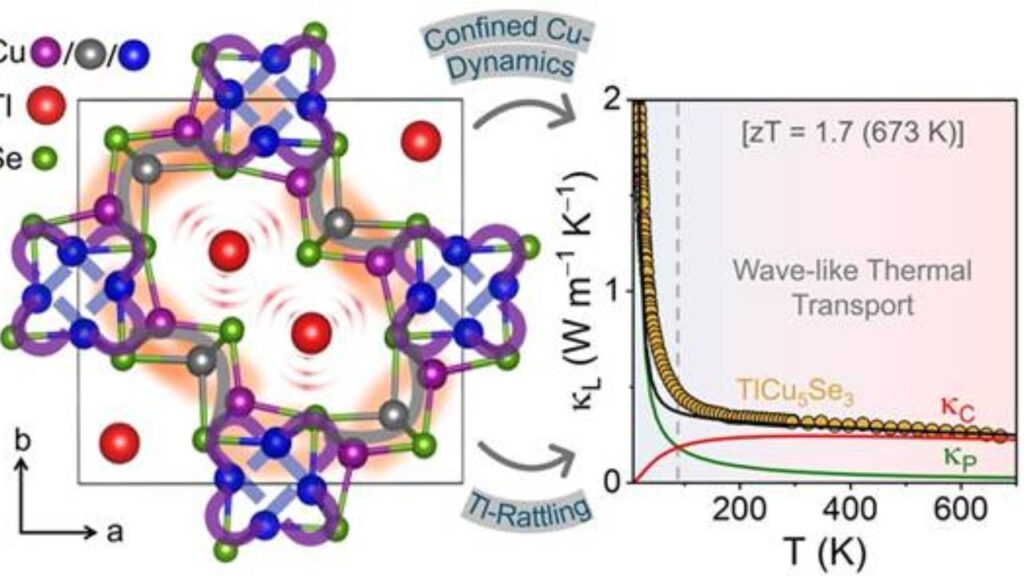

Researchers at the Jawaharlal Nehru Centre for Advanced Scientific Research (JNCASR), Bengaluru, have identified an unusual mechanism of heat transport in a newly studied copper chalcogenide, thallium copper selenide (TlCu5Se3). The discovery could contribute to the development of advanced thermoelectric materials capable of converting waste heat into electricity more efficiently.
Thermoelectric technologies can potentially recover otherwise wasted heat from power plants, cement and steel industries, automobiles, data centres and battery systems. A major challenge in designing such materials is achieving very low thermal conductivity while maintaining structural stability and good electronic transport.
Conventional superionic materials reduce thermal conductivity through highly mobile ions. However, excessive movement of ions can destabilise their crystal structures and adversely affect their thermoelectric properties. TlCu5Se3 presents a different approach, where the movement of copper atoms remains confined within a complex crystal framework.
The research team found that this restricted atomic motion generates strong anharmonicity and leads to an unconventional, predominantly wave-like mode of heat transport. Their findings have been published in the prestigious journal Science Advances.
In ordinary crystalline materials, thermal energy is generally understood to move through particle-like vibrations known as phonons. These phonons typically travel over distances considerably larger than the spacing between neighbouring atoms. In highly disordered materials such as glasses, phonon propagation becomes strongly disrupted, reducing the mean free path to nearly the scale of interatomic distances.
TlCu5Se3 occupies an interesting intermediate regime. Despite retaining long-range crystalline order, it contains strong structural complexity, disorder and anharmonic atomic vibrations. These characteristics produce closely spaced and highly localised vibrational modes that interact strongly with one another.
The study was led by Prof. Kanishka Biswas along with his Ph.D. students Ms. Sayantoni Choudhury and Dr. Animesh Bhui from the New Chemistry Unit at JNCASR. The researchers combined experimental investigations with advanced theoretical calculations to understand the material’s structural, thermal and electronic behaviour.
The crystal structure of TlCu5Se3 is tetragonal and features a complex three-dimensional framework resembling a cloverleaf knot, with open channels extending along the crystallographic c-axis. The researchers proposed that the compound’s distinctive bonding hierarchy confines the movement of copper atoms within this framework.
To investigate this behaviour, the team collaborated with Prof. Umesh V. Waghmare and postdoctoral researcher Dr. Prasad V. Matukumilli from JNCASR‘s Theoretical Sciences Unit. First-principles calculations and molecular-dynamics simulations were used to examine atomic motion and heat transport at the microscopic level.
The simulations showed that copper atoms undergo localised dynamic disorder rather than the long-range, liquid-like diffusion seen in many superionic copper chalcogenides. Instead of migrating freely through the lattice, the copper atoms remain dynamically confined. This restricted motion produces pronounced lattice anharmonicity and significantly suppresses conventional heat transport.
The researchers found that thermal energy can consequently move through wave-like coherence between localised vibrational states. In this process, phonons can effectively tunnel between vibrational modes rather than travelling solely as well-defined particles.
To capture this behaviour, the researchers went beyond the conventional phonon-gas model and used a unified framework for thermal transport. This approach accounts for both particle-like phonon propagation and wave-like coherence between different vibrational branches.
The resulting combination of exceptionally low lattice thermal conductivity and favourable electronic transport produced a thermoelectric figure of merit (zT) of 1.7, placing TlCu5Se3 among the high-performing pristine ternary chalcogenides.
The findings demonstrate that thermal transport can be controlled not only through conventional disorder or mobile ions, but also through carefully confined atomic dynamics within a complex crystal structure. The work could therefore provide a new design strategy for materials used in waste-heat recovery, thermal barrier coatings and advanced thermal management technologies, including applications relevant to future quantum technologies.
Also Read: India Emerges as Global Hub for Vaccine Innovation and Epidemic Preparedness

Author: Shivam
Proficient Writer Contact: [email protected]