
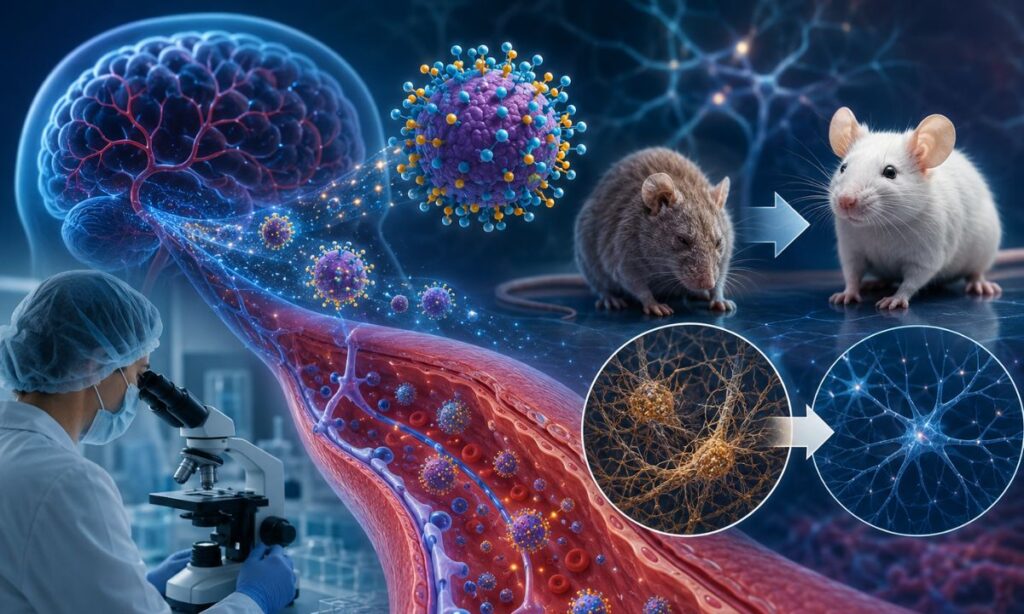

Researchers from Spain, China, and the United Kingdom have reported a major breakthrough in Alzheimer’s research after successfully reversing disease-related damage in mice using specially engineered nanoparticles that restore the brain’s natural waste-clearing system.
The study, published in the journal Signal Transduction and Targeted Therapy, was led by scientists from the Institute for Bioengineering of Catalonia and West China Hospital Sichuan University, alongside collaborators from the United Kingdom.
Unlike many conventional Alzheimer’s therapies that directly target damaged neurons or amyloid plaques, the researchers focused on repairing the blood-brain barrier (BBB) – the protective network of blood vessels and cells responsible for controlling what enters and leaves the brain.
Scientists say the breakdown of this barrier plays a critical role in Alzheimer’s disease by allowing toxic proteins such as amyloid-β (Aβ) to accumulate in the brain.
Nanoparticles Acted as the Treatment
The team developed bioactive nanoparticles known as “supramolecular drugs.” Rather than simply carrying medicine, the nanoparticles themselves acted as the therapy by restoring the brain’s vascular system and reactivating its waste-removal pathways.
In healthy brains, the BBB helps remove harmful proteins like amyloid-β, which is strongly linked to Alzheimer’s disease. But in patients with Alzheimer’s, this clearance mechanism gradually fails, leading to plaque buildup, neuron damage, and cognitive decline.
To test the therapy, researchers used genetically engineered mice that develop Alzheimer’s-like symptoms and high levels of amyloid-β.
The animals received only three doses of the nanoparticles, and the effects appeared rapidly.
“Only one hour after the injection we observed a reduction of 50–60% in Aβ amount inside the brain,” said Junyang Chen, first co-author of the study.
Long-Term Recovery Observed
Researchers also monitored the mice for several months using behavioral and memory tests.
In one experiment, a 12-month-old mouse – considered biologically similar to a 60-year-old human – was treated and later evaluated six months afterward. By then, the mouse was roughly equivalent to a 90-year-old human, yet it reportedly behaved similarly to a healthy animal without signs of Alzheimer’s-related decline.
According to the scientists, the treatment appears to work by restoring healthy blood vessel function, allowing the brain to naturally remove toxic proteins again.
“The long-term effect comes from restoring the brain’s vasculature,” explained Giuseppe Battaglia. “Once the vasculature is able to function again, it starts clearing Aβ and other harmful molecules, allowing the whole system to recover its balance.”
Targeting the Brain’s Transport System
A key focus of the research was a protein called LRP1, which acts as a transport receptor at the blood-brain barrier.
Under normal conditions, LRP1 binds to amyloid-β and moves it out of the brain into the bloodstream for disposal. However, in Alzheimer’s disease, this transport system becomes dysfunctional.
The nanoparticles were engineered to mimic natural molecules that interact with LRP1, effectively “resetting” the transport process and improving amyloid clearance.
Researchers say this strategy could represent a major shift in Alzheimer’s treatment by repairing the brain’s infrastructure instead of only attacking plaques directly.
A New Direction for Alzheimer’s Research
Scientists increasingly believe Alzheimer’s is not solely a neurological disorder but also a vascular disease involving damaged blood vessels and impaired blood flow.
The new findings add momentum to research exploring how restoring blood-brain barrier health may slow or even reverse disease progression.
The team noted that the nanoparticles were created using a highly controlled molecular engineering process that allowed precise interaction with cell receptors involved in brain waste removal.
Researchers also believe the technology could eventually complement existing Alzheimer’s therapies, including anti-amyloid antibody drugs, which often struggle to cross the blood-brain barrier efficiently.
Human Trials Still Needed
Despite the promising results, experts caution that the research remains in the animal-testing stage. Many Alzheimer’s treatments that showed success in mice have failed during human clinical trials.
Still, the study is being viewed as an important advance in understanding how repairing the brain’s vascular and clearance systems may help combat neurodegenerative diseases.
“Our study demonstrated remarkable efficacy in achieving rapid Aβ clearance, restoring healthy function in the blood-brain barrier and leading to a striking reversal of Alzheimer’s pathology,” said Lorena Ruiz Perez.
The project involved scientists from multiple institutions, including University College London, University of Barcelona, and the Chinese Academy of Medical Sciences.

Author: Shivam
Proficient Writer Contact: [email protected]