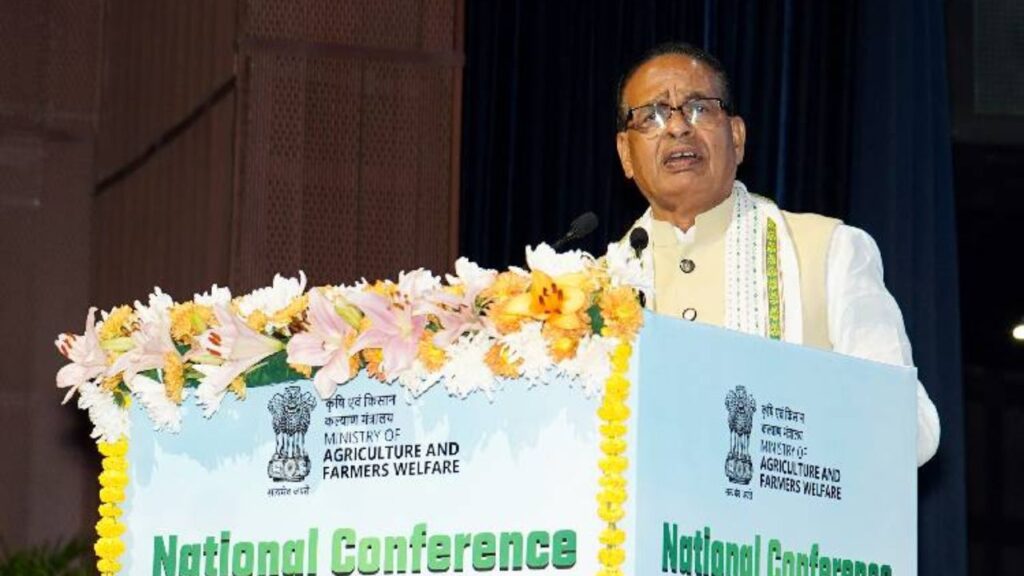

Union Minister for Agriculture and Farmers’ Welfare and Rural Development, Shivraj Singh Chouhan, has announced that India is fully prepared for the Kharif 2026 season, highlighting extensive planning and coordination between the Centre and state governments to ensure a smooth and productive agricultural cycle.
Addressing the media during the National Kharif Agriculture Conference at Pusa in New Delhi, Chouhan said comprehensive consultations had been held with state agriculture ministers, scientists, agricultural universities, Krishi Vigyan Kendras (KVKs), progressive farmers and senior officials. The discussions focused on critical aspects such as seed availability, fertiliser management, crop insurance, agricultural credit, natural farming and state-specific agricultural planning.
The minister emphasized that quality seed availability remains the foundation of a successful crop season. According to him, the country requires around 173 lakh quintals of seeds for the Kharif season, while nearly 192 lakh quintals have already been arranged, ensuring a surplus of about 11 percent. Seed allocations have been completed for all states, and efforts are underway to ensure timely distribution before sowing begins.
To address weather-related uncertainties, the Centre has also established a national seed reserve of 1.74 lakh quintals. This reserve is intended to support farmers in case of delayed monsoons, extended dry spells or situations requiring re-sowing.
Chouhan also highlighted the progress of the Farmer ID initiative, which aims to simplify farmers’ access to government schemes. More than 9.76 crore Farmer IDs have already been generated across the country. The initiative is expected to reduce paperwork, improve transparency and ensure targeted delivery of benefits such as subsidies, fertilisers and financial assistance.
On agricultural credit, the minister noted that the average farm loan size in India currently stands at approximately ₹1.32 lakh. However, he acknowledged significant regional disparities, particularly in eastern India where credit flow remains lower. To address this issue, discussions with banking institutions will be undertaken in affected states to improve timely access to agricultural finance.
The conference also focused on the needs of tenant farmers who cultivate leased land but often remain outside the coverage of several government welfare programmes. Chouhan said successful state-level models would be examined to develop a broader framework that could help extend benefits to such farmers.
Discussing the Pradhan Mantri Fasal Bima Yojana, the minister said efforts are being made to enhance the accuracy and transparency of crop loss assessments through improved crop-cutting experiments and remote sensing technologies. He also warned against delays in insurance claim settlements and clarified that a provision for 12 percent interest on delayed compensation would apply once all required formalities are completed.
The issue of counterfeit and substandard pesticides was identified as a major challenge. Chouhan urged states to strengthen testing systems, increase sample inspections and expand the network of NABL-certified laboratories. A nationwide campaign against fake agricultural inputs is also being planned.
The minister further stressed the importance of timely procurement under the PM-AASHA scheme and called for adherence to fixed timelines. He also advocated strengthening Farmer Producer Organisations (FPOs) and Krishi Vigyan Kendras to improve farmer outreach and support.
A significant outcome of the conference was the decision to prepare separate agricultural roadmaps for every state. These plans will consider local soil conditions, climate patterns, nutrient availability, suitable crop varieties and fertiliser requirements, enabling more scientific and region-specific agricultural planning.
Natural farming and balanced fertiliser use were also central themes of the discussions. Chouhan revealed that around 20 lakh farmers have registered for natural farming, covering nearly 8 lakh hectares. He described integrated farming as a sustainable approach capable of enhancing the incomes of small and marginal farmers.
To strengthen grassroots engagement, the Centre and states will jointly launch the ‘Khet Bachao Abhiyan’ from June 1 to June 30. Under the campaign, agricultural teams will visit villages to promote balanced fertiliser use, soil health management, natural farming and awareness of government schemes.
Concluding the conference, Chouhan said India’s agricultural sector has witnessed remarkable growth over the past 12 years, driven by innovation, technology and farmer-focused policies. He expressed confidence that the extensive preparations for Kharif 2026 would help ensure a productive season and further strengthen the country’s agricultural economy.

Author: Shivam
Proficient Writer Contact: [email protected]