
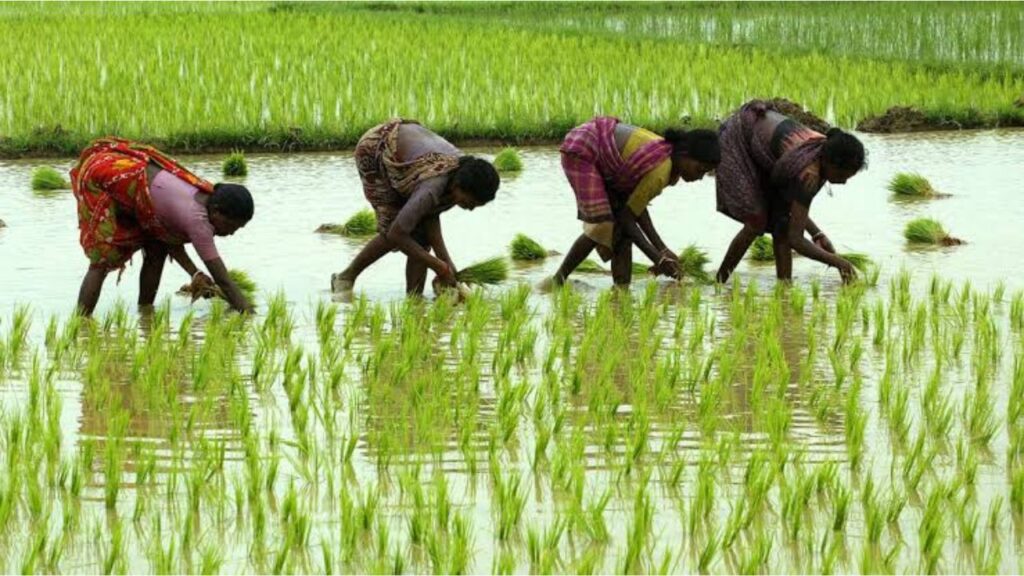

The Centre has intensified monitoring of the ongoing Kharif season as concerns over uneven rainfall, possible El Niño conditions and crop preparedness continue to remain in focus. Under the chairmanship of Union Minister for Agriculture and Farmers’ Welfare and Rural Development Shri Shivraj Singh Chouhan, a high-level review meeting was held in New Delhi to assess the progress of Kharif crop sowing, monsoon performance, fertiliser and seed availability, water storage levels and the situation in rainfall-deficient regions.
During the meeting, the Agriculture Minister directed officials to maintain close surveillance over districts experiencing inadequate rainfall and ensure constant coordination with state governments. He emphasised the need for timely interventions and effective agricultural management strategies to safeguard farmers’ interests during the Kharif season.
Kharif Sowing Covers Over 658 Lakh Hectares
Officials informed that the total area under Kharif crop sowing in the country reached 658.19 lakh hectares as of July 17, 2026. Although the overall sowing area is lower compared to the corresponding period last year, encouraging trends have been observed in several states, particularly in the cultivation of paddy, pulses and other important crops.
Reviewing the sowing situation, Shri Chouhan instructed the national missions dealing with pulses, oilseeds and cotton to conduct weekly meetings with state authorities. He stressed that field-level feedback should be analysed regularly and necessary steps should be taken quickly to address emerging challenges.
The Minister also highlighted the importance of strengthening communication between central agencies, state governments and farmers to ensure that agricultural activities continue smoothly despite weather-related uncertainties.
Monsoon Progress and Rainfall Situation Under Review
The meeting also examined the impact of the southwest monsoon and possible El Niño conditions on agricultural activities. Officials presented a detailed assessment of rainfall patterns, crop sowing progress and the condition of crops using indicators such as the Normalised Difference Vegetation Index (NDVI).
The monsoon covered the entire country by July 9, 2026, reaching the remaining parts of Rajasthan, Haryana and Punjab. Normally, the southwest monsoon completes its nationwide coverage by July 8, making this year’s expansion only one day later than the usual schedule.
The widespread arrival of monsoon rains has created favourable conditions for Kharif crop operations in most parts of the country. However, rainfall distribution remains uneven, requiring continuous monitoring and region-specific measures.
Rainfall Deficiency Recorded in Several Regions
According to the review, the country received 23 per cent less rainfall than normal between June 1 and July 15, 2026. During this period, India recorded 227 mm of rainfall against the normal average of 294.2 mm.
The eastern and northeastern regions witnessed the highest rainfall deficit, receiving 348 mm rainfall compared to the normal 540.2 mm, reflecting a shortfall of 36 per cent. Southern Peninsular India recorded a 26 per cent deficit, while Northwest India and Central India reported rainfall deficiencies of 19 per cent and 13 per cent, respectively.
The government reviewed the status of 270 rainfall-sensitive districts and assured that contingency plans and suitable agricultural measures would be implemented in coordination with state governments wherever required.
Adequate Fertiliser and Seed Availability Ensured
The availability of essential agricultural inputs, particularly urea and seeds, was another major focus area during the meeting. Officials informed that sufficient stocks of fertilisers and seeds have been arranged for Kharif 2026 and supply chains are being monitored continuously.
Shri Chouhan directed officials to verify ground-level availability through Krishi Vigyan Kendras (KVKs) and state administrations. He instructed that farmers should receive fertilisers according to their requirements and any disruption in distribution should be resolved immediately.
Focus on Farmer Support and Agricultural Stability
Concluding the review, the Agriculture Minister directed both departments under the Ministry of Agriculture to maintain continuous assessment of Kharif season activities in collaboration with states. He called for the effective use of scientific advice, weather-based agricultural practices and government schemes to support farmers.
The Centre reiterated its commitment to protecting farmers from weather-related challenges and ensuring stable agricultural production. With close monitoring of rainfall patterns, crop conditions and input availability, the government aims to minimise risks and strengthen preparedness for the ongoing Kharif season.

Author: Shivam
Proficient Writer Contact: [email protected]