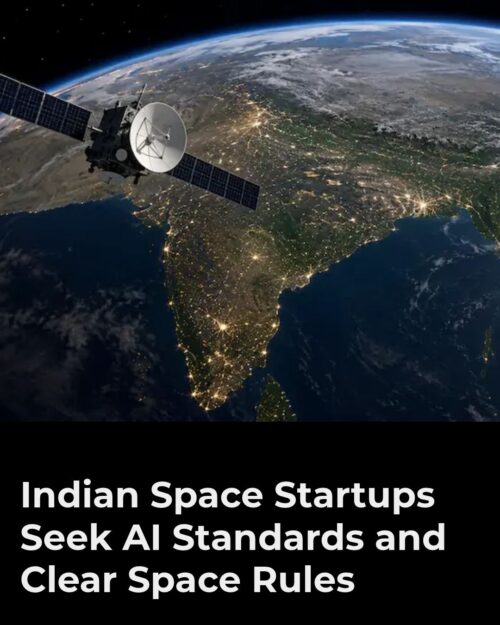

India’s private space industry is growing rapidly, but startups believe clearer government policies and stronger infrastructure are needed to support its next phase of development. Space entrepreneurs are calling for dedicated rules on spacecraft re-entry and recovery, artificial intelligence (AI) in space and satellite-based edge computing.
These concerns were raised by startup founders during the Bengaluru Tech Summit. Industry leaders said that although India has made significant progress in space technology, regulatory gaps, imported components and limited domestic demand could slow down the growth of private space companies.
According to a Jefferies report, India’s space economy could grow from around $8.4 billion in 2023 to $40-45 billion by 2030. The government has also set an ambitious target of building a $100 billion space economy by 2040.
The startup ecosystem has expanded significantly. Government data shows that India had around 440 registered space startups as of August 2026, compared with just one in 2014.
Indian Space Startups:- Space Startups Want a Clear Framework for Spacecraft Recovery
One of the major demands from the industry is a proper system for bringing spacecraft and materials safely back to Earth.
Capt Abhijit Bhutey (retd), co-founder of Inbound Aerospace, said India needs clear rules and dedicated facilities for spacecraft re-entry and recovery.
He explained that India has started developing procedures for such missions but still lacks a dedicated recovery range where returning spacecraft can be safely retrieved.
This could create difficulties for companies planning future missions. Without domestic recovery facilities, Indian startups may have to depend on foreign countries, including Australia, to recover their spacecraft.
Inbound Aerospace, an IIT Madras-incubated startup, is developing reusable spacecraft technology to bring hardware, research samples and manufactured products back from orbit.
The company is planning its first re-entry mission in 2028. It has also completed an aerial drop test of its Precision Aerial Delivery System, which uses smart parachute technology for controlled landings.
Indian Space Startups:- Industry Calls for AI and Edge Computing Standards
Artificial intelligence is becoming an important part of satellite operations. However, startups believe India needs clear standards to ensure that AI-based systems work safely and reliably in space.
Vishesh Vatsal, co-founder and CTO of SkyServe, said India should develop its own standards while maintaining compatibility with international systems.
He also stressed the need for discussions between private companies and the Indian Space Research Organisation (ISRO) to establish rules for AI and edge computing technologies.
SkyServe is developing technology that allows satellites to process information directly in orbit instead of sending all the data back to Earth.
The company has demonstrated its technology through missions involving D-Orbit and NASA’s Jet Propulsion Laboratory.
Industry experts believe that proper safety and security standards are essential because mistakes in AI-driven satellite operations could create serious risks, including the generation of space debris.
Indian Space Startups:- Indian Space Companies Seek Stronger Global Representation
Indian space startups are also asking for a stronger voice in international organisations that manage satellite communications and spectrum regulations.
Denil Chawda, co-founder and CTO of GalaxEye, said Indian companies need better representation in international telecommunications forums.
He explained that unclear regulations around microwave sensor licensing and frequency use can delay projects and limit the capabilities of advanced Earth-observation satellites.
According to Chawda, regulatory uncertainty could delay some projects by one to two years.
GalaxEye is developing OptoSAR technology, which combines optical imaging and Synthetic Aperture Radar (SAR). The technology is designed to capture Earth images during both day and night, including under cloudy weather conditions.
Indian Space Startups:- Startups Want More Government Support and ISRO Collaboration
Another important concern is the limited domestic demand for privately developed space technologies.
Lokesh Kabdal, co-founder and CEO of VyomIC, said the government should create more opportunities for Indian space companies through supportive policies and domestic procurement.
He also called for deeper cooperation between ISRO and private space startups.
According to him, private companies often work as suppliers to ISRO rather than participating as development partners in major space programmes.
He believes companies should be involved in planning and developing technologies from the beginning.
VyomIC, founded by IIT Madras alumni, is working on a private low Earth orbit satellite constellation designed to provide secure and high-precision positioning, navigation and timing services.
Indian Space Startups:- Too Many Startups Could Create New Challenges
While the growing number of space startups reflects rising interest in the sector, founders have also warned about the risk of market oversaturation.
Bhutey estimated that the number of space startups could increase from around 450 to 700-800 by the following year.
He said companies need to coordinate their efforts instead of developing technologies independently without proper industry cooperation.
Greater collaboration between satellite manufacturers, launch service providers and technology companies could help avoid duplication and improve efficiency.
Vatsal also highlighted the need for more testing, operational experience and learning from failures to build reliable space technologies.
Indian Space Startups:- Dependence on Imported Chips Raises Supply Chain Concerns
Access to semiconductor components is another major challenge for Indian space startups.
Denil Chawda said many companies still depend on imported integrated circuits (ICs) and other specialised electronic components. Delays in receiving these parts can affect product development and mission schedules.
He believes India needs more domestic semiconductor manufacturers producing components specifically for space applications.
Kabdal also highlighted the long waiting periods for certain components, saying delivery timelines can extend to 52 weeks.
Such delays make it difficult for Indian startups to complete projects on time and compete with international companies.
Industry leaders believe this challenge creates an opportunity for Indian manufacturers, MSMEs and semiconductor companies to become part of the growing space supply chain.
Indian Space Startups:- India’s Space Industry Needs the Right Foundation for Growth
India’s space startup ecosystem has moved a long way in the past decade. Private companies are now developing satellites, launch technologies, AI-based systems and advanced Earth-observation solutions.
However, the next stage of growth will depend on more than just new startups and investments.
Clear government regulations, domestic manufacturing, better infrastructure, international cooperation and stronger partnerships with ISRO will be important for building a competitive space industry.
If these challenges are addressed, Indian space startups could play a much bigger role in the global space economy and help India achieve its ambitious $100 billion space economy target by 2040. Source :-Business Standard
Read more:- AI Startup Landeed Simplifies Property Records and Land Verification in India