
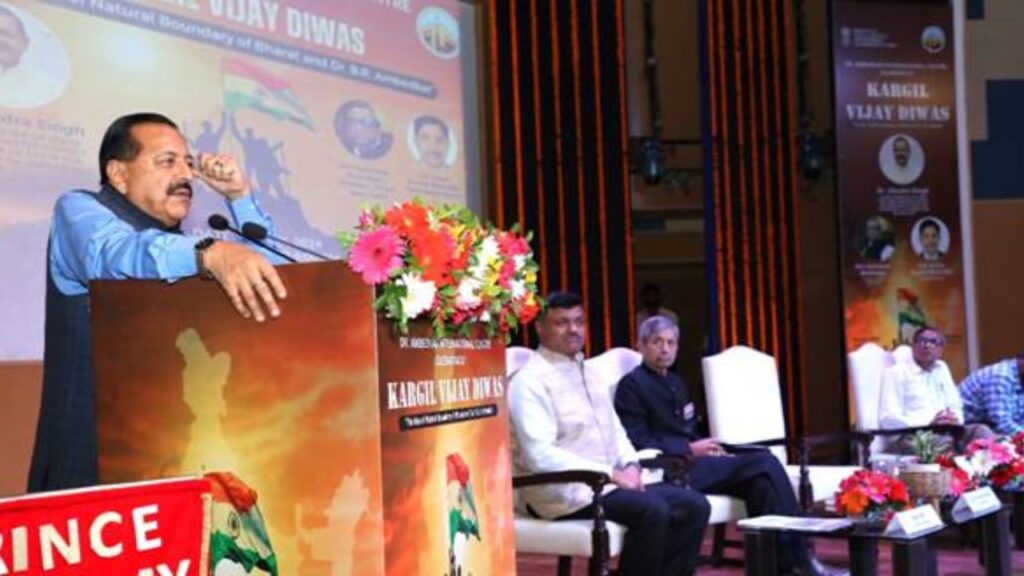

Union Minister of State (Independent Charge) for Science and Technology, Dr. Jitendra Singh, on Sunday said that the retrieval of Pakistan-occupied Jammu and Kashmir (PoJK) remains the only unresolved issue between India and Pakistan. Addressing the 27th Kargil Vijay Diwas commemoration in New Delhi, he asserted that India’s national security doctrine has undergone a significant transformation in recent years, shifting from a reactive stance to one of decisive action and preparedness.
The event was organised by the Jammu Kashmir Peoples’ Forum in collaboration with the POJK Youth Forum, a unit of the Mirpur Balidan Bhawan Samity, at the Kashmiri Cultural Centre. Member of Parliament Bansuri Swaraj attended as the Guest of Honour, while Kargil War veteran Colonel K.K. Sharma (SC, SM & Bar) presided over the function. The programme honoured the soldiers who laid down their lives during the 1999 Kargil conflict.
Kargil Victory Symbolises National Resolve
Describing Kargil Vijay Diwas as more than a day of remembrance, Dr. Jitendra Singh said the occasion reflects the courage and sacrifice of the Indian Armed Forces and reinforces the nation’s commitment to safeguarding its sovereignty and territorial integrity.
He noted that the lessons of the Kargil War remain relevant in today’s security environment, emphasizing the need for constant vigilance and national unity in the face of evolving challenges.
Partition Called a Historic Mistake
Reflecting on India’s history, the Minister described the Partition of the country as “the greatest blunder of history,” stating that it caused immense human suffering, displaced millions, and sowed the seeds for decades of conflict between India and Pakistan.
He linked the Kargil conflict to a broader historical context that includes the wars of 1947, 1965 and 1971, as well as continued cross-border terrorism and proxy warfare. Dr. Singh also referred to the displacement of Kashmiri Pandits as one of independent India’s most tragic humanitarian crises.
Security Strategy Has Changed
Highlighting changes in India’s security framework, Dr. Jitendra Singh said the government has adopted a policy of zero tolerance towards terrorism while strengthening border management and defence preparedness.
According to him, the country’s security approach has evolved from responding to threats after they occur to proactively preventing and addressing external aggression. He said this strategic shift has enhanced national confidence and reinforced India’s ability to protect its borders.
Development Driving Stability in Jammu and Kashmir
The Minister also spoke about the developmental changes witnessed in Jammu and Kashmir over recent years. He said peace and development are closely interconnected and that sustained stability has enabled faster infrastructure growth across the region.
He cited projects such as railway connectivity to the Kashmir Valley, the construction of the world’s highest railway bridge, new AIIMS institutions, irrigation projects and other infrastructure initiatives as examples of the region’s transformation. These developments, he said, have improved public services, enhanced connectivity and strengthened people’s confidence.
Dr. Singh added that development itself has become an important pillar for ensuring long-term peace and stability in the Union Territory.
Indigenous Defence Capabilities Expanded
Speaking on India’s defence sector, the Minister highlighted the country’s growing self-reliance in defence manufacturing. He said India has significantly increased indigenous production of military equipment, strengthened strategic capabilities and emerged as an important exporter of defence products.
He credited these achievements to technological advancements and policy initiatives aimed at reducing dependence on imports while enhancing national security.
PoJK Resolution Reaffirmed
Referring to the situation across the Line of Control, Dr. Jitendra Singh said the pace of development in Jammu and Kashmir has generated interest among people living in Pakistan-occupied Jammu and Kashmir.
Recalling the unanimous Parliamentary Resolution adopted in 1994, he reiterated that PoJK is an integral part of India and maintained that its retrieval remains the only outstanding issue between India and Pakistan.
Tribute to Kargil Heroes
Concluding his address, Dr. Jitendra Singh paid tribute to the soldiers who sacrificed their lives during the Kargil War and urged young Indians to draw inspiration from their courage, patriotism and dedication.
He said the spirit of Kargil continues to motivate citizens to contribute towards building a stronger, self-reliant and developed India while remaining committed to protecting the country’s unity, sovereignty and national interests.

Author: Shivam
Proficient Writer Contact: [email protected]