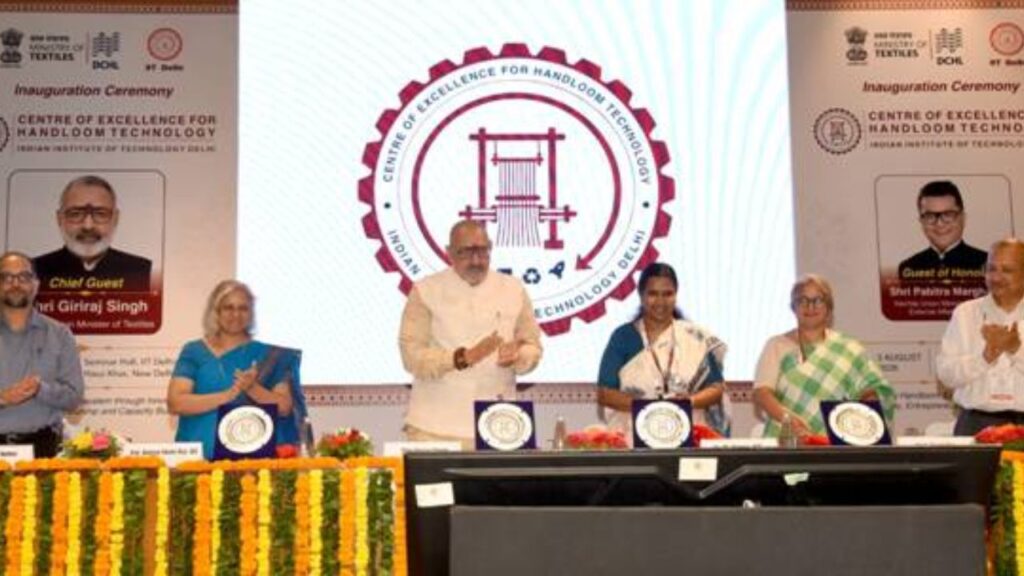

India’s handloom sector received a major technological boost with the inauguration of the Centre of Excellence for Handloom Technology (CoE-HT) at IIT Delhi by Union Minister of Textiles Giriraj Singh. The initiative is aimed at integrating advanced technologies with the country’s centuries-old weaving traditions to improve productivity, promote innovation and enhance the global competitiveness of Indian handloom products.
The Centre has been established as part of the Ministry of Textiles’ broader strategy to modernise the handloom ecosystem through research, digital transformation and entrepreneurship while safeguarding India’s rich textile heritage.
The inauguration ceremony was attended by Secretary, Ministry of Textiles, Neelam Shami Rao; Development Commissioner (Handlooms), Dr. M. Beena; Development Commissioner (Handicrafts), Amrit Raj; Director-in-Charge of IIT Delhi, Prof. Arvind K. Nema; Dean of IIT Delhi, Prof. Ashwini Agrawal; senior government officials, researchers, startup founders, representatives of the handloom industry and weavers from different parts of the country.
Blending Tradition with Technology
Speaking at the event, Giriraj Singh said the Centre of Excellence reflects the government’s vision of combining India’s traditional weaving skills with modern scientific and technological advancements. He stressed that emerging technologies such as artificial intelligence, digital platforms and sustainable manufacturing practices will play a crucial role in transforming the handloom sector.
According to the minister, technology-driven innovation can improve loom efficiency, expand market access and create better livelihood opportunities for millions of artisans and weavers engaged in the handloom industry.
He also highlighted the importance of entrepreneurship and innovation in helping the sector respond to changing consumer preferences while preserving the authenticity of handcrafted textiles.
Collaboration to Drive Innovation
Textiles Secretary Neelam Shami Rao emphasised that the success of the Centre will depend on close collaboration among academic institutions, industry partners and government agencies. She noted that such partnerships can generate practical technological solutions tailored to the needs of weavers and the handloom industry.
Development Commissioner (Handlooms) Dr. M. Beena described the Centre as a platform that will encourage research, innovation, knowledge sharing and skill development. She said it would create fresh opportunities for designers, entrepreneurs, startups and artisans working across the handloom value chain.
Five Key Initiatives Unveiled
A major highlight of the inauguration was the launch of five flagship initiatives designed to accelerate digital transformation and innovation in the sector.
The Handloom 4.0 Mobile App has been developed to digitally monitor loom productivity, quality, maintenance requirements and sustainability parameters, enabling data-driven improvements in weaving operations.
The Handloom e-Vidya platform will serve as a digital learning ecosystem, offering training and knowledge resources for weavers, students, designers and professionals involved in the handloom sector.
To encourage entrepreneurship, the Centre introduced HandloomX, an accelerator and incubation platform that will support startups developing innovative products and services across the Ministry’s 5F value chain—from farm to fibre, fabric, fashion and foreign markets.
The Kalagriha Handloom Studio, also known as the GenZ Design Studio, aims to connect younger consumers with authentic handloom products by using digital design tools, product visualization and customization technologies.
Another important initiative, Threads of Valour, focuses on sustainability by converting recycled defence textiles into premium handloom fabrics through scientific recycling techniques combined with traditional craftsmanship.
Research and Capacity Building
The Centre of Excellence will undertake research in several emerging areas, including loom modernisation, ergonomics, artificial intelligence, sustainability, digital technologies and functional textile innovation.
Among its long-term objectives is the creation of a national repository of handloom knowledge that will document traditional weaving practices while supporting future technological advancements. The Centre also plans to develop AI-enabled tools, facilitate technology transfer and promote innovation across the sector.
As part of its capacity-building efforts, the Centre has set a target of training at least 1,000 weavers, faculty members and handloom professionals over the next five years. These programmes are expected to enhance technical skills, encourage innovation and improve the adoption of modern technologies at the grassroots level.
Strengthening India’s Global Handloom Presence
The establishment of the Centre of Excellence for Handloom Technology marks an important step in the government’s efforts to make India’s handloom sector more resilient, sustainable and globally competitive. By bringing together researchers, industry experts, startups, educational institutions and traditional artisans under one platform, the Centre is expected to accelerate technology adoption while preserving the cultural identity of Indian handloom.
With a strong focus on innovation, digital transformation and sustainable practices, the initiative aims to ensure that India’s handloom heritage not only survives but also thrives in an increasingly technology-driven global marketplace.

Author: Shivam
Proficient Writer Contact: [email protected]