
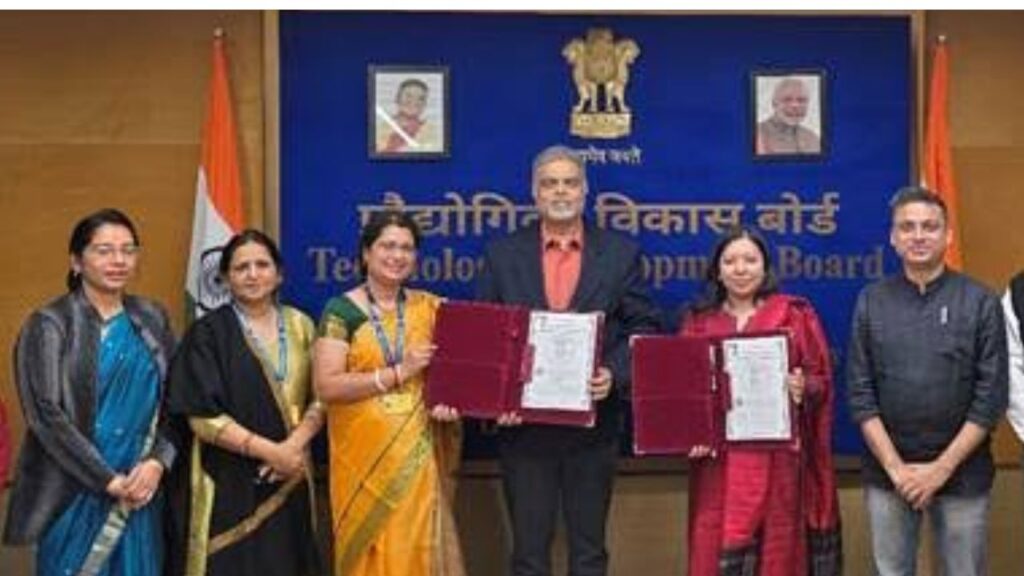

The Technology Development Board (TDB), under the Department of Science and Technology (DST), Government of India, has entered into an agreement with Visakhapatnam-based Griva Healthcare Pvt. Ltd. to support the manufacturing and commercialisation of GrivaVision, an indigenous portable digital colposcope equipped with artificial intelligence (AI)-assisted capabilities for the early identification of cervical pre-cancerous lesions.
The initiative comes amid the growing need for accessible and affordable cervical cancer screening, particularly for women who have limited access to specialised diagnostic facilities. With TDB support, Griva Healthcare will establish manufacturing capabilities at Kollam, Kerala, paving the way for large-scale production and wider deployment of the device across healthcare settings.
Portable Technology for Early Cervical Screening
GrivaVision has been developed as a compact diagnostic platform designed to help gynaecologists examine the vaginal canal and identify abnormalities on the cervix during routine clinical examinations. The system combines a high-definition camera, built-in display, advanced optics and a user-friendly interface with indigenous AI-enabled software.
The AI-assisted functionality is intended to support healthcare professionals in recognising potentially pre-cancerous lesions, thereby facilitating timely evaluation and follow-up. The technology has been designed in accordance with the World Health Organization’s Automated Visual Evaluation (AVE) standards.
The device’s software is also compliant with the Ayushman Bharat Digital Mission (ABDM) framework, allowing it to be integrated with India’s expanding digital health ecosystem.
Strengthening Domestic Medical Device Manufacturing
The TDB-backed project is expected to help bridge the gap between technology development and commercial-scale manufacturing. Griva Healthcare is currently undertaking its research and development activities at AIC-AMTZ Medivalley in Visakhapatnam, while the proposed facility in Kerala will support the transition to larger-scale production.
The project also places emphasis on domestic manufacturing and localisation. More than half of the components used in GrivaVision are currently sourced from within India. Scaling up production could therefore contribute to the development of the domestic medical device ecosystem and reduce reliance on imported diagnostic equipment.
The hardware architecture of GrivaVision is proprietary and has been patented in India by Griva Healthcare. The product has been classified as a Class B non-invasive medical device and has received a CDSCO Class B manufacturing licence. Its development is being undertaken in accordance with ISO 13485 quality standards, which apply to quality management systems for medical devices.
Expanding Screening to Underserved Areas
The portability of GrivaVision could be particularly useful in primary and community healthcare settings, where access to sophisticated diagnostic infrastructure can be limited. By bringing digital imaging and AI-assisted assessment into a portable format, the technology could help healthcare professionals extend cervical screening services beyond major hospitals and specialised centres.
The initiative is also expected to support more affordable access to cervical cancer diagnostic technologies, particularly in resource-constrained regions. Wider deployment could enable women to receive screening closer to their communities and potentially improve the chances of detecting abnormalities at an earlier stage.
TDB Highlights Importance of Indigenous Innovation
TDB Secretary Shri Rajesh Kumar Pathak highlighted the importance of early detection in addressing cervical cancer and said that indigenous innovations such as GrivaVision demonstrate how medical devices, digital health and artificial intelligence can be combined to address major healthcare challenges.
According to him, TDB’s intervention seeks to help home-grown technologies move from the development stage to commercial manufacturing, while improving access to advanced screening solutions and strengthening India’s capabilities in medical technology.
Griva Healthcare welcomed the support, stating that the assistance would help the company move towards commercial-scale manufacturing and expand the availability of AI-assisted cervical cancer screening. The company aims to make reliable screening technology accessible closer to women, especially in areas where specialised diagnostic services remain limited.
The commercialisation of GrivaVision represents another step towards building an indigenous medical device ecosystem in India, while using AI and digital technologies to improve the reach of preventive healthcare.
Also Read: CSIR-CRRI Showcases Indigenous MSS+ Technology for Sustainable Road Maintenance in Rajasthan

Author: Shivam
Proficient Writer Contact: [email protected]