

Scientists have developed a sophisticated three-dimensional computer simulation that could help improve understanding and forecasting of Coronal Mass Ejections (CMEs), powerful solar eruptions capable of affecting satellites, communication networks and electricity infrastructure on Earth.
The multi-institutional research team has used advanced magnetohydrodynamic (MHD) modelling to trace how magnetic energy accumulates and is released during a CME. The study was led by researchers at the Indian Institute of Astrophysics (IIA), an autonomous institute under the Department of Science and Technology (DST), Government of India, in collaboration with scientists from India and overseas.
Understanding the Origins of CMEs
CMEs are massive clouds of magnetised plasma launched from the Sun at speeds reaching millions of kilometres per hour. When such an eruption travels towards Earth, it can interact with the planet’s magnetic environment and trigger space-weather disturbances. These events can interfere with satellite operations, navigation systems, radio communications and power grids.
At the centre of many CME eruptions are magnetic flux ropes (MFRs), structures made up of twisted magnetic field lines embedded in solar plasma. Although MFRs are widely considered important drivers of CMEs, the precise process through which magnetic energy builds up and is suddenly released has remained a major question in solar physics.
The newly developed simulation provides a detailed way to follow this process.
Simulating the Magnetic Build-Up
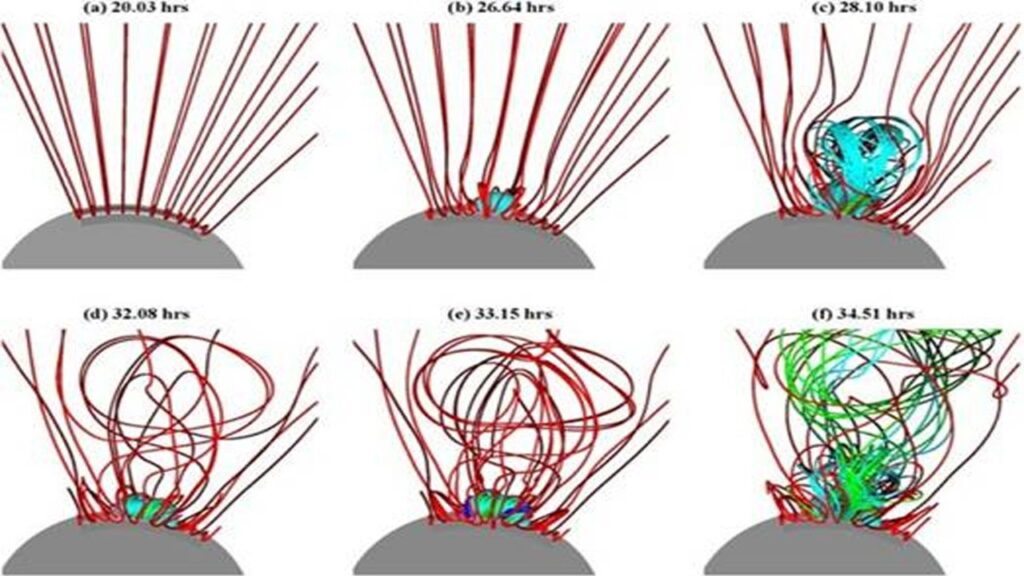
The model begins with a realistic representation of the solar corona containing a magnetic field configuration similar to an observed coronal streamer. Researchers then gradually introduce a twisted magnetic flux rope from below, reproducing the emergence of magnetic flux from beneath the Sun’s surface.
As the flux rope rises, it stretches and compresses the magnetic field surrounding it. According to the simulations, magnetic reconnection initially develops gradually rather than through an immediate explosive event. A thin current sheet forms as opposing magnetic fields are pushed together.
With time, the reconnection process becomes increasingly intense. Eventually, the accumulated magnetic energy is released through a rapid eruption, propelling the flux rope outward and producing the conditions associated with a CME.
The computational work was carried out using the NOVA high-performance computing facility hosted at the IIA data centre.
Simulation Matched With Solar Observations
A key feature of the research was the combination of numerical modelling with observations. The scientists simulated two successive flux-rope eruptions and compared the results with observational data.
The observational analysis was conducted in collaboration with a researcher from the University of Helsinki, Finland. Data from NASA’s Helioseismic and Magnetic Imager (HMI) and Atmospheric Imaging Assembly (AIA) were used to examine the behaviour of the Sun’s magnetic field and associated eruptions.
The comparison produced an important result. Researchers found a clear, monotonic relationship between the rate of magnetic reconnection and CME acceleration. In simple terms, as magnetic reconnection became faster, the eruption also accelerated.
Potential for Better Space-Weather Forecasting
The finding suggests that reconnection flux could serve as an important indicator of the speed and energy of a CME. Understanding this relationship may eventually help scientists estimate how rapidly an eruption will develop and assess its potential impact before it reaches Earth.
The study, published in The Astrophysical Journal, was carried out by Dr. Samriddhi Sankar Maity of NASA and Georgia State University, Dr. Piyali Chatterjee of IIA, Mr. Ijas S Mytheen of Eotvos University, Hungary, and Dr. Ranadeep Sarkar of the University of Helsinki, Finland.
By linking magnetic-field evolution, reconnection and CME acceleration in a single three-dimensional framework, the research offers fresh insight into how relatively slow magnetic processes on the Sun can culminate in some of the most powerful explosions in the solar system. The approach could contribute to the long-term development of more reliable space-weather monitoring and forecasting systems.

Author: Shivam
Proficient Writer Contact: [email protected]