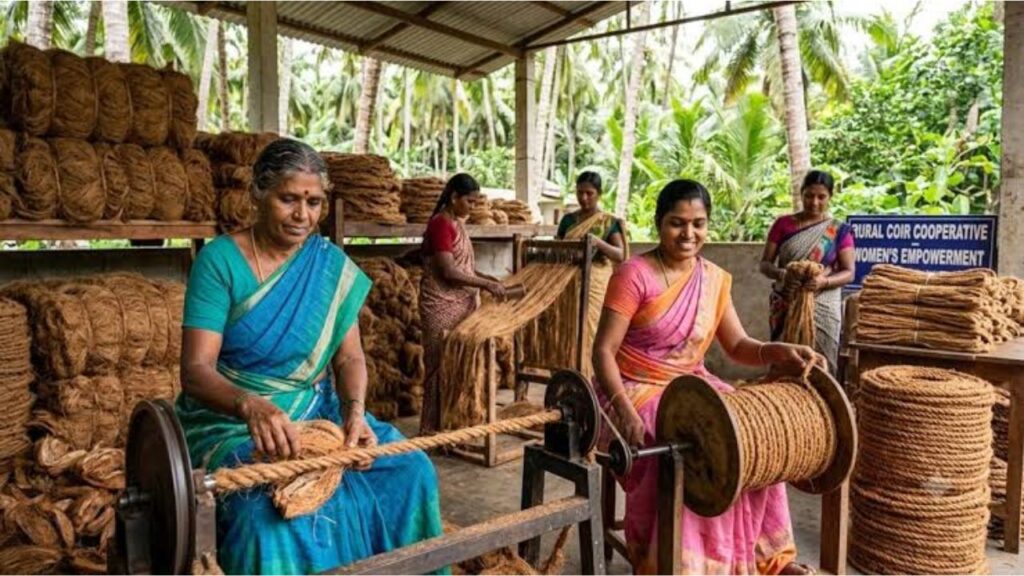

What was once largely viewed as coconut waste is emerging as a valuable source of income, entrepreneurship and sustainable development across India’s coconut-growing regions. Coir, a natural and biodegradable fibre obtained from coconut husk, is being transformed into a wide range of products, creating employment opportunities for rural communities, particularly women.
With institutional support from the Ministry of Micro, Small & Medium Enterprises (MSME), including the Coir Board and the Prime Minister’s Employment Generation Programme (PMEGP), traditional coir activities are increasingly evolving into organised and value-added enterprises.
Women Entrepreneurs Driving Coir-Based Businesses
A notable example comes from Kadiyam in Andhra Pradesh’s East Godavari district, where Allam Gowthamy has built a successful coir enterprise. After receiving specialised training at the Coir Board Training Centre in Dhawaleswaram, she established Adigo Coir Products during 2024–25.
The enterprise was set up with a project cost of ₹10 lakh, supported by a bank loan of ₹6.50 lakh along with assistance under PMEGP. The unit manufactures eco-friendly products such as doormats, ropes, decorative dolls and handicrafts.
The business has reportedly achieved an annual turnover of about ₹35 lakh and a profit of nearly ₹10 lakh. While the enterprise directly employs six women, its wider impact has been significantly larger. Gowthamy has trained nearly 120 women in coir mat weaving, rope-making and handicraft production, enabling them to explore additional livelihood opportunities.
Her entrepreneurial journey has also encouraged the establishment of around five more coir units in neighbouring areas with support from PMEGP.
Converting Coir Waste into Bio-Fertiliser
Innovation is also helping entrepreneurs discover new applications for coir by-products. In Kozhikode, Kerala, P. Surendran established Sampoorna Plus Agro Fertilizer Enterprises (SAFE) in November 2024, focusing on the production of coir pith-based bio-fertiliser.
With training and technical assistance from the Coir Board, Kannur, and the Central Coir Research Institute (CCRI), Kalavoor, Surendran began converting coir pith into an agricultural input designed to improve soil fertility and moisture retention.
Within a year, the enterprise developed a customer base of more than 500, sold over 20 tonnes of bio-fertiliser and recorded a turnover of ₹13 lakh, with a profit of around ₹4 lakh in FY 2024–25. The unit employs five workers, including two women, demonstrating how waste from the coconut industry can be converted into a productive rural enterprise.
Coir’s Importance to India’s Rural Economy
India has a long history of coir production. Organised coir manufacturing dates back to 1859, when the first coir factory was established in Alappuzha, Kerala. Over the decades, the industry has expanded to several major coconut-producing states.
India is currently the world’s largest producer of coir and contributes more than 80 per cent of global coir fibre production. The sector is particularly important for women, who account for nearly 80 per cent of workers involved in fibre extraction and spinning.
Coir therefore connects a broad rural value chain involving coconut growers, workers, artisans, cooperatives, entrepreneurs, manufacturers and exporters.
Moving Towards Higher-Value Products
The economic potential of coir extends far beyond raw fibre. Processing and innovation have enabled manufacturers to develop products such as mats, ropes, yarn, brushes, handicrafts, garden products and horticultural materials. Coir is also finding applications in environmentally friendly packaging and other sustainable alternatives to conventional materials.
The Coir Board, a statutory body under the Ministry of MSME, supports the sector through skill development, technological advancement, research, market promotion, exports and welfare programmes.
Under the Coir Vikas Yojana, initiatives cover technology and research, skill development, women’s training, market development, industry promotion and worker welfare. Exhibitions, fairs, showrooms and export promotion programmes further help producers reach wider domestic and international markets.
Innovation Giving Traditional Fibre a Modern Role
Research institutions are also expanding the applications of coir. The Central Coir Research Institute has developed eco-friendly coir rail wheel axle packaging cups as an alternative to HDPE plastic cups. Such innovations demonstrate the potential of natural fibre-based materials to serve modern industrial requirements while supporting sustainable production.
The experiences of entrepreneurs such as Gowthamy and Surendran highlight the changing role of coir in India’s rural economy. With access to training, finance, technology, research and markets, coconut husk is increasingly becoming a raw material for modern enterprises—creating jobs, empowering women and converting locally available resources into sustainable economic opportunities.
Also Read: MSME Technology Centre Inaugurated in Bengaluru to Boost ESDM and Aerospace Capabilities