
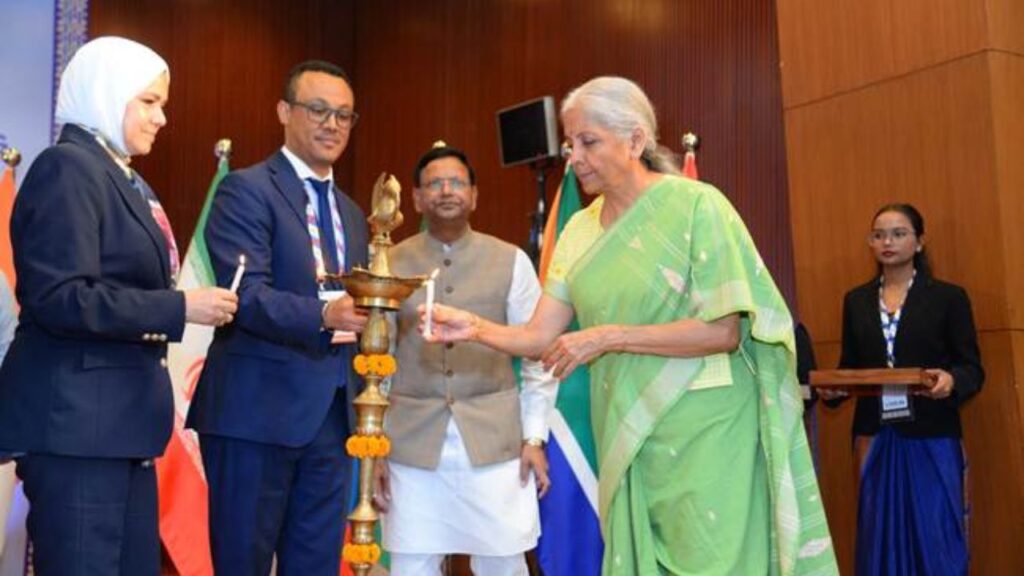

Union Finance and Corporate Affairs Minister Nirmala Sitharaman inaugurated the BRICS Heads of Tax Authorities Meeting in New Delhi, marking the culmination of India’s chairship of the BRICS tax cooperation track. The high-level meeting brought together senior tax officials from ten BRICS member countries to review cooperation, exchange administrative experiences and discuss emerging challenges in international taxation.
The meeting was hosted by the Central Board of Direct Taxes (CBDT), under the Ministry of Finance. Union Minister of State for Finance Pankaj Chaudhary and Revenue Secretary Arvind Shrivastava also addressed the gathering. CBDT Chairman Ravi Agrawal, Member (Legislation) Prasenjit Singh, other CBDT Members and senior officials of the Department of Revenue were among those present.
Representatives from Brazil, China, Egypt, Ethiopia, India, Indonesia, Iran, Russia, South Africa and the United Arab Emirates participated in the meeting. The discussions provided an opportunity for BRICS tax administrations to share practical experiences and explore ways to strengthen cooperation in response to changing global taxation challenges.
Technology, Administration and People at the Core
In her address, Sitharaman identified technology, administration and people as three central themes that shaped BRICS tax cooperation during India’s chairship.
She highlighted the growing importance of data and digital infrastructure in improving tax administration and making services more precise and accessible. According to the Finance Minister, effective technology-based systems can support better decision-making while improving the experience of taxpayers and tax authorities.
The Minister also stressed the need for durable institutional mechanisms that can continue delivering results beyond individual BRICS chairships. Practical tools and structured platforms, she noted, can help ensure that cooperation remains consistent as leadership of the tax track changes between member countries.
Another key focus was investment in people. Sitharaman underlined the importance of professional relationships and capacity building among tax officials from BRICS economies. Stronger institutional and professional networks can facilitate the exchange of expertise and support cooperation on complex taxation issues.
She further emphasised that the perspectives of BRICS economies are important to the fairness and long-term sustainability of multilateral tax discussions. This includes ongoing negotiations related to the proposed UN Framework Convention on International Tax Cooperation.
New Working Groups Established
The meeting adopted several significant outcomes aimed at institutionalising tax cooperation among BRICS members. Two new working groups were established—one focusing on International Taxation and Transfer Pricing, and another dealing with Revenue Statistics.
India will lead both working groups, providing continuing institutional platforms for cooperation irrespective of which country holds the BRICS chairship in a particular year. The move is intended to support sustained technical engagement and knowledge sharing among member tax administrations.
Another major decision was the institutionalisation of the BRICS Young Tax Professionals Capacity Building Programme as an annual initiative. The first in-person programme was conducted at the National Academy of Direct Taxes in Nagpur in April 2026. Its continuation as a regular BRICS activity is expected to strengthen professional development and create greater opportunities for young tax officials to engage with counterparts from other member countries.
Cross-Learning and Tax Support Network
The BRICS Tax Cross-Learning Lab was also formally launched during the meeting. The initiative brings together the work of the Client-Centric Administration and HR Practices Working Groups under a common peer-learning platform.
The participating administrations will be able to exchange approaches, experiences and practices in areas relevant to taxpayer services and human resource management.
In addition, the meeting approved the Terms of Reference of the BRICS Tax Support Network, providing a structured framework for continued cooperation among member tax authorities.
China to Lead Tax Cooperation in 2027
The meeting concluded with the formal signing of the BRICS Tax Progress Report 2026, documenting the work and outcomes achieved during India’s chairship of the tax cooperation track.
At the conclusion of the meeting, the BRICS Heads of Tax Authorities welcomed China as the incoming chair of the BRICS tax cooperation track for 2027.
The participating tax authorities also acknowledged India’s efforts in organising the meeting and highlighted the depth of its work during the year-long chairship. The outcomes adopted in New Delhi are expected to provide a continuing institutional foundation for collaboration, capacity building and knowledge exchange among BRICS tax administrations.
Also Read: Public Sector Banks, RRBs to Remain Open on September 27 Amid Proposed Nationwide Bank Strike

Author: Shivam
Proficient Writer Contact: [email protected]