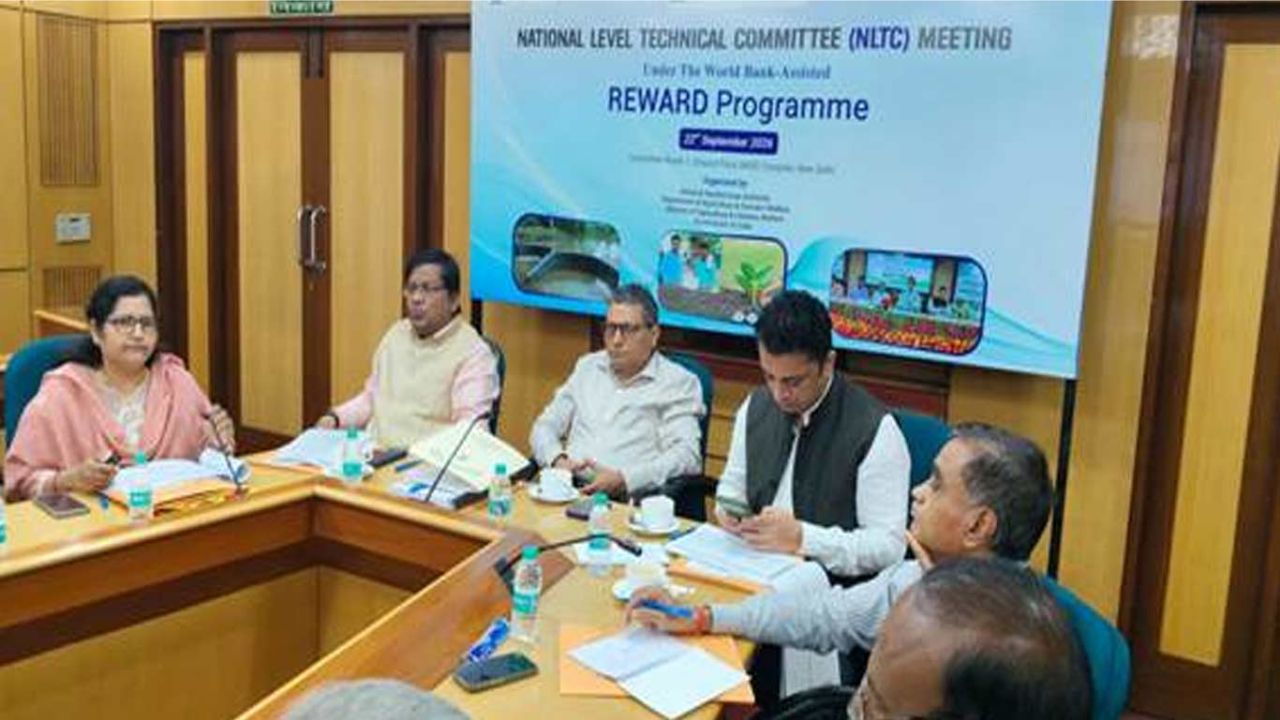
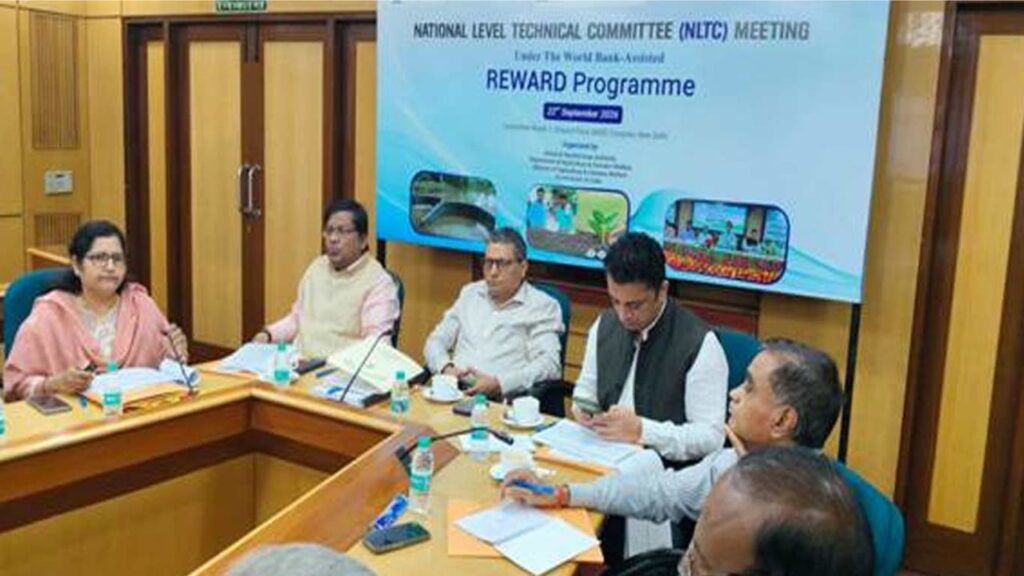

The National Rainfed Area Authority (NRAA), under the Ministry of Agriculture and Farmers Welfare, convened a National Level Technical Committee (NLTC) meeting on September 22, 2026, at the NASC Complex in New Delhi to review progress under the REWARD (Rejuvenating Watersheds for Agricultural Resilience through Innovative Development) programme.
The meeting focused on strengthening the scientific and technical framework for watershed development and reviewing the second draft of the National Technical Guidelines (NTG) being prepared under the programme. The guidelines are expected to provide a framework for future watershed development initiatives under the Watershed Development Component of the Pradhan Mantri Krishi Sinchayee Yojana (PMKSY) 3.0.
The meeting was chaired by Dr. Chandra Shekhar Kumar, IAS, Chief Executive Officer of NRAA. Senior officials and experts attending the meeting included Dr. A. K. Nayak, Deputy Director General (Natural Resource Management), ICAR; Shri Nitin Khade, IAS, Joint Secretary (Watershed Management), Department of Land Resources (DoLR); Dr. Subrat Panda, IAS, Director, Directorate of Soil Conservation and Watershed Development, Odisha; and Shri Upendra Pratap Singh, Commissioner, Watershed Development Department, Karnataka, who participated online.
Around 45 participants took part in the deliberations. They included scientists and representatives from the State Level Nodal Agencies (SLNAs) of Odisha and Karnataka, technical partners from ICAR institutes and agricultural universities, IIT representatives, NGOs, consortium partners, and members of the REWARD Programme Management Units of DoLR and NRAA. The Centre of Excellence for Watershed Management (CoE-WM) also participated in the discussions.
At the outset, Dr. Susama Sudhishri, Technical Expert (Watershed Development) and Principal Investigator of REWARD at NRAA, presented the action taken report from the previous NLTC meeting. She also outlined the key additions and revisions incorporated into the second draft of the National Technical Guidelines.
Dr. Chandra Shekhar Kumar stressed the importance of scientifically validating statements and claims included in the draft NTG using data generated through the REWARD programme. He urged the governments of Odisha and Karnataka to make relevant watershed datasets and Decision Support Systems (DSS) accessible to stakeholders. Such data sharing, he noted, would support evidence-based analysis and improve the validation process for the proposed guidelines.
Dr. A. K. Nayak highlighted the need to integrate Land Resource Inventory (LRI) with hydrological information for more effective watershed planning. He further emphasized that the methodologies used to derive findings and conclusions should be clearly documented in the NTG. He also called for the development of dedicated web portals at the earliest to facilitate access to relevant technical information and resources.
The meeting also examined ways to improve the efficiency of watershed project implementation. Shri Nitin Khade suggested that the time required for preparation of Detailed Project Reports (DPRs) could potentially be reduced from six months to three months. This, he said, could provide additional time for actual execution of watershed activities. He also called for greater exploration of convergence among different sectors and consideration of such approaches in the National Technical Guidelines.
During the discussions, Dr. Susama Sudhishri requested the SLNAs of Odisha and Karnataka to share recorded field data with NRAA and consortium partners. The data will be used for detailed analysis, preparation of reports and further validation of the NTG.
The REWARD programme seeks to promote resilient and scientifically planned watershed development by using improved data, technology and innovative approaches. The ongoing process of developing the National Technical Guidelines is aimed at creating a robust technical foundation for future watershed interventions, with greater emphasis on evidence-based planning, hydrology, land resources, data sharing and convergence.
The outcomes of the NLTC meeting are expected to contribute to refining the guidelines and strengthening watershed development practices under PMKSY 3.0, supporting more effective management of rainfed areas and improving agricultural resilience across the country.
Also Read: Ministry of Textiles Launches Swachhata Hi Seva 2026 Campaign Across Organisations

Author: Shivam
Proficient Writer Contact: [email protected]