

Scientists have, for the first time, captured detailed evidence of how bacteria respond and ultimately succumb to the action of widely used preservatives. The study provides new insights into the cellular and biochemical changes triggered by sodium benzoate and phenoxyethanol, two preservatives extensively used across food, personal care and other consumer products.
Researchers from the Institute of Nano Science & Technology (INST), Mohali, an autonomous institute under the Department of Science and Technology (DST), in collaboration with Unilever R&D, Bengaluru, investigated the antimicrobial mechanisms of the two preservatives. Their findings have helped bridge a long-standing gap in understanding how these compounds actually damage bacterial cells.
Sodium benzoate has been used as a food preservative for more than a century in products such as pickles, ketchup and carbonated beverages. It was among the earliest food preservatives approved by the US Food and Drug Administration in 1908. Phenoxyethanol, meanwhile, has become widely used in products including shampoos, moisturisers and sunscreens, and has also been used in certain pharmaceutical applications.
Despite their extensive use, the precise molecular processes through which these preservatives eliminate bacteria have remained incompletely understood.
To investigate these mechanisms, the research team combined transmission electron microscopy (TEM) with a series of biochemical and microbiological tests. The study examined two representative bacterial pathogens: the Gram-positive Staphylococcus aureus and the Gram-negative Pseudomonas aeruginosa.
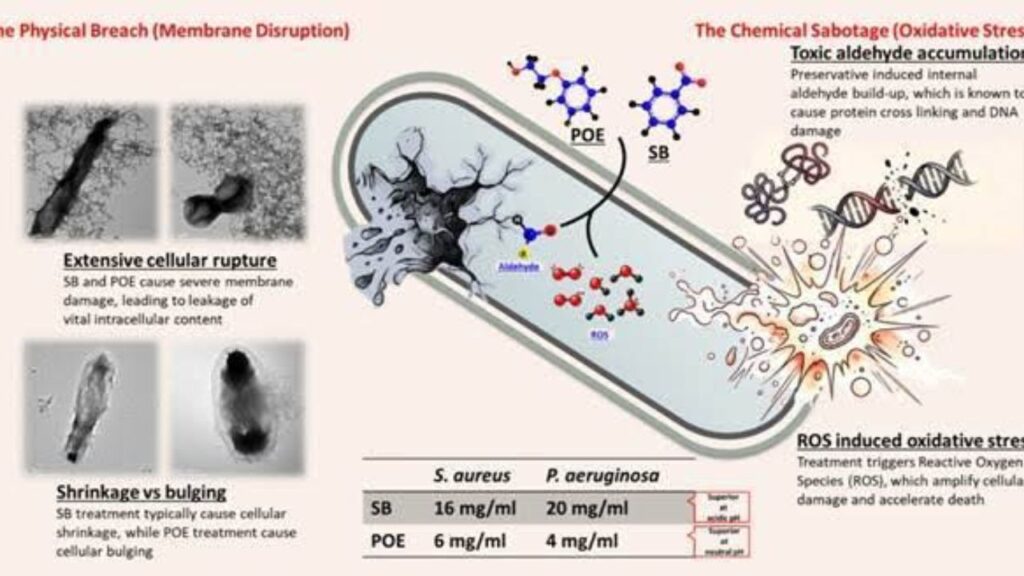
The researchers discovered that the preservatives do not rely on a single mechanism to inactivate bacteria. Instead, they trigger a series of damaging events affecting both the bacterial cell envelope and its internal chemistry.
The study found that bacterial cells exposed to the preservatives accumulated reactive aldehydes and oxygen-derived species. These chemically reactive compounds can interfere with proteins, genetic material and other vital cellular processes. At the same time, structural damage to the cell envelope further weakened the bacteria.
Microscopic observations also revealed that sodium benzoate and phenoxyethanol produce distinctly different physical effects. Sodium benzoate caused bacterial cells to shrink and collapse, while phenoxyethanol produced membrane expansion followed by rupture. These contrasting changes provide visual evidence that the two preservatives follow different routes while ultimately producing bacterial inactivation.
An important finding concerned the influence of acidity on preservative performance. Sodium benzoate became substantially more effective under acidic conditions, showing an approximately 16-fold increase in activity. Phenoxyethanol, in contrast, maintained relatively consistent antibacterial effectiveness across a broad range of pH conditions.
The research team—comprising Ishani Sharma, S. M. Rose, Madhu Lata, Somnath Das, Nagaraja IS Acharya, Maheshwara Naik, Samiran Mahapatra and Sharmistha Sinha—used multiple experimental approaches to establish these findings. These included inhibition-zone and minimum inhibitory concentration (MIC) assays, electron microscopy to observe structural damage, dye-leakage experiments to detect membrane disruption, and biochemical assays using MBTH and DCFDA to assess chemical changes occurring inside bacterial cells.
By combining structural imaging with biochemical analysis, the researchers were able to connect visible changes in bacterial morphology with the underlying chemical damage occurring within the cells.
The findings, published in Letters in Applied Microbiology, could have practical implications for the development of preservation systems. A better understanding of how individual preservatives perform under different conditions could help manufacturers select appropriate preservatives and concentrations for specific formulations.
For example, the strong performance of sodium benzoate under acidic conditions could be particularly relevant to acidic products, while phenoxyethanol’s relatively stable activity across varying pH conditions may offer advantages in formulations where acidity can fluctuate.
The researchers said that a clearer understanding of preservative action could also support more efficient formulation, reduce unnecessary preservative use, limit product spoilage and waste, and contribute to strategies for managing bacterial adaptation. Overall, the study offers a closer look at the complex biological processes through which commonly used preservatives disrupt and eliminate bacterial cells.

Author: Shivam
Proficient Writer Contact: [email protected]