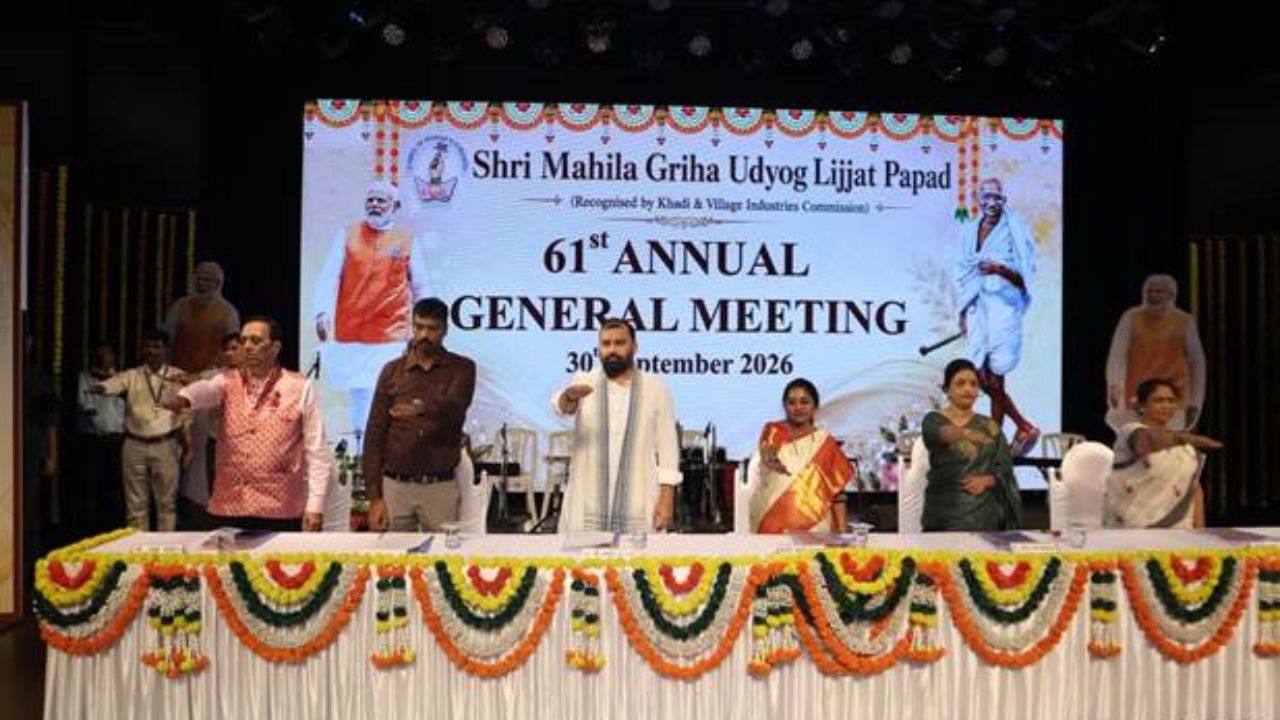

Khadi and Village Industries Commission (KVIC) Chairman Shri Manoj Goyal highlighted the contribution of women-led enterprises to self-reliance, employment generation and the growth of local industries while addressing women artisans associated with Shri Mahila Griha Udyog Lijjat Papad in Mumbai. The event was held at the Sri Shanmukhananda Chandrasekharendra Saraswathi Auditorium in Sion (East), where Shri Goyal attended as the chief guest.
The KVIC Chairman praised the efforts of the women artisans and said that institutions such as Lijjat Papad have demonstrated how local enterprises can create sustainable livelihood opportunities while promoting dignity and economic independence. He also underlined the organisation’s contribution to the objectives of ‘Vocal for Local’, ‘Local to Global’ and ‘Atmanirbhar Bharat’.
Recalling the origins of Lijjat Papad, Shri Goyal said the organisation began its journey on 15 March 1959 with only seven women and an initial investment of ₹80. According to him, the initiative represented much more than the production of papads. It reflected the determination of women to become self-reliant, earn with dignity and build an independent livelihood.
The recognition of Lijjat Papad as a Village Industry by KVIC in 1966 provided further impetus to its growth. Over the decades, the organisation has expanded considerably and now has 83 branches spread across 16 states, with more than 45,000 women associated with its activities.
Lijjat Papad has also expanded beyond its traditional product. Its portfolio includes spices, flour, detergent and liquid soaps, reflecting the organisation’s diversification into different consumer products. Its products have also gained an international presence, reaching more than 30 countries, including the United States, Australia, Japan and South Africa.
Shri Goyal described quality, hard work and discipline as some of the major strengths behind the organisation’s sustained journey. He said Lijjat Papad demonstrates how a grassroots enterprise can combine commercial activity with women’s empowerment and economic opportunity.
The organisation has received recognition at both national and international levels. It was conferred the Best Village Industry Award in 2003, followed by the Brand Equity Award in 2005 and the Women Development Award in 2017. Its journey and model of women-led entrepreneurship have also been highlighted by international platforms and media organisations.
During his address, the KVIC Chairman also outlined the Commission’s efforts to strengthen employment and entrepreneurship in the Khadi and Village Industries sector. He stated that nearly five lakh artisans across the country are being provided employment through the sector, with women accounting for around 80 per cent of the workforce associated with approximately 3,000 Khadi institutions.
According to Shri Goyal, the earnings of Khadi artisans have also witnessed substantial growth, with wages increasing by up to 275 per cent over the past 12 years. He added that production in the Khadi and Village Industries sector has risen to approximately ₹1.25 lakh crore, while sales have reached around ₹1.87 lakh crore.
The KVIC Chairman further highlighted support extended to artisans through the Village Industry Development Scheme. More than 3.23 lakh machines and toolkits have been distributed during the last 12 years to facilitate production and improve livelihood opportunities.
He also cited the Prime Minister’s Employment Generation Programme (PMEGP) as an important initiative for promoting entrepreneurship. Around 11 lakh new projects have been established under the programme so far, supported by subsidies exceeding ₹30,000 crore. These projects, he said, have created employment opportunities for approximately one crore people.
The event highlighted the continuing role of women-led village industries in strengthening livelihoods, encouraging entrepreneurship and connecting traditional Indian products with domestic and international markets. The success of Lijjat Papad was presented as an example of how collective enterprise and grassroots participation can contribute to broader goals of self-reliance and inclusive economic development.
Also Read: MSME Ministry and MoSPI Sign MoU to Strengthen Statistical Business Register

Author: Shivam
Proficient Writer Contact: [email protected]