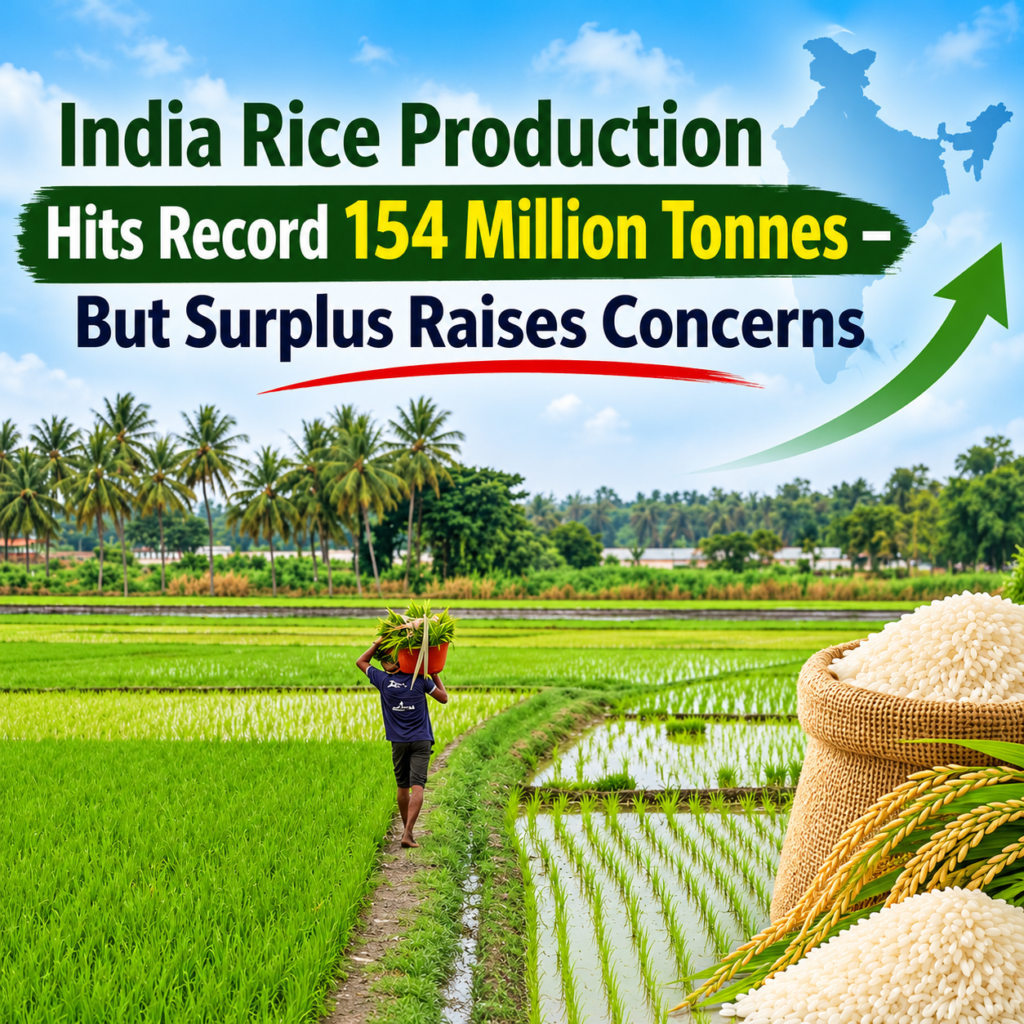

India has transformed itself into one of the world’s biggest rice producers and exporters. Better farming technology, improved seed varieties and government support have helped farmers increase production over the years. However, this success is now creating a new challenge: India is producing more rice than the country needs, while the cost of storing and subsidising the surplus continues to rise.
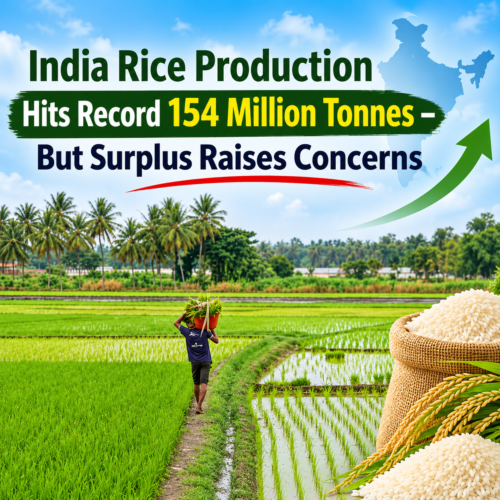
According to a Reuters report, India’s rice production is expected to reach a record 154 million tonnes in 2025-26, marking a nearly 50% increase over the past decade. In comparison, domestic rice consumption is estimated at around 107 million tonnes.
This growing gap between production and consumption has increased the pressure on government finances, storage facilities and agricultural policies.
India Rice Production:- Government Support Has Boosted Rice Production
India’s rice production growth is closely linked to government policies introduced in the 1960s. At that time, the country faced serious food shortages and depended heavily on imported food grains.
To encourage farmers to grow more rice, the government introduced a Minimum Support Price (MSP) system. Under this arrangement, farmers receive a guaranteed minimum price for their crops, providing them with greater financial security.
Over time, subsidies on fertilisers, electricity and irrigation further supported rice cultivation. New high-yielding and flood-tolerant rice varieties also helped farmers in eastern states improve production.
These developments have made rice farming more productive and expanded cultivation into areas that previously faced challenges due to flooding and uncertain weather.
India Rice Production:- Rice Surplus Is Increasing the Financial Burden
While higher production has strengthened India’s food security, it has also created a major economic concern.
Rice subsidies now account for more than two-thirds of India’s central food subsidy expenditure. The total food subsidy bill has increased to Rs 2.28 lakh crore in 2025-26, more than double the amount recorded a decade ago.
The government purchases rice from farmers at MSP rates and supplies it to eligible households through the public distribution system. However, when procurement exceeds domestic requirements, the government must also manage the additional stocks.
Storage shortages and rising procurement costs have become serious concerns in several rice-producing regions.
Agricultural economist Ashok Gulati has raised concerns that public money is being used to support rice exports, effectively benefiting consumers in other countries.
India Rice Production:- India Is Strengthening Its Position in Global Rice Trade
Despite the growing surplus, India continues to play a major role in international rice markets.
Indian rice exports reached approximately 22.3 million tonnes in 2025, almost double the level recorded ten years earlier. India now accounts for around 40% of global rice trade.
Competitive prices and large available stocks have helped Indian exporters increase their presence in international markets.
However, India’s growing market share has also raised concerns among competing rice-exporting countries, as lower-priced Indian rice puts pressure on international prices.
India Rice Production:- Political Differences Over Rice Pricing
Rice procurement and pricing have also become a subject of discussion between the central and state governments.
Some state governments provide additional bonuses to farmers over and above the central government’s MSP. These payments encourage farmers to continue growing rice, even when production is already high.
Although such incentives can improve farmers’ incomes, they may also encourage excess production and increase the financial burden on public agencies.
The challenge is to balance farmers’ interests with the country’s long-term agricultural and economic needs.
India Rice Production:- What Lies Ahead for India’s Rice Sector?
India’s rice production may face some weather-related challenges in 2026-27, with concerns over weaker rainfall linked to El Niño conditions. However, large existing stocks could help maintain export supplies.
With domestic rice consumption unlikely to increase at the same pace as production, the government may need to rethink its agricultural support policies.
Experts believe India should encourage farmers to diversify into other crops, improve water-use efficiency and adopt more sustainable farming practices.
India’s journey from a food-deficit nation to a global rice powerhouse is a major achievement for its agricultural sector. Government support, scientific research and farmers’ hard work have played an important role in this transformation.
However, producing more rice is not the only measure of agricultural success. The country now needs to focus on better crop planning, efficient storage, responsible subsidies and sustainable farming.
The next big challenge for India is to ensure that higher agricultural production also brings better farmer incomes, financial stability and long-term food security. Read More-Fertilizer News: ICRISAT Study Finds Crops Can Grow with 50 % Less Fertilizer
Source:- The Economic Times