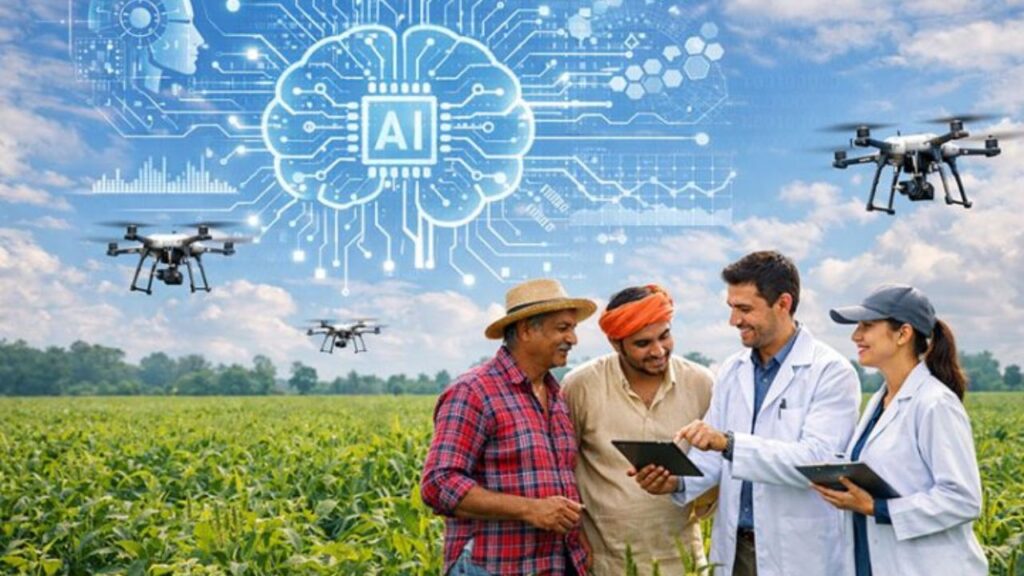

Artificial intelligence (AI) is emerging as a powerful tool in India’s agriculture sector, with the potential to reshape how farmers make decisions on crops, weather, irrigation, inputs, diseases and markets. While traditional knowledge and experience continue to influence farming practices, AI-driven information is increasingly helping bridge the gaps created by unpredictable weather, limited resources and changing market conditions.
One of the major developments in this space is the creation of India-focused agricultural AI models by Google DeepMind’s AnthroKrishi team. Led by agriculture and sustainability research lead Alok Talekar, the team has developed technologies designed to generate detailed agricultural insights using satellite imagery and other datasets.
AI Builds Detailed Digital Maps of Farmland
The AnthroKrishi system uses two layers of AI-based analysis. The first identifies and maps fields, trees and water bodies using around 15 years of satellite imagery. These maps are periodically updated to ensure that changes in the agricultural landscape are captured.
The second layer focuses specifically on agriculture. It identifies crop types and tracks important stages such as sowing and harvesting across 12 crops. The underlying data is refreshed approximately every two weeks, allowing users to obtain information closer to real-time conditions.
According to Talekar, such technology can help overcome limitations in conventional agricultural databases, which have traditionally been designed around districts rather than individual farms. More precise digital information could allow governments and other organisations to develop services and interventions that are better suited to specific farms.
Supporting Farmers Without Replacing Traditional Knowledge
AI is not necessarily intended to replace farmers’ experience or traditional agricultural practices. Instead, it can provide additional information to help farmers and policymakers make better-informed decisions.
The technology can assist with identifying crop stress, monitoring fields, anticipating weather-related risks and improving the use of agricultural inputs. It could also support decisions involving irrigation, fertilisers, pest management and market planning.
Talekar emphasised that technology should primarily provide information rather than dictate decisions. Data-driven insights, when combined with farmers’ knowledge and local experience, can create a more effective decision-making framework.
AI can also highlight situations where conventional practices may be inefficient or environmentally damaging. For example, excessive flooding of rice fields can increase pressure on water resources. Data-based monitoring could help identify opportunities for more efficient water management.
Satellite Data Could Improve Equity
A significant advantage of satellite-based agricultural mapping is that it can provide comparable coverage of farms of different sizes. With metre-scale resolution, the technology can identify both smallholder and larger farms, potentially reducing the bias that can occur in manually collected agricultural data.
This could have implications for government schemes, crop surveys, insurance, credit and targeted agricultural support. Better identification of individual farms may enable authorities and service providers to reach farmers more accurately and efficiently.
However, challenges remain. Data quality, model evaluation, technological awareness and limited digital capacity within parts of the agricultural sector could slow adoption. To address these issues, the AnthroKrishi team is providing not only APIs but also visual interfaces that allow users to examine and verify information.
Partnerships Expanding Agricultural Applications
The agricultural datasets are already being explored for multiple applications. IIT Bombay-linked Terrastack is using such information to support land-record digitisation and help connect farmers with formal credit systems.
France-based CarbonFarm is using AI and satellite-based information to monitor flooded rice fields and support carbon-credit generation, including projects in Andhra Pradesh.
Public-sector initiatives are also adopting these technologies. Telangana’s Agriculture Data Exchange platform is incorporating AI-generated agricultural layers to support services for millions of farmers. In Karnataka, the Water Resources Department is combining these datasets with weather and remote-sensing information to improve water management across irrigated areas.
India Could Leapfrog in Agricultural Technology
The development of agriculture-specific digital infrastructure could give India an opportunity to advance rapidly in precision farming and agricultural governance. Unlike systems that primarily analyse agricultural conditions after a season has ended, frequently updated datasets can provide information while the season is still underway.
The wider ambition is to make these digital layers foundational infrastructure for agricultural ecosystems, similar to how digital mapping platforms support navigation and location-based services.
With a large share of India’s population dependent on agriculture, the effective integration of AI, satellite technology and digital public infrastructure could help address productivity, climate resilience, resource efficiency and information gaps.
The emerging shift suggests that the future of Indian farming may not be a choice between traditional knowledge and artificial intelligence. Instead, combining farmers’ experience with timely, precise and accessible data could become the foundation of a more resilient and technology-enabled agricultural sector.

Author: Shivam
Proficient Writer Contact: [email protected]