
Researchers at the ICAR-National Research Centre on Mithun (ICAR-NRC on Mithun), Nagaland, have developed an artificial intelligence-based system capable of detecting and tracking the behaviour of Mithun in real time. The technology combines computer vision and animal tracking to enable continuous, non-contact monitoring of livestock under natural farm conditions.
The research, published in Engineering Research Express, could provide a new technological approach to livestock management by helping farmers and animal-care professionals monitor behavioural changes associated with health, welfare, nutrition and reproduction.
AI-Based Monitoring of Mithun Behaviour
Mithun (Bos frontalis), often referred to as the “Cattle of the Hills”, has considerable social, cultural and economic importance for tribal communities in Northeast India. The animal contributes significantly to local livelihoods, food security and traditional practices.
Behavioural monitoring is an important part of livestock management because changes in activities such as feeding, standing, lying and mounting may indicate variations in health, comfort, nutrition or physiological status. However, conventional monitoring generally relies on human observation, making continuous surveillance difficult, particularly during nighttime.
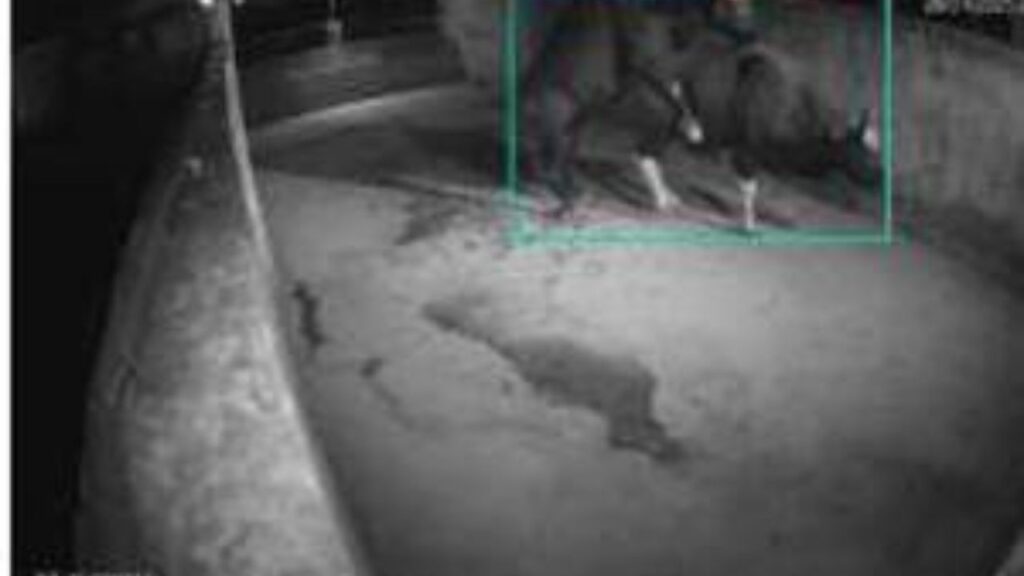
To overcome these limitations, the research team installed 12 high-definition CCTV cameras across two sheds at the ICAR-NRC on Mithun farm in Nagaland. The cameras enabled round-the-clock monitoring, including infrared surveillance during low-light and nighttime conditions.
Dataset and Computer Vision Technology
Researchers used footage captured by the cameras to create a dataset containing 3,000 manually annotated images. The images represented four major Mithun behaviours: feeding, standing, lying and mounting.
The AI framework combines the YOLOv8n object-detection model with DeepSORT tracking technology. While YOLOv8n identifies the behaviour of animals appearing in video footage, DeepSORT enables individual Mithun to be tracked across successive video frames and assigned persistent identities.
This combination allows the system to determine both what an animal is doing and which individual animal is performing the behaviour, providing a foundation for continuous behavioural monitoring.
High Accuracy and Real-Time Performance
The YOLOv8n model demonstrated strong performance during evaluation. It achieved a mean average precision of 99.5 per cent at [email protected], along with a recall of 99.6 per cent.
The system processed approximately 31 frames per second when operated on an NVIDIA RTX 3060 graphics processing unit, indicating its suitability for real-time monitoring applications.
Researchers also evaluated the framework under challenging farm conditions. These included partial obstruction of animals, background clutter, uneven and wet surfaces, shadows, motion blur and nighttime infrared imagery. The results indicate that the technology can operate under several practical conditions encountered in livestock farms.
Potential Applications in Livestock Management
The automated system could have several applications in precision livestock farming. Continuous observation of feeding, standing and lying patterns may help identify changes that could signal health problems, discomfort or altered physiological conditions.
Similarly, automated detection of mounting behaviour could provide useful information for reproductive and oestrus management. Such monitoring may reduce the dependence on constant physical observation and allow livestock managers to obtain behavioural information throughout the day and night.
The technology could therefore contribute to more data-driven approaches to animal health, welfare and breeding management.
Scope for Further Development
Despite its promising performance, the researchers highlighted several limitations. The system has so far been evaluated at a single farm and will require validation across different farms, geographical locations, seasons, stocking densities and camera configurations.
The current framework is also limited to four behavioural categories. Severe occlusion may affect detection and tracking, while further work is required to quantitatively assess identity-tracking performance using established tracking metrics.
Future research is expected to expand the system to detect behaviours such as aggression, grooming and disease-related inactivity. Researchers may also investigate temporal AI models, edge-device deployment and larger datasets covering diverse farm environments and seasonal conditions.
Published in Engineering Research Express, Volume 8 (2026), Article 175213, the study represents a significant effort to bring artificial intelligence and computer vision into Mithun research and management. The work, involving researchers from ICAR-NRC on Mithun, Nagaland, along with NIT Nagaland, Nagaland University and CHRIST (Deemed to be University), highlights the growing potential of technology-enabled livestock monitoring in India.