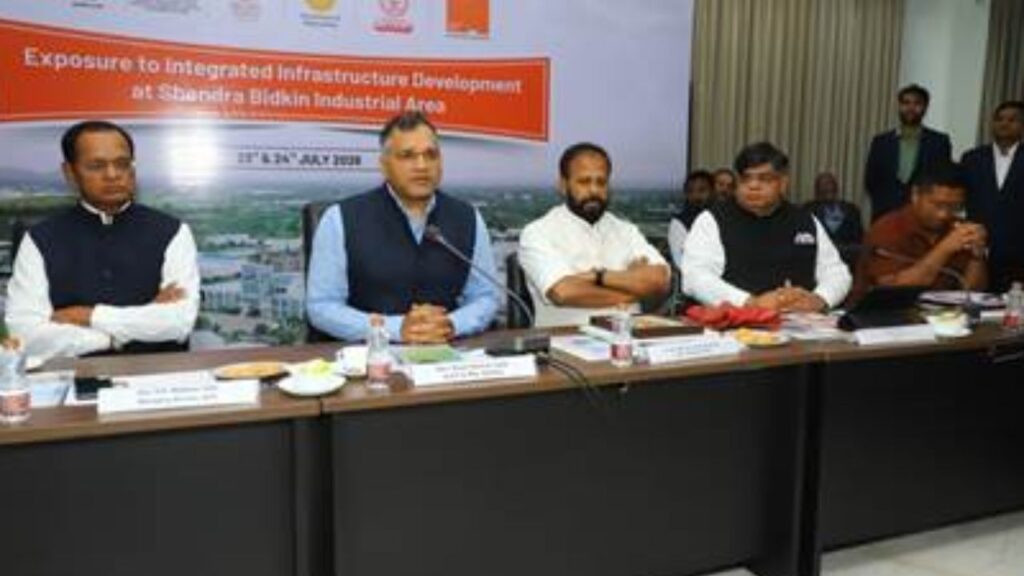

The National Industrial Corridor Development Corporation (NICDC), in partnership with Maharashtra Industrial Township Limited (MITL), has launched a two-day cross-learning programme at the Shendra-Bidkin Industrial Area, popularly known as AURIC Smart City, to promote knowledge sharing and strengthen the implementation of industrial corridor projects across India.
The initiative, which began on July 23, has brought together senior government officials, representatives of Special Purpose Vehicles (SPVs), Programme Managers for New Cities (PMNCs), engineering and infrastructure experts, and other stakeholders involved in the development of industrial corridors. The programme aims to facilitate the exchange of best practices while enhancing institutional capabilities for developing world-class greenfield industrial smart cities.
AURIC Presented as a Benchmark for Industrial Corridors
Inaugurating the programme, NICDC Chief Executive Officer and Managing Director Rajat Kumar Saini described AURIC as a successful example of integrated industrial city development under the National Industrial Corridor Development Programme (NICDP).
He said the project demonstrates how modern infrastructure, investor-focused planning, digital governance systems and multimodal connectivity can together create globally competitive manufacturing hubs. According to Saini, empowering Special Purpose Vehicles with greater flexibility in planning and land management is essential for ensuring efficient infrastructure development and accommodating future industrial expansion.
He also stressed that structured cross-learning programmes enable project teams across different states to adopt proven implementation strategies, thereby improving the quality and pace of industrial corridor development nationwide.
Participants Explore Smart Infrastructure
The opening day offered delegates an in-depth understanding of AURIC’s planning framework and operational infrastructure. Officials attended presentations detailing the evolution of the Shendra-Bidkin Industrial Area and observed demonstrations of digital planning and monitoring platforms used for project management.
Participants also visited industrial units and key infrastructure facilities, including utility networks, transportation links and industrial development sites. These field visits provided practical insights into the integration of physical infrastructure with digital systems to improve efficiency and service delivery.
The sessions highlighted how coordinated planning, advanced monitoring tools and modern infrastructure can enhance the attractiveness of industrial townships for domestic and global investors.
Focus on Better Project Management
The programme also featured discussions on integrated master planning, land utilisation, project implementation, investor facilitation, digital governance and monitoring systems.
Officials from participating states shared their experiences in managing industrial infrastructure projects and discussed ways to improve coordination among implementing agencies. The exchange of ideas focused on overcoming implementation challenges while ensuring faster execution of infrastructure projects under various industrial corridor initiatives.
The deliberations underscored the importance of collaborative learning in strengthening institutional capacity and promoting uniform standards across industrial development projects.
BHAVYA Scheme Takes Centre Stage
A major highlight of the programme was a detailed discussion on the Bharat Audyogik Vikas Yojana (BHAVYA), NICDC’s flagship initiative aimed at establishing world-class plug-and-play industrial parks across India.
Participants examined how AURIC’s experience in integrated planning, utility management, digital governance and investor facilitation could be replicated under the BHAVYA framework.
States and implementing agencies were encouraged to participate actively in the first round of applications for the scheme, with submissions remaining open until July 31, 2026.
The discussions also explored how industrial parks developed under BHAVYA can benefit from streamlined infrastructure planning, technology-driven management systems and efficient approval mechanisms.
Strengthening India’s Manufacturing Ecosystem
Experts participating in the programme emphasised that plug-and-play infrastructure, integrated utility networks and multimodal connectivity are becoming increasingly important for attracting investment and improving the ease of doing business.
The participants also exchanged ideas on sustainable infrastructure development, digital land management systems and investor-friendly regulatory processes that can help create future-ready industrial ecosystems across the country.
These discussions reflected the broader objective of strengthening India’s manufacturing competitiveness by adopting globally accepted planning and governance practices.
Second Day to Focus on Implementation Strategies
The cross-learning programme will continue on July 24 with technical presentations covering infrastructure development, project implementation, operational challenges and successful practices adopted across various industrial corridor projects.
An interactive session involving participating states and project stakeholders is expected to generate recommendations for improving coordination, accelerating project execution and replicating successful development models under the National Industrial Corridor Development Programme.
By bringing together policymakers, implementing agencies and industry experts on a common platform, the initiative is expected to contribute to stronger institutional collaboration and support the creation of modern industrial ecosystems that align with India’s long-term manufacturing and economic growth ambitions.