
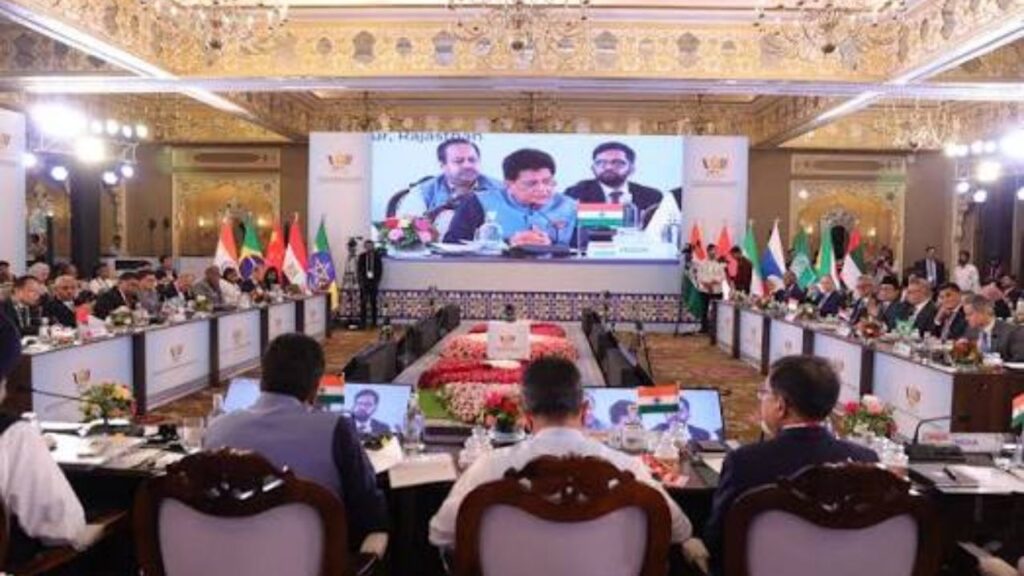

The 16th BRICS Trade Ministers’ Meeting concluded successfully in Jaipur, Rajasthan, under India’s BRICS Chairship 2026, with member countries reaffirming their commitment towards a resilient, inclusive and sustainable global trading system. The high-level meeting was chaired by Union Minister of Commerce and Industry Shri Piyush Goyal and brought together trade ministers, vice ministers, heads of delegations and senior officials from BRICS nations.
Held under the theme “Building for Resilience, Innovation, Cooperation and Sustainability,” the meeting focused on strengthening multilateral trade, improving economic cooperation among member countries, supporting small businesses and creating more secure global supply chains.
The ministerial meeting was preceded by the Third Meeting of the BRICS Contact Group on Economic and Trade Issues (CGETI), held on 3–4 August 2026 in New Delhi, where officials discussed key trade and economic priorities.
The meeting witnessed participation from representatives of Brazil, China, Egypt, Ethiopia, Indonesia, Iran, Russia, South Africa, the United Arab Emirates and India. The visiting delegates also explored Jaipur’s historic City Palace and appreciated India’s cultural heritage and Rajasthan’s traditional crafts.
Addressing the gathering, Commerce and Industry Minister Shri Piyush Goyal highlighted India’s priorities during its BRICS Chairship and stressed the need to protect the interests of farmers while ensuring food and livelihood security. He said BRICS economies represent an increasing share of the global economy and have a crucial role in promoting resilience, innovation, cooperation and sustainability.
The Minister reiterated India’s support for a reformed and development-oriented multilateral trading framework with the World Trade Organization (WTO) at its centre. He emphasized the importance of preserving Special and Differential Treatment (S&DT) provisions for developing countries and restoring a fully functional, two-tier and binding dispute settlement mechanism.
Shri Goyal underlined that principles such as Most-Favoured-Nation (MFN) treatment and Special and Differential Treatment remain essential for creating a fair, inclusive and rules-based global trade environment. He also outlined India’s priorities, including strengthening the multilateral trading system, developing diversified global value chains, expanding MSME participation in international trade and facilitating cross-border digital services.
Minister of State for Commerce and Industry Shri Jitin Prasada welcomed the delegates to Jaipur and highlighted the people-centric approach of BRICS cooperation. He said that the future of intra-BRICS trade depends on empowering micro, small and medium enterprises, encouraging women-led businesses and creating opportunities for young entrepreneurs in developing economies.
A major outcome of the meeting was the adoption of the Jaipur Consensus, which proposes studying a BRICS Invoice Discounting Mechanism to improve access to trade finance for small businesses. Ministers also adopted guiding principles for credit assessment frameworks for export-oriented MSMEs, focusing on evaluating businesses based on cash flow rather than only assets and collateral.
The measures aim to address the global trade finance gap estimated at around USD 2.5 trillion, which disproportionately affects smaller enterprises. These initiatives form part of the BRICS Workplan on the Internationalisation of MSMEs.
The meeting also advanced cooperation on global value chains through the BRICS Shared Understanding on Global Value Chains. The framework includes the Global Value Chain Action Plan 2026–2030, establishment of a BRICS Technical Council, BRICS Connect initiative, joint studies on value chains and possibilities for strategic supply chain and investment promotion platforms.
Special attention was given to digitally delivered services, with the adoption of the BRICS Principles to Facilitate Digitally Delivered Services Across Borders. The framework aims to promote secure digital trade, expand cooperation in technology-driven services and support balanced economic growth among member nations.
Another important development was progress towards finalising the Strategy for BRICS Economic Partnership 2030, covering areas such as trade in services, digital economy, innovation, technology, industry, investment, financial cooperation and sustainable development. The strategy will be submitted to BRICS Leaders for endorsement.
The 16th BRICS Trade Ministers’ Meeting marked an important milestone in India’s BRICS Chairship 2026. The outcomes reflected a shared commitment towards strengthening global trade cooperation, supporting farmers and small enterprises, promoting innovation and building a more inclusive economic order.
The decisions taken in Jaipur are expected to contribute towards India’s vision of Viksit Bharat@2047 while supporting shared prosperity among emerging economies.

Author: Shivam
Proficient Writer Contact: [email protected]