
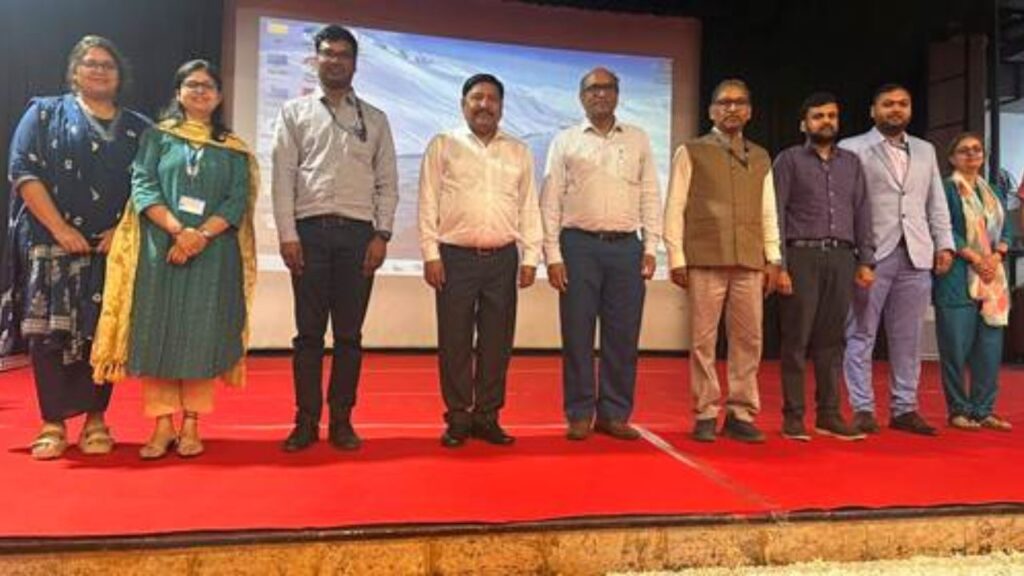

The CSIR-Central Road Research Institute (CSIR-CRRI) organised a specialised one-day training programme for engineers of the Public Works Department (PWD), Government of National Capital Territory of Delhi (GNCTD), focusing on the implementation of the Commission for Air Quality Management (CAQM) Standard Framework for paving and greening urban roads. The programme was held at the NDMC Convention Centre with the objective of strengthening scientific and standardised approaches to road development across Delhi.
The training brought together CRRI scientists and PWD engineers to discuss practical measures for improving urban road infrastructure while addressing environmental concerns, particularly road dust, which remains an important contributor to air pollution in the National Capital Region.
Focus on Scientific Road Design and Air Quality
The inaugural session began with the traditional lighting of the lamp, followed by a formal welcome of the participating dignitaries and officials. Dr. Ch. Ravi Sekhar, Director, CSIR-CRRI, delivered the inaugural address along with Sh. Naveen Bansal, Engineer-in-Chief (EinC), PWD, and Sh. Ravi Jha, Special Secretary-2, PWD.
The speakers highlighted the importance of adopting scientific road engineering practices and environmentally responsible infrastructure solutions. They emphasised that proper road design, standardised paving methods and systematic greening can contribute significantly to reducing road dust and supporting better air quality in Delhi.
The programme was designed to provide engineers with both conceptual understanding and practical guidance required for implementing the CAQM framework on the ground.
Technical Modules Cover Urban Road Planning
The comprehensive training programme covered several important aspects of urban road development. CRRI experts and scientists, including Dr. Sampath Kumar, Dr. K. Ravinder, Dr. E. Madhu, Dr. Mukti Advani, Dr. Minal Chandra, Dr. Chintaman Bari and Dr. Nischal Gupta, along with Dr. Ch. Ravi Sekhar, conducted the technical sessions.
One of the key modules focused on the background and principles of the paving and greening guidelines applicable to the NCR. Participants were briefed on urban space standards and the importance of planning road networks in accordance with relevant Indian Roads Congress (IRC) guidelines. The discussions also linked road planning with environmental sustainability and road-user safety.
Another session dealt with carriageway design and standardised data formats. Engineers received technical guidance on designing carriageways for different categories of urban roads and were introduced to standard formats for collecting and managing road-related data. Such standardisation is expected to facilitate more consistent planning and implementation across different road projects.
Emphasis on Public Transport, Pedestrians and Safety
The training also addressed the integration of public transport and non-motorized transport (NMT) into urban road design. Engineering benchmarks for public transport facilities were discussed, along with standards for pedestrian pathways and infrastructure supporting non-motorized mobility.
The programme further examined road safety and integration of urban utilities. Participants received guidance on road signs and markings and on coordinating road infrastructure with essential services such as drainage systems, electricity networks, telecommunications infrastructure, bus stops and gas fuel stations.
Integrating these facilities during the planning and design stage can help minimise conflicts between road infrastructure and utility services while improving the functionality and safety of urban roads.
Roadmap for Field-Level Implementation
The programme concluded with an interactive session between CRRI scientists and participating PWD engineers. The discussion provided an opportunity to address practical issues related to applying the CAQM framework and to identify an operational roadmap for its implementation across Delhi’s road network.
The initiative underlines the importance of collaboration between scientific institutions and government agencies in developing cleaner, safer and more sustainable urban infrastructure. Through technical capacity building and adoption of standardised practices, the training seeks to support Delhi’s efforts towards effective road dust management, improved urban mobility and enhanced environmental quality.

Author: Shivam
Proficient Writer Contact: [email protected]