
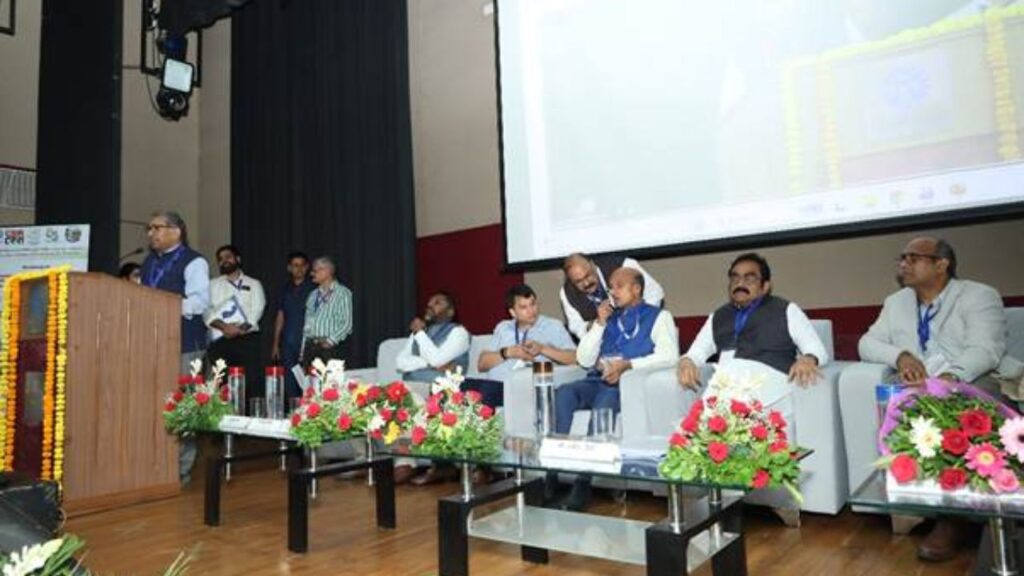

The CSIR-Central Road Research Institute (CSIR-CRRI), New Delhi, and CSIR-Advanced Materials and Processes Research Institute (CSIR-AMPRI), Bhopal, jointly organised a one-day workshop on “Innovative Materials and Advanced Composites for Sustainable Infrastructure” at CSIR-AMPRI, Bhopal. The event brought together researchers, policymakers, engineers, industry representatives and academic experts to explore sustainable technologies for developing and rehabilitating transportation infrastructure.
The workshop was organised as part of the Platinum Jubilee celebrations of CSIR-CRRI, being observed from July 2026 to July 2027. Around 300 delegates from organisations including Madhya Pradesh Public Works Department (MP PWD), Madhya Pradesh Road Development Corporation (MPRDC), National Highways Authority of India (NHAI), CSIR-AMPRI, NITTTR Bhopal, MANIT Bhopal and SPA Bhopal participated in the programme.
Focus on Sustainable Infrastructure Technologies
The workshop was inaugurated by Shri Rakesh Singh, Minister of Public Works Department, Government of Madhya Pradesh, as the Chief Guest. Dr. (Mrs.) N. Kalaiselvi, Director General, CSIR and Secretary, Department of Scientific and Industrial Research (DSIR), joined the programme online as Guest of Honour.
Dr. Thallada Bhaskar, Director, CSIR-AMPRI, delivered the welcome address, while Dr. Chalumuri Ravi Sekhar, Director, CSIR-CRRI, presented the theme of the workshop. He highlighted CSIR-CRRI’s 75-year contribution to the country and stressed the importance of developing practical, sustainable and field-ready solutions for infrastructure challenges.
Shri Rakesh Singh emphasised the need to integrate sustainable rainwater harvesting systems around roads and bridges to support groundwater recharge. He also highlighted digital initiatives such as the Lok Path mobile application, aimed at improving road infrastructure management in Madhya Pradesh.
Dr. N. Kalaiselvi underlined the importance of innovations emerging from CSIR laboratories in the field of road infrastructure. She encouraged industry representatives and engineering departments to work closely with CSIR institutions so that research-based technologies can be effectively deployed to address real-world infrastructure requirements.
Technical Sessions Explore Advanced Materials
The technical programme was organised around three major themes: innovative construction and rehabilitation technologies, sustainable materials and recycling, and advanced materials and composites.
The first session examined technologies for infrastructure construction and rehabilitation. Presentations covered box-jacking technology combined with soil nailing for road and railway underpasses, along with scientific approaches for rehabilitating distressed highway geostructures, particularly reinforced-soil walls.
The second session focused on the use of waste and biological processes in construction. Experts discussed the utilisation of waste materials in highway development, biostimulated calcite precipitation for stabilising expansive soils, and full-depth reclamation techniques for sustainable road rehabilitation.
The third session highlighted advanced construction materials and composite technologies. Discussions included fly ash-based geopolymeric concrete, resource-efficient geopolymer concrete mix designs, natural fibre geosynthetics for ground improvement, sisal fibre reinforcement for asphalt pavements and fibre-reinforced polymer composites for bridge superstructures.
Industry representatives from Techfab International, Strata Geosystems (India) and Maccaferri Environmental Solutions also shared perspectives on the practical application of innovative infrastructure technologies.
Roadmap for Wider Technology Adoption
The workshop concluded with a panel discussion on strategies for adopting innovative materials and technologies in highway projects. The discussion brought together senior representatives from CSIR-CRRI, CSIR-AMPRI and Madhya Pradesh PWD.
The panel examined ways to move promising research outcomes and field demonstrations towards large-scale implementation. The programme underscored the importance of collaboration among research institutions, government agencies, academia and industry in creating durable, resource-efficient and environmentally sustainable infrastructure.
The workshop concluded with a vote of thanks by Dr. Hemant Shukla of CSIR-AMPRI.
Also Read: RDI Fund to Get Faster Disbursal, Wider Strategic Scope: Dr Jitendra Singh

Author: Shivam
Proficient Writer Contact: [email protected]