
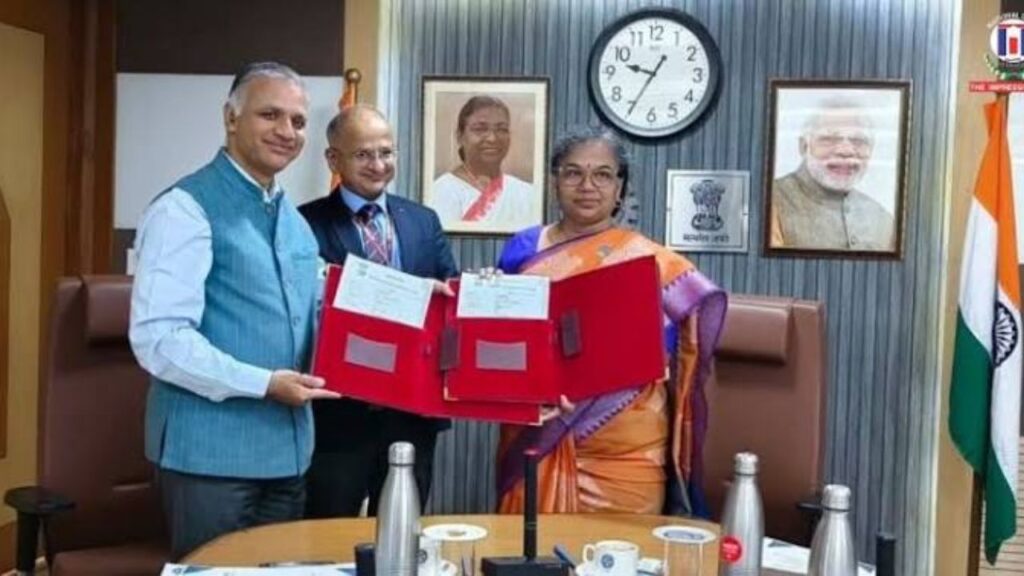

The Council of Scientific and Industrial Research (CSIR) and Nalanda University (NU) have entered into a strategic partnership aimed at strengthening the link between scientific innovation, sustainability and community development. The two institutions signed a Memorandum of Understanding (MoU) to promote technology deployment, rural development, skill enhancement and scientific outreach, while enhancing the global visibility of India’s indigenous technologies.
The agreement marks a significant effort to combine CSIR’s scientific expertise with Nalanda University’s international academic ecosystem, creating practical and scalable solutions for societal challenges.
Partnership Focuses on Science for Society
The MoU was exchanged in the presence of CSIR Director General and Secretary, Department of Scientific and Industrial Research (DSIR), Dr. N. Kalaiselvi; Nalanda University Vice-Chancellor Prof. Sachin Chaturvedi; and Secretary (East), Ministry of External Affairs, Shri Rudrendra Tandon. Senior scientists, faculty members and officials from both institutions also attended the event.
The collaboration seeks to accelerate the deployment of indigenous technologies in areas such as environmental sustainability, waste management, water quality improvement and rural development. It also aims to strengthen scientific outreach and build capacities through joint academic and technological initiatives.
Community-Centric Development at the Core
Speaking at the ceremony, Prof. Sachin Chaturvedi highlighted the importance of ensuring that scientific innovations address real societal needs. He said that while developing new technologies is essential, identifying solutions that directly benefit communities is equally critical.
According to him, the partnership will support sustainable development initiatives in and around the Nalanda region by implementing technologies related to model village development, solid waste management, environmental protection and water resource management. The collaboration is also expected to deepen Nalanda University’s engagement with local communities through science-driven interventions.
Supporting Nalanda’s Global Vision
Shri Rudrendra Tandon said the collaboration aligns with the Prime Minister’s vision of transforming Nalanda University into a globally recognised institution with strong international academic and research partnerships.
He described CSIR as India’s premier scientific research organisation and noted that its association with Nalanda University would strengthen research, innovation and academic excellence. He expressed confidence that students, researchers and neighbouring communities would benefit from access to CSIR’s extensive scientific knowledge and technological capabilities.
Expanding the Reach of Indigenous Technologies
Dr. N. Kalaiselvi described the MoU as an important milestone for both institutions. She said Nalanda University’s diverse international student community provides an ideal platform to showcase India’s scientific achievements to the world.
She stressed that scientific innovations achieve greater impact when complemented by insights from social sciences, ensuring that technologies are effectively adopted by communities.
Dr. Kalaiselvi highlighted several mission-oriented technologies developed by CSIR that could be deployed under the partnership. These include solutions for solid waste management, soil reclamation, water quality improvement and other societal development programmes.
To ensure measurable outcomes, she proposed launching at least three focused societal missions during the initial phase of the collaboration. These projects are expected to demonstrate how scientific research can directly improve the quality of life in nearby villages and surrounding regions.
Technology Gallery to Showcase Indian Innovations
One of the key features of the partnership is the establishment of a CSIR Technology Gallery at the Nalanda University campus. The gallery will display indigenous technologies developed by various CSIR laboratories, offering students, researchers and international visitors an opportunity to explore India’s scientific advancements.
The facility is expected to serve as a platform for knowledge dissemination, technology demonstration and innovation awareness, while encouraging collaboration between academia, researchers and industry.
Framework for Long-Term Collaboration
Beyond technology deployment, the MoU provides a structured framework for joint activities in research, capacity building, rural outreach and knowledge exchange. Both institutions will work together to develop sustainable models that integrate scientific research with community welfare and environmental conservation.
The collaboration is expected to promote skill development, support local livelihoods and encourage wider adoption of indigenous technologies in rural areas.
By combining CSIR’s research capabilities with Nalanda University’s international academic network, the partnership aims to create a replicable model of science-led development that can be implemented in other regions of the country. It also reinforces India’s commitment to using scientific innovation not only for technological advancement but also for inclusive and sustainable societal progress.

Author: Shivam
Proficient Writer Contact: [email protected]