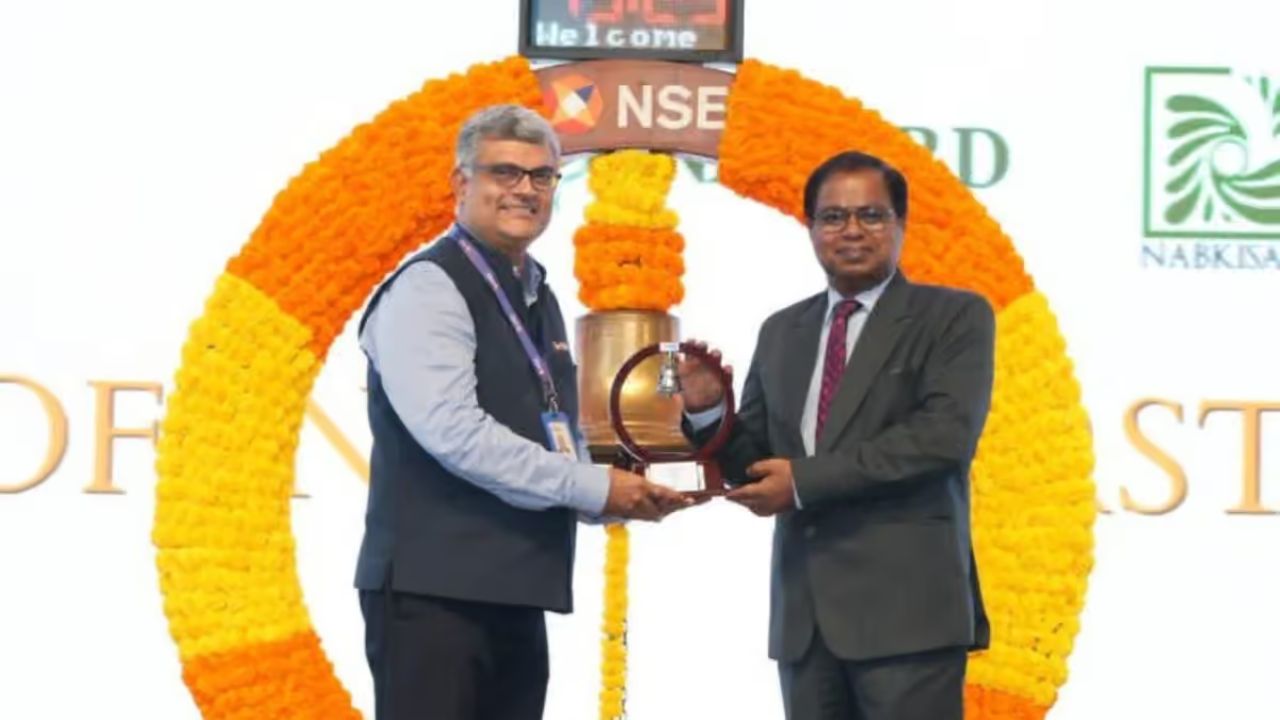
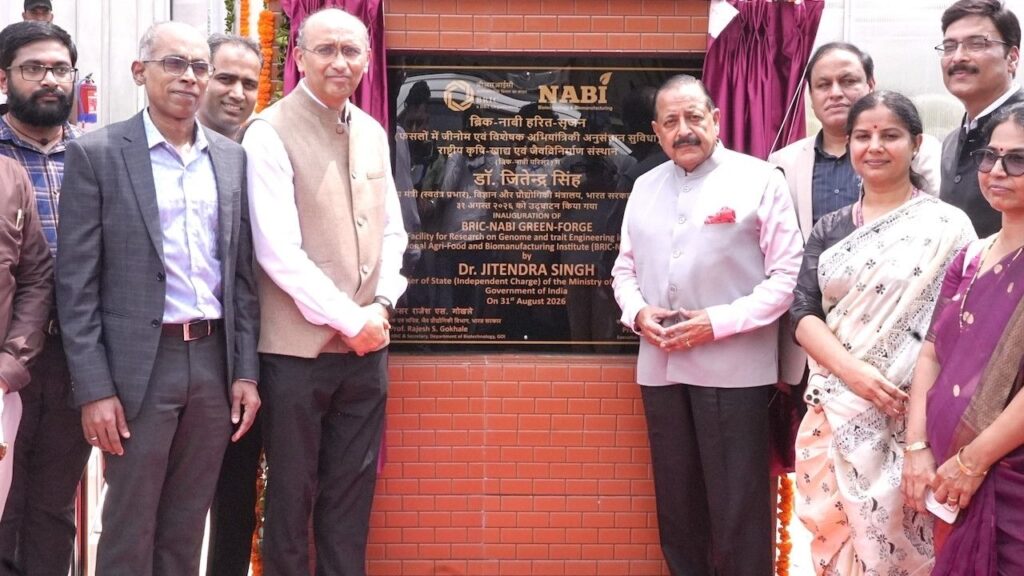

Union Minister of State (Independent Charge) for Science and Technology and Earth Sciences, Dr Jitendra Singh, inaugurated the “Green Forge” Complex at the National Agri-Food and Biomanufacturing Institute (BRIC-NABI) in Mohali, describing the facility as a significant development in India’s genetically modified crop research and biotechnology ecosystem.
The facility was inaugurated during the National Conclave on BioE3 (Biotechnology for Economy, Environment and Employment), where the Minister outlined how advanced controlled-environment infrastructure can strengthen agricultural research and accelerate the development of innovative biological solutions.
Controlled Environment for Crop Research
The newly established Green Forge Complex features specialised simulation chambers that allow researchers to recreate and regulate environmental conditions. Parameters such as light intensity and quality, humidity and temperature can be adjusted to provide controlled conditions for growing and studying genetically modified crops.
Dr. Jitendra Singh said the facility would help scientists examine how particular crop varieties respond to different environmental conditions. This could support more informed decisions about the geographical areas where newly developed varieties may be suitable for cultivation.
According to the Minister, one of the key challenges following the development of a genetically modified crop is determining the environments in which it can perform optimally. Green Forge can address this challenge by reproducing different combinations of environmental conditions in a controlled setting before researchers move towards field-level applications.
Biotechnology and Artificial Intelligence
The Minister highlighted the potential of combining the facility’s simulation capabilities with Artificial Intelligence. By integrating advanced technologies, researchers could analyse crop responses more efficiently and design experiments with greater precision.
He said the convergence of biotechnology, simulation technologies and AI is creating new opportunities not only in agriculture but also in medical and other areas of life-science research.
Dr. Jitendra Singh also emphasised the transformation taking place across India’s biotechnology sector. He noted that the country’s bioeconomy has grown substantially, from around US$10 billion to US$200 billion, and attributed this expansion to an enabling policy environment and increasing participation from the private sector.
Focus on Industry-Ready Biotechnology
The Minister said the BioE3 initiative is increasingly focused on translating scientific research into manufacturing, products and commercially relevant technologies. He stressed that research institutions need to remain responsive to industry and other stakeholders so that scientific investments can generate practical and economic outcomes.
He highlighted the establishment of 22 manufacturing hubs designed to support start-ups, small and medium enterprises and researchers. He also pointed to the National Bio-Foundry Network, comprising eight specialised facilities aimed at providing infrastructure and support to entrepreneurs and emerging biotechnology ventures.
More than 50 process innovations are also being scaled up, reflecting the government’s emphasis on moving biotechnology research from laboratories towards real-world applications.
Carbon Capture and Emerging Fields
Dr. Jitendra Singh highlighted ongoing work in Carbon Capture and Utilisation (CCU), stating that the Department of Biotechnology is supporting around 38 projects in the field. He said integrated biomanufacturing approaches could help capture carbon while addressing emissions from industrial sectors such as cement and steel.
The Minister also referred to emerging biotechnology areas including sustainable aviation fuels, the I3 PhD programme and space biotechnology. He highlighted collaborations with ISRO involving life-science experiments related to myogenesis, cognitive effects and cyanobacteria growth, along with India’s expanding work in genetics.
Turning Agricultural Waste into Value
BRIC-NABI’s contribution to agri-biotechnology was another key focus of the address. Dr. Jitendra Singh highlighted the institute’s work at the intersection of agriculture and bioprocess engineering, particularly its potential to convert agricultural residues into nutraceuticals and high-value biomaterials.
Such approaches, he said, could help create additional economic value from agricultural waste while contributing to the development of a more circular and low-carbon economy.
Call for Greater Institutional Collaboration
The Minister also advocated stronger collaboration among institutions located within the same region. He suggested that institutions working in biotechnology, medicine, agriculture, pharmaceuticals and related disciplines could form interconnected clusters to promote research partnerships, academic exchanges and talent development.
Referring to Chandigarh and its surrounding institutions, he suggested developing a coordinated ecosystem that could strengthen interdisciplinary research and broaden the reach of BRIC-NABI.
Dr. Jitendra Singh said India’s biotechnology journey is increasingly moving towards the conversion of scientific discoveries into products, technologies and solutions. He linked this transition with the broader goals of Net Zero 2070 and Atmanirbhar Bharat.
Congratulating the BRIC-NABI team, the Minister expressed confidence that the institute would emerge as a major contributor to India’s biotechnology revolution, particularly in the field of agri-biotechnology.
Secretary, Department of Biotechnology, Dr Rajesh Gokhale, BRIC-NABI Director Dr Pareekh and BIRAC Managing Director Dr Dhananjay Tiwary also addressed the gathering.
Also Read: AI Loss-of-Control Incidents Nearly Double, Raising Fresh Concerns Over Rogue Behaviour

Author: Shivam
Proficient Writer Contact: [email protected]