
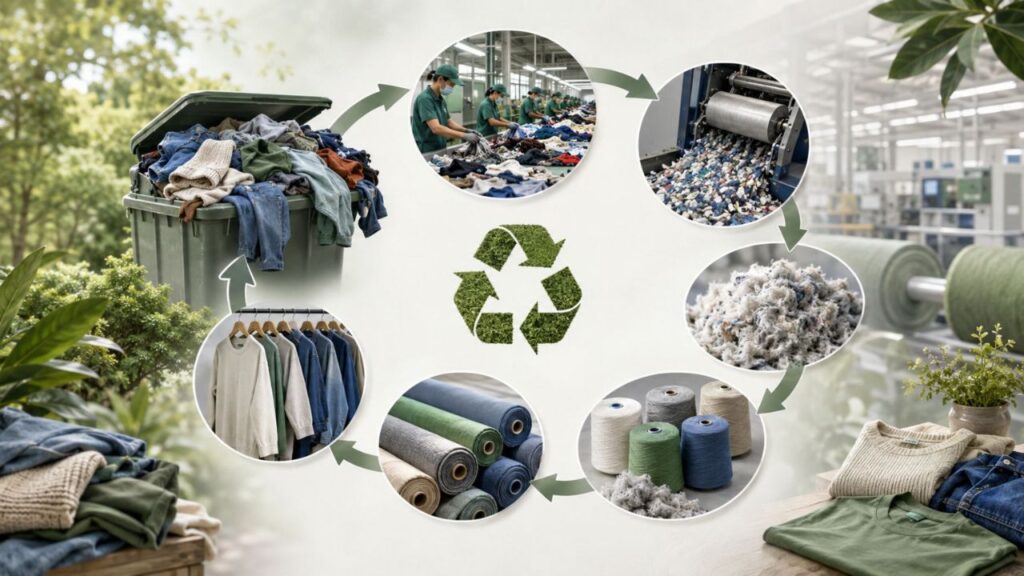

The Government e Marketplace (GeM), under the Ministry of Commerce and Industry, and the Textiles Committee (TC), Ministry of Textiles, Government of India, have entered into a strategic partnership to promote recycled and upcycled textile products through public procurement. The initiative aims to convert pre- and post-consumer textile waste, discarded garments and scrap into commercially viable products while creating new opportunities for enterprises operating in the circular economy.
The collaboration was formalised through a Memorandum of Understanding (MoU) signed in Mumbai during the 62nd Foundation Day celebrations of the Textiles Committee. The partnership is expected to establish a ‘Waste-to-Value-to-Market’ ecosystem that connects textile waste collection and processing with product development, certification and access to government buyers.
Focus on Circular Textile Economy
Under the agreement, the Textiles Committee will play a key role in identifying and verifying manufacturers and enterprises involved in producing recycled and upcycled textile goods. It will also certify and recognise eligible producers to help establish quality and reliability in the emerging market.
The Textiles Committee will further support consultations with industry stakeholders, capacity-building programmes and market research. It will contribute to developing suitable technical specifications and product standards required for bringing recycled and upcycled textile products into organised public procurement.
GeM, meanwhile, will establish dedicated online categories for such products on its procurement platform. The marketplace will facilitate seller registration, provide digital market access and encourage government organisations to consider recycled and upcycled products for their procurement needs.
Enabling Small Enterprises and Local Producers
A key feature of the initiative is its focus on bringing smaller enterprises and last-mile producers into the formal procurement ecosystem. Training and handholding assistance will be provided to recyclers and upcyclers to help them understand procurement procedures and participate more effectively on GeM.
The partnership will adopt a hub-and-spoke model. The Textiles Committee and its affiliated offices will facilitate outreach, mobilisation and capacity building among recyclers and upcyclers at the local level. They will also support the development of suitable product catalogues and specifications for government purchasing.
The approach is expected to particularly benefit women-led enterprises, micro, small and medium enterprises (MSMEs), artisans, local businesses and other organisations involved in recycling and upcycling activities.
Government Procurement to Drive Demand
Government procurement is being positioned as an important tool for creating stable demand for products manufactured from textile waste. With its extensive network of government buyers, GeM can provide producers with access to a large institutional market.
CEO of GeM, Shri Mihir Kumar, said that the partnership would bring certification, standardisation and market access together to establish dependable demand for products made from textile waste. He noted that the scale of government procurement could help accelerate the adoption of sustainable products across offices, institutions, gifting requirements and other public-use applications.
Supporting Sustainable Development
The initiative aligns with broader national priorities such as Vocal for Local, Make in India and AatmaNirbhar Bharat. By creating market opportunities for recycled materials, the partnership seeks to encourage resource efficiency while supporting livelihoods and local entrepreneurship.
The event was attended by Union Minister of Textiles Shri Giriraj Singh and Maharashtra Minister of Textiles Shri Sanjay Savkare. The MoU was signed by Additional CEO of GeM Shri Ajit B. Chavan and Secretary of the Textiles Committee Shri Kartikay Dhanda in the presence of senior government officials and industry representatives.
The GeM-Textiles Committee partnership represents an important step towards integrating textile waste management with organised markets. By linking waste recovery, product quality, certification and public procurement, the initiative could help transform discarded textiles into economic assets while promoting responsible consumption and production.
Ultimately, the collaboration seeks to strengthen India’s transition towards a circular and resource-efficient textile sector, where waste is increasingly treated not as a disposal challenge but as a source of new products, businesses, employment and sustainable economic value.

Author: Shivam
Proficient Writer Contact: [email protected]