
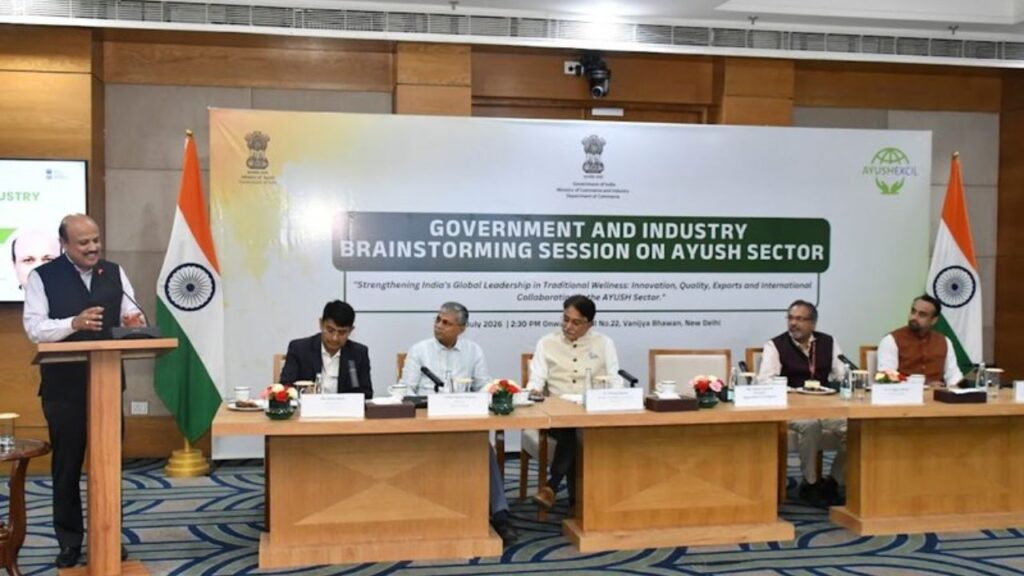

In a major push to position India as a global leader in traditional wellness and holistic healthcare, the Department of Commerce, under the Ministry of Commerce and Industry, organised a high-level Government–Industry Brainstorming Session on the AYUSH sector in collaboration with the Ministry of AYUSH and the AYUSH Export Promotion Council (AYUSHEXCIL). The event, held at Vanijya Bhawan in New Delhi on July 1, brought together policymakers, exporters, manufacturers, startups, researchers and industry representatives to develop a roadmap for expanding India’s global presence in the traditional medicine market.
Held under the theme “Strengthening India’s Global Leadership in Traditional Wellness: Innovation, Quality, Exports and International Collaboration in the AYUSH Sector,” the session witnessed participation from more than 150 stakeholders. The discussions focused on strengthening exports, improving quality standards, enhancing global branding and addressing regulatory challenges to make Indian AYUSH products more competitive in international markets.
Participants examined the opportunities created by India’s expanding network of Free Trade Agreements (FTAs), which are expected to open new export destinations for AYUSH products and wellness services. Deliberations also covered strategies for improving compliance with international quality standards, including WHO-GMP norms, promoting the Ayush Quality Mark, strengthening scientific validation of traditional medicine, encouraging innovation and expanding medical value travel.
The event served as a platform for constructive dialogue between government departments, industry associations, research institutions, MSMEs and private enterprises. Stakeholders shared practical suggestions on improving market access, streamlining regulations, promoting innovation and enhancing India’s reputation as a trusted supplier of traditional healthcare products.
Delivering the special address, AYUSHEXCIL Chairman and Member of Parliament Dr. Anurag Sharma highlighted the increasing global demand for traditional medicine and holistic wellness solutions. He said India possesses a unique opportunity to emerge as a trusted global destination for natural healthcare by combining its rich traditional knowledge with modern scientific validation and quality assurance.
He stressed the importance of stronger collaboration among the government, industry and research institutions to build internationally recognised AYUSH brands. He also highlighted AYUSHEXCIL’s ongoing efforts to support exporters through market development initiatives, capacity-building programmes and international outreach activities aimed at expanding India’s export footprint.
In his keynote address, Commerce Secretary Rajesh Agrawal described the AYUSH sector as one of India’s most promising sunrise industries with significant export potential. He said the government’s objective extends beyond increasing export volumes to creating globally competitive Indian brands that command trust and recognition across international markets.
Agrawal encouraged businesses to focus on innovation, product differentiation, branding and value addition while taking advantage of opportunities offered by India’s trade agreements. He also underlined the important role of trade facilitators and intermediaries in connecting Indian manufacturers with overseas buyers.
Calling upon entrepreneurs and exporters to share their success stories more actively, he said such examples could encourage wider participation in the sector and inspire new businesses to enter global markets. He assured participants that the Department of Commerce would continue to work closely with AYUSHEXCIL through stakeholder consultations, awareness campaigns and capacity-building programmes to strengthen exports.
Addressing the gathering, AYUSH Secretary Vaidya Rajesh Kotecha emphasised the need to accelerate flagship initiatives such as Ayush Mark and Ayurveda Aahar, which are designed to improve quality assurance, strengthen branding and enhance the international acceptance of Indian AYUSH products.
He urged manufacturers and exporters to capitalise on the growing global interest in Ayurveda and other traditional systems of medicine by improving packaging, product quality, branding and market readiness. Kotecha also stressed the importance of continuous dialogue between industry and government to identify challenges and develop practical solutions.
Highlighting the importance of capacity building, particularly for MSMEs and exporters, he noted that ongoing efforts are underway to align Indian standards with globally accepted benchmarks through collaboration with national and international standard-setting organisations. Such initiatives, he said, would help improve market access and increase confidence among overseas consumers.
The brainstorming session concluded with an interactive open-house discussion during which participants offered recommendations on regulatory reforms, ease of doing business, innovation, international collaboration and export facilitation. The suggestions gathered during the event are expected to shape future policy initiatives and export promotion strategies jointly undertaken by the Department of Commerce, the Ministry of AYUSH and AYUSHEXCIL.
As global demand for natural healthcare and wellness solutions continues to rise, the collaborative initiative signals India’s determination to strengthen Brand India AYUSH and establish itself as a leading global hub for traditional medicine, wellness products and holistic healthcare services.
Also Read: India’s UPI Goes Live in Greece as Piyush Goyal Strengthens Bilateral Economic Ties

Author: Shivam
Proficient Writer Contact: [email protected]