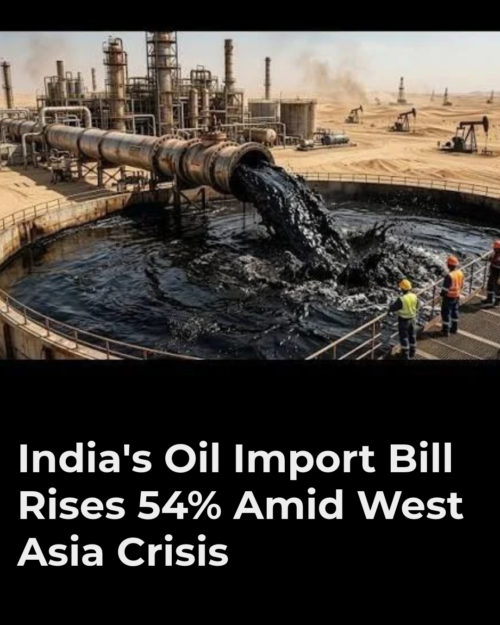

India’s Oil Import Bill:- India’s energy import costs have increased sharply due to the ongoing conflict in West Asia. The country’s crude oil import bill rose by 53.5% in the first seven months of the current financial year, even though the quantity of oil imported increased only slightly.
The rise in global oil and gas prices, along with higher transportation and insurance costs, has put additional pressure on India’s energy spending. The crisis around the Strait of Hormuz has also affected the movement of important energy supplies.
According to provisional data from the Ministry of Petroleum and Natural Gas (MoPNG), India’s higher import expenses highlight the economic risks of depending heavily on foreign energy supplies.
India imports more than 88% of its crude oil requirements and around half of its natural gas consumption. Natural gas is mainly imported in the form of liquefied natural gas (LNG).
India’s Oil Import Bill:- India’s Crude Oil Import Bill Jumps 53.5%
Data from the Petroleum Planning and Analysis Cell (PPAC) shows that India’s crude oil import bill reached $111 billion between April and October, compared with the same period last year.
During these seven months, crude oil import volumes increased by only 2.7% to 146.6 million tonnes. However, the average landed cost of imported crude rose to around $103.3 per barrel, compared with approximately $69 per barrel a year earlier.
The increase in international oil prices has made every barrel more expensive for Indian refiners.
October recorded an even sharper rise. India’s crude oil import bill increased by 87.5% year-on-year to $19.5 billion.
The Indian crude oil basket averaged $119.9 per barrel in October, compared with $82 per barrel in July.
The April-October import bill has already reached around 88% of the total crude oil import expenditure recorded during the entire 2025-26 financial year.
India’s Oil Import Bill:- LNG Import Costs Also Increase
India’s spending on natural gas imports has also increased.
Between April and October, LNG import volumes grew by 7.4% to 22,175 million standard cubic metres. However, the import bill increased by 35.8% to $11 billion.
This difference shows how higher international gas prices are increasing the cost of meeting India’s energy needs.
Petroleum product imports, meanwhile, almost halved in volume terms to 15.1 million tonnes from 29.8 million tonnes during the same period last year.
Their import value declined by a smaller 25% to $9.9 billion because international fuel prices remained high.
India’s Oil Import Bill:- India Cuts Fuel Exports to Protect Domestic Supply
India is also adjusting its petroleum trade to manage domestic energy requirements.
Between April and October, petroleum product export volumes declined by 13.5% to 32.1 million tonnes. The government and energy companies have given greater priority to meeting domestic fuel demand amid global supply concerns.
However, higher international prices pushed the value of petroleum product exports up by 47% to $34.1 billion.
After accounting for crude oil, LNG and petroleum product imports, along with petroleum product exports, India’s net oil and gas import bill increased by nearly 39% year-on-year to $97.7 billion.
This indicates that higher energy prices are increasing India’s overall spending, even with changes in import and export volumes.
India’s Oil Import Bill:- Why Rising Oil Prices Are a Concern for India
India’s heavy dependence on imported energy makes the economy vulnerable to sudden increases in international oil and gas prices.
Higher import costs can affect several important areas of the economy, including:
-
Trade deficit: Expensive oil imports increase the country’s overall import expenditure.
-
Inflation: Higher fuel and energy costs can push up transportation, manufacturing and electricity-related expenses.
-
Rupee pressure: A larger import bill increases demand for foreign currency, particularly US dollars.
-
Current account deficit: Higher oil prices can widen the gap between India’s foreign exchange earnings and spending.
Government data also shows rising pressure on wholesale fuel and power prices. Inflation in this category reached 32.8% in October, compared with 25.9% in September and 23.2% in August.
According to estimates, India imports around 1.8 billion to 2 billion barrels of crude oil annually. Every $1 increase in the price of a barrel can add up to $2 billion to the country’s annual oil import bill.
A March report by Nomura also identified India as one of the three Asian economies most exposed to higher oil prices. The report estimated that a 10% increase in crude oil prices could widen India’s current account deficit by around 0.4% of GDP.
India’s Oil Import Bill:- Strait of Hormuz Crisis Adds to Energy Security Risks
The Strait of Hormuz is an important route for global energy transportation. Before the West Asia conflict began in late February, around 40% of India’s crude oil imports, 60% of its LNG imports and nearly 90% of its LPG imports came from the Persian Gulf through this route.
Disruptions in the region created concerns about the availability and cost of energy supplies.
Although physical supply shortages have eased to a large extent, transportation charges and insurance premiums remain high because of security risks.
India has diversified its crude oil sources to maintain the availability of petrol, diesel and aviation fuel. However, the initial supply disruptions affected gas availability for some industries and commercial consumers.
During that period, gas supplies were prioritised for households and certain essential sectors.
India’s Oil Import Bill:- What Lies Ahead for India’s Economy?
The rising oil and gas import bill highlights a major challenge for India’s economy. Even when the country manages to secure sufficient energy supplies, higher global prices can increase its financial burden.
If international oil and gas prices remain elevated, India could face additional pressure on inflation, its trade balance and the rupee.
Reducing dependence on imported energy, expanding domestic production and increasing the use of alternative energy sources will remain important for long-term energy security.
For now, the West Asia crisis has shown how international conflicts can directly affect India’s economy, businesses and consumers through higher energy costs. Read more:- City Economic Regions in India: Boosting the $30 Trillion Economy Goal