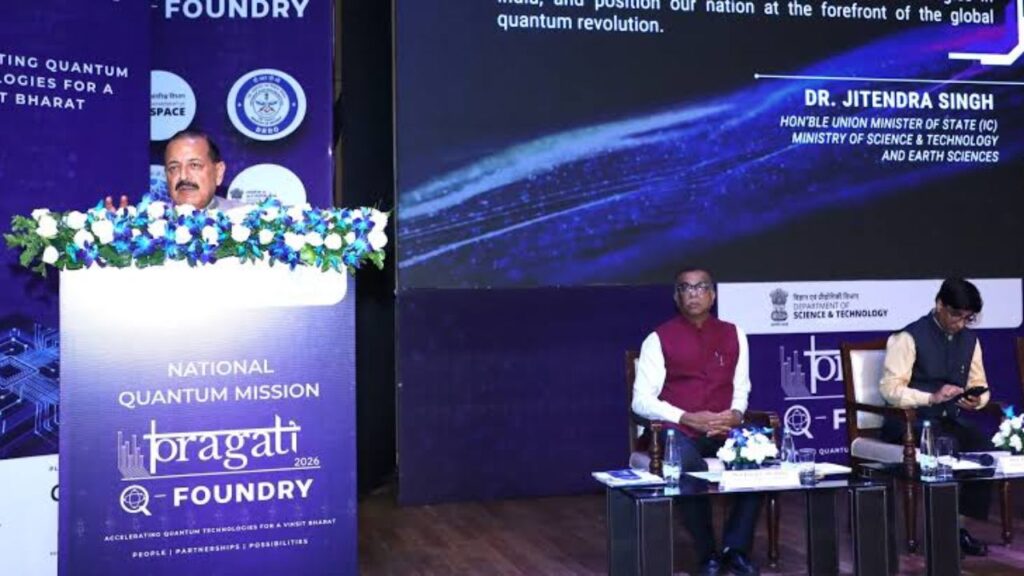

India is rapidly strengthening its position in the global quantum technology landscape, with the National Quantum Mission (NQM) creating greater opportunities for startups, industry, investors and research institutions to participate in the development of advanced technologies. Union Minister of State (Independent Charge) for Science & Technology and Earth Sciences, Dr. Jitendra Singh, said the country possesses the scientific expertise and technological capabilities required to develop a globally competitive quantum ecosystem.
Addressing PRAGATI Q-FOUNDRY 2026 – NQM Co-development and Venture Partnership Meet at the Dr. Ambedkar International Centre in New Delhi, the Minister said the National Quantum Mission represents a collaborative model involving government, academia, startups, industry, investors, States and strategic users.
Dr. Jitendra Singh emphasised that India is working towards becoming a developer and exporter of quantum technologies rather than remaining dependent on technologies developed elsewhere. The Mission is supporting the creation of domestic infrastructure, skilled manpower, enterprises and technological capabilities across the quantum value chain.
Highlighting the pace of progress, the Minister said India has achieved 1,000-km quantum-secure communication within around three years of the Mission, against a target of 2,000 km planned over its eight-year duration. He said the achievement demonstrates the growing capabilities of the country’s quantum ecosystem and provides momentum for accelerating further development.
The National Quantum Mission operates through four thematic hubs located at IISc Bengaluru, IIT Madras, IIT Bombay and IIT Delhi. Together, these hubs bring researchers from 43 institutions across 17 States and two Union Territories. Their work covers four major areas: quantum computing, quantum communication, quantum sensing and metrology, and quantum materials and devices.
According to the Minister, developments during the past two to three years have created opportunities for India to become globally competitive in quantum communication and quantum sensing while building greater self-reliance in quantum computing.
A key focus of the Mission is supporting startups beyond conventional financial assistance. Government support includes access to infrastructure, mentorship, technology validation, industry connections and potential customer pathways. Dr. Jitendra Singh called for stronger participation from industry and investors through funding, technical validation, co-development, procurement and market access.
He also urged State governments to assess and consider the deployment of indigenous technologies developed by quantum startups. Such early adoption, he said, could help promising ventures establish sustainable business models and scale their solutions.
The National Quantum Mission has so far supported 17 startups, while nine additional startups were announced during the event, taking the total number of supported ventures to 26. The expansion is intended to strengthen India’s emerging quantum entrepreneurship ecosystem and provide startups with greater access to resources and markets.
The event also featured demonstrations of quantum technologies and the exchange of Memoranda of Understanding (MoUs). Among the showcased achievements was a hybrid Post-Quantum Cryptography–Quantum Key Distribution (PQC-QKD) link demonstrated by a technical group under the Quantum Communication Hub at IIT Madras. The system operated across 17 secure nodes between Chennai and Bengaluru using existing BSNL fibre infrastructure. A 50-picosecond daisy-chain timing synchronisation solution was also released as an open-source resource for researchers.
Principal Scientific Adviser to the Government of India, Prof. Ajay Kumar Sood, noted that quantum research is increasingly moving faster from fundamental science towards practical technologies. He said approximately 52 technologies at different Technology Readiness Levels have emerged from the four thematic hubs, alongside the financially supported startups.
Prof. Abhay Karandikar, Member, NITI Aayog, highlighted the importance of cooperation among government, academia, startups and industry in building indigenous quantum capabilities. Prof. Umesh V. Waghmare, Secretary, Department of Science & Technology, and Dr. J. B. V. Reddy, Mission Director, National Quantum Mission, also participated in the event.
During a roundtable interaction, Dr. Jitendra Singh discussed the technological progress and scaling requirements of quantum startups with their founders. The discussions focused on strengthening connections among entrepreneurs, investors, industry and potential users.
The Minister said future progress under the National Quantum Mission would depend on moving technologies beyond demonstrations towards validation, investment, procurement and deployment. He stressed that building indigenous capabilities in quantum processors, secure communication, advanced sensors, materials and devices would be important for India’s technological self-reliance and long-term competitiveness in strategic sectors.
Also Read: CSIR Launches Five New Regional-Language Science Magazines on 85th Foundation Day