
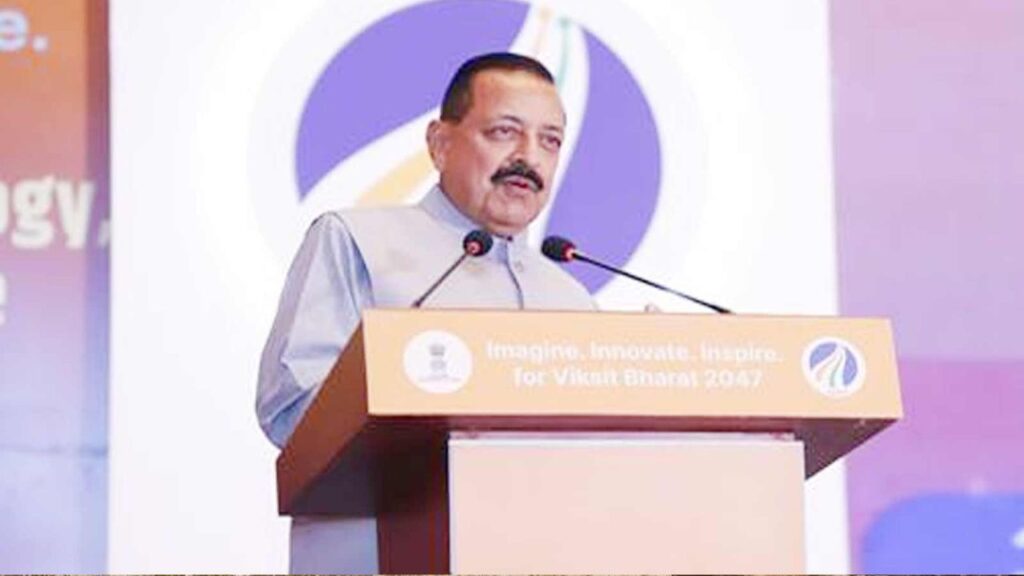

The National Education Policy (NEP) 2020 has transformed India’s education system by promoting aptitude-driven learning, encouraging innovation, and creating equal opportunities for students from smaller towns, Union Minister of State (Independent Charge) for Science & Technology, Dr. Jitendra Singh, said while addressing a two-day hybrid conference organised by Government Degree College (GDC), Doda.
Speaking virtually on the theme “Implementation of the National Education Policy 2020 in Jammu & Kashmir: Challenges of Inclusion, Equity and Accessibility,” the Minister said the policy has dismantled rigid academic structures and empowered students to pursue subjects aligned with their interests and abilities instead of being bound by conventional educational pathways.
Focus Shifts from Degrees to Skills
Dr. Jitendra Singh highlighted that NEP 2020 has redefined the purpose of education by placing greater emphasis on skills, innovation, entrepreneurship and multidisciplinary learning. According to him, the value of education today lies not merely in obtaining a degree but in acquiring capabilities that prepare young people for the rapidly evolving knowledge economy.
He noted that employment aspirations have also undergone a significant transformation. Rather than viewing government jobs as the only career option, students are increasingly exploring entrepreneurship, startups and technology-driven professions.
Doda’s Academic Legacy Recognised
Congratulating Government Degree College, Doda, and its Principal Dr. Javed Iqbal for organising the conference, Dr. Singh described the institution as one of the oldest and most respected centres of higher education in the region. He recalled that for decades students from remote parts of the erstwhile Doda district travelled long distances to pursue higher studies because educational institutions were limited.
The Minister said Doda possesses a rich educational heritage and has the potential to emerge as a major academic hub by expanding educational opportunities and strengthening its existing institutions.
Flexible Learning Encouraging Student Interest
Explaining the impact of NEP 2020, Dr. Singh said the policy has introduced flexibility that allows students to study subjects outside their traditional streams. He shared an example from an institution implementing the policy, where science students voluntarily attended literature classes purely out of academic curiosity.
Such experiences, he observed, demonstrate how the new education framework encourages intellectual exploration, improves classroom engagement and strengthens teacher-student interaction by making learning interest-driven rather than compulsory.
Startup Growth Reflects Changing Mindset
Highlighting India’s expanding entrepreneurial ecosystem, the Minister said the country’s startup landscape has witnessed remarkable growth over the past decade. From around 350 startups in 2014, India now has more than 2.3 lakh startups, making it the world’s third-largest startup ecosystem.
He pointed out that over half of these ventures are being established in Tier-2 and Tier-3 cities, proving that innovation is no longer concentrated in metropolitan centres. This shift, he said, reflects the success of policy reforms that encourage entrepreneurship among young people across the country.
Lavender Revolution Shows Rural Potential
Dr. Jitendra Singh also cited the success of the Lavender Revolution under the CSIR Aroma Mission as an example of how scientific interventions can transform rural economies.
Beginning with limited cultivation in Bhaderwah, lavender farming has expanded across Doda district, the Kashmir Valley and other Himalayan states, generating employment and new business opportunities. He said the initiative has demonstrated that entrepreneurship can flourish in agriculture and allied sectors with the support of science and technology.
Institutions Should Promote Innovation
The Minister encouraged Government Degree College, Doda, to develop incubation facilities focused on Himalayan products, aroma-based industries and wellness enterprises by collaborating with the Ministry of AYUSH, the Jammu & Kashmir AYUSH Department and CSIR’s Aroma Mission.
He also noted that the region is witnessing the establishment of new scientific infrastructure, including a Himalayan laboratory, which could strengthen collaboration among research institutions, academia, startups and industry.
Youth Must Prepare for Viksit Bharat
Dr. Singh urged educational institutions to familiarise students with government initiatives such as the Pradhan Mantri Mudra Yojana and PM Vishwakarma Yojana to help them convert innovative ideas and traditional skills into sustainable livelihoods.
He further observed that improved digital connectivity has enabled students from remote regions to access quality education, prepare for competitive examinations and build successful careers without relocating to major cities.
Calling the present era one of unprecedented opportunity, the Minister said today’s students will lead India during the centenary year of Independence in 2047. He appealed to teachers and academic institutions to nurture young minds with a long-term vision so they emerge as innovators, entrepreneurs, responsible citizens and active contributors to the goal of building a Viksit Bharat.
Also Read: India and Australia Strengthen Traditional Knowledge Protection with TKDL Access Agreement

Author: Shivam
Proficient Writer Contact: [email protected]