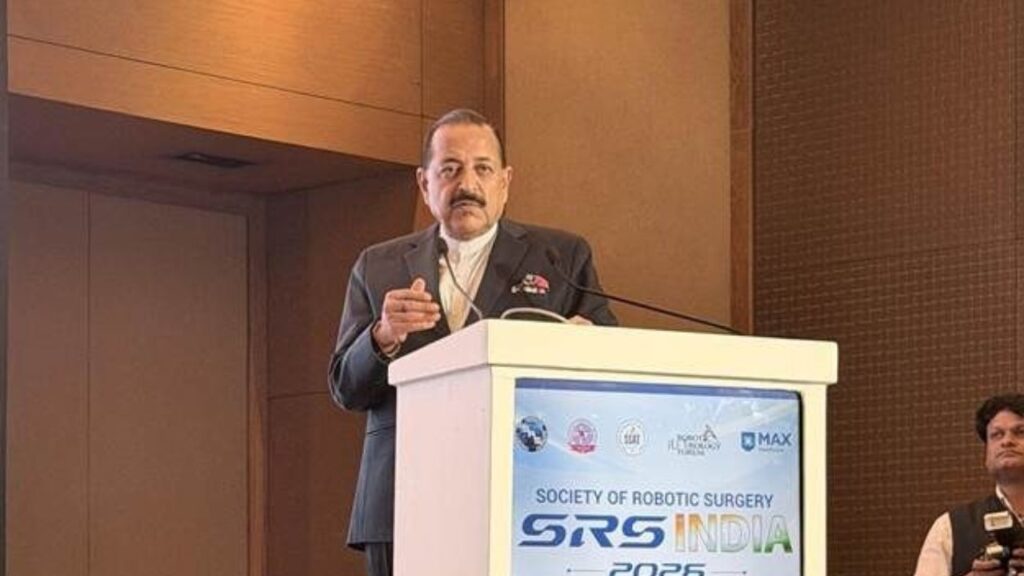

Union Minister of State (Independent Charge) for Science & Technology and Earth Sciences, and MoS in the Prime Minister’s Office, Personnel, Public Grievances, Pensions, Atomic Energy and Space, Dr. Jitendra Singh, has said that robotics is poised to become an important technology across multiple branches of medicine, extending well beyond its current applications in surgery.
Addressing the inaugural session of the International Conference of the Society of Robotic Surgery (SRS India 2026), Dr. Singh said the convergence of robotics with Artificial Intelligence (AI) and nanoscience could help establish a broader ecosystem for precision healthcare and personalised medicine.
According to the Minister, emerging technologies are expected to enable healthcare systems to increasingly consider individual factors such as genetic characteristics, environmental exposure, lifestyle and dietary habits while determining diagnosis and treatment strategies. He emphasised that robotics should not be regarded solely as a surgical technology but as a tool with potential applications throughout the medical field.
While the current focus remains on robotic surgery, Dr. Singh suggested that future developments could lead to areas such as robotic medicine, robotic endocrinology and robotic cardiology. He drew a parallel with AI, which is already being adopted across a wide range of medical specialties.
The Minister said healthcare is entering a new phase driven by frontier technologies, with developments in AI, biotechnology, nuclear medicine and other advanced scientific fields creating new possibilities. He noted that future medical practices could increasingly combine genetically informed diagnostics with innovations in quantum technologies, nanomedicine and robotics.
Highlighting the growing importance of precision medicine, Dr. Singh said patients suffering from the same disease may eventually receive different treatment approaches depending on their individual biological and environmental characteristics. Genetic information, lifestyle and other personal factors could therefore play a greater role in medical decision-making.
Referring to the Genome India Programme, he said genetic sequencing of 10,000 individuals had already been completed. He expressed the possibility of India eventually moving towards genome sequencing of every newborn. Given India’s population scale, he said AI and robotics would be important in handling and utilising such large volumes of genetic information.
Dr. Singh also highlighted the potential of nanomedicine in tackling persistent healthcare challenges. Referring to research related to oral insulin, he explained that developments at the nanoscale could help address some limitations of conventional drug-delivery methods and create new avenues for treatment.
The Minister stressed that India’s geographical diversity and large population make technologies such as AI, robotics and tele-robotics particularly relevant. He shared an example from his experience with robotic ultrasonography, stating that he had conducted an ultrasound examination of a person located approximately 10,000 kilometres away in Antarctica. The example, he said, demonstrated how remotely enabled technologies could expand access to specialised healthcare.
Dr. Singh also outlined how tele-robotics could change the conventional relationship between patients and specialists. Instead of patients travelling long distances to access expert medical care, advanced technologies could enable specialists to provide expertise remotely to people in distant locations.
Discussing India’s changing disease burden, the Minister noted that infectious diseases continue to exist alongside metabolic and lifestyle-related disorders. Conditions traditionally associated with older age are also increasingly being observed among younger populations, creating new challenges for healthcare systems.
He said the country’s healthcare requirements, combined with its size and diversity, make the adoption of advanced technologies increasingly significant. AI and robotics, he added, can act as enabling tools for expanding healthcare delivery while supporting a shift towards precision and personalised medicine.
Dr. Jitendra Singh congratulated the organisers of SRS India 2026 for creating a platform that brings robotic surgery into academic, institutional and professional discussions. He emphasised that embracing emerging technologies will be crucial for keeping pace with the rapid transformation taking place in medical science.
Also Read: Ministry of Textiles Launches Special Campaign 6 with Focus on Cleanliness and E-Waste Management