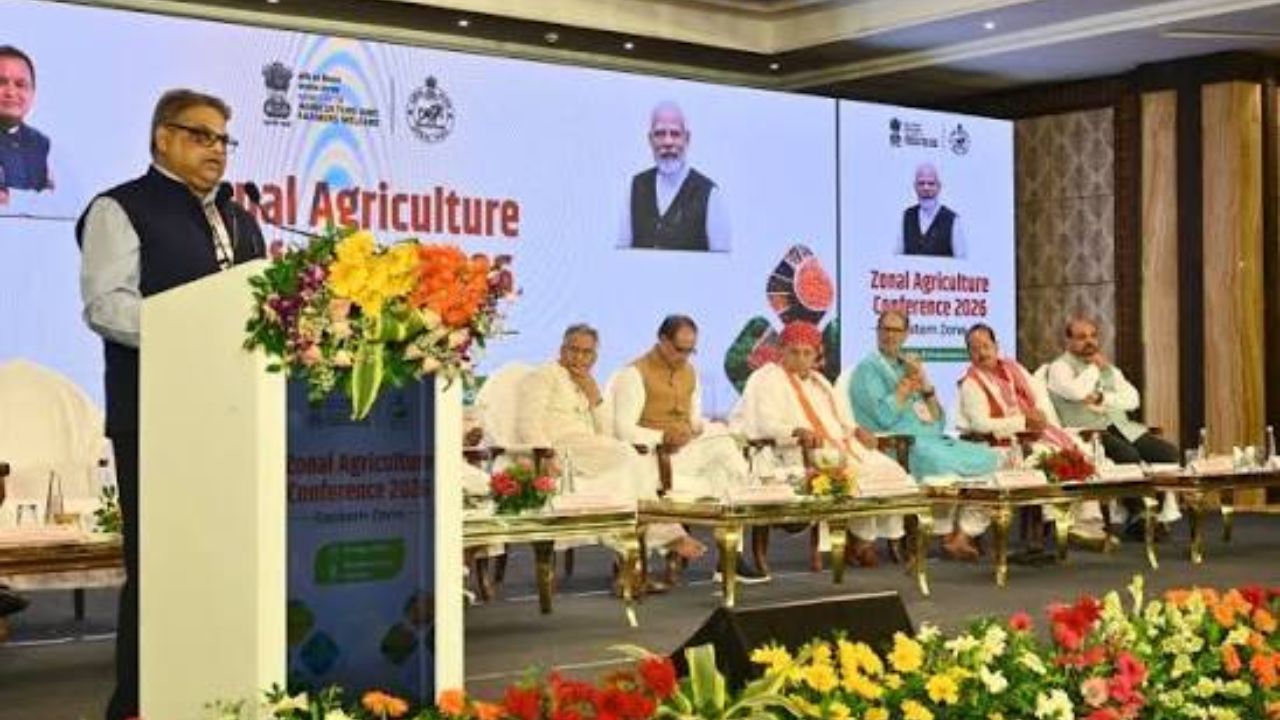

The Department of Agriculture & Farmers Welfare, Government of India, will convene the Zonal Agriculture Conference – South Zone in Hyderabad on September 18, bringing together policymakers, state governments, agricultural institutions, experts, farmers and other stakeholders to discuss priorities for strengthening the agriculture sector across southern India.
The conference will provide a platform for the Centre, participating States and Union Territories to review emerging agricultural challenges and exchange experiences on successful initiatives. Union Minister for Agriculture & Farmers Welfare Shri Shivraj Singh Chouhan will attend the event, along with Ministers of State Shri Ram Nath Thakur and Shri Bhagirath Choudhary.
Senior ministers and officials from Telangana, Andhra Pradesh, Karnataka, Kerala and Tamil Nadu, as well as the Union Territories of Andaman & Nicobar Islands, Puducherry and Lakshadweep, are also expected to participate. Representatives from ICAR institutions, agricultural experts, progressive farmers and other stakeholders will contribute to the discussions.
A major focus of the conference will be the expansion of Digital Agriculture and Farmer Registry initiatives. The discussions are expected to examine how digital systems can improve farmer services, strengthen agricultural databases and support more efficient delivery of government programmes.
The conference will also place emphasis on high-value horticulture and value addition, with discussions aimed at improving productivity, processing, storage, marketing and income opportunities for farmers. Strengthening the infrastructure needed to reduce post-harvest losses and enhance the value of agricultural produce will form an important part of the deliberations.
Another key priority will be achieving greater self-reliance in edible oils and pulses. The participating States will discuss strategies for improving domestic production, strengthening supply chains and encouraging farmers to adopt suitable technologies and production practices.
The meeting will additionally address natural farming and integrated farming systems, which can support resource-efficient agricultural production while diversifying farm-based livelihoods. Participants are also expected to deliberate on balanced fertilizer management and measures to prevent the circulation and use of spurious pesticides and fertilizers, which can adversely affect farm productivity, soil health and farmer incomes.
An important feature of the conference will be the presentation of state-level innovations and best practices. Telangana will showcase its Rythunestham initiative, while Andhra Pradesh will highlight its approach to managing weather variability and its implications for farmers.
Karnataka is expected to present improved practices for pulse production, offering insights that could potentially be adapted in other pulse-growing regions. Kerala will share its experiences in procurement and marketplace initiatives, while Tamil Nadu will highlight developments in precision farming and high-tech agriculture.
The exchange of these experiences is intended to facilitate wider adoption and replication of successful approaches suited to local conditions. By bringing different stakeholders together, the conference will also provide an opportunity to identify implementation challenges and explore coordinated solutions.
The South Zone meeting is expected to contribute to stronger Centre-State coordination in agricultural planning and programme implementation. It will seek to develop focused strategies around agricultural self-reliance, high-value horticulture, digital transformation and climate-resilient farming.
Strengthening the supporting agricultural ecosystem will also remain a priority, particularly in areas such as storage, processing, value addition and marketing. Better infrastructure in these areas can help farmers secure improved market access and derive greater value from their produce.
The Hyderabad conference is therefore expected to serve as a platform for aligning national agricultural priorities with the specific requirements and innovations of southern States and Union Territories. The deliberations and exchange of best practices will aim to support a more resilient, technology-enabled and economically sustainable agricultural sector.
Also Read: Designer Atelier Exhibition Showcases India’s Textile Heritage and Contemporary Fashion

Author: Shivam
Shivam Dwivedi is a senior journalist with extensive experience in research-driven journalism, policy communication, and multi-platform storytelling. His areas of interest include international relations, defence, science & technology, education, urban development, agriculture, spirituality, and environmental sustainability. His work focuses on in-depth analysis, public discourse, and impactful narratives across governance and development sectors, with a strong commitment to the Sustainable Development Goals (SDGs). Contact: [email protected]