
In a breakthrough that could reshape the future of photonics and semiconductor technologies, researchers from Bengaluru have demonstrated for the first time that the optical behaviour of a metal can be actively controlled through mechanical strain. The discovery overturns a long-standing assumption in physics that the optical properties of metals remain fixed once their composition is determined.
The study, led by scientists at the Jawaharlal Nehru Centre for Advanced Scientific Research (JNCASR), an autonomous institute under the Department of Science and Technology (DST), offers a new strategy for designing reconfigurable optical devices that can be integrated into existing semiconductor manufacturing processes.
A New Dimension in Plasmonics
The research focuses on plasmon resonance, a phenomenon in which metals confine and amplify light into dimensions much smaller than its wavelength. This unique capability is central to a wide range of advanced technologies, including ultra-sensitive biosensors, cancer diagnostic tools, nanoscale photonic circuits and next-generation optical components.
Traditionally, the plasma frequency—a key factor determining plasmonic behaviour—has been regarded as an intrinsic property dictated by the metal’s free-electron concentration. Scientists have previously relied on nanostructuring techniques or dielectric engineering to indirectly influence plasmonic performance, but directly altering plasma frequency through mechanical deformation had remained largely unexplored.
The latest findings challenge this conventional understanding by proving that mechanical strain can directly influence the electronic properties of a metal, thereby modifying its interaction with light.
Titanium Nitride at the Centre of the Discovery
To investigate the effect of strain, the JNCASR team selected ultrathin epitaxial films of titanium nitride (TiN), a material known for combining gold-like plasmonic performance with exceptional thermal and chemical stability. TiN is also fully compatible with complementary metal-oxide-semiconductor (CMOS) fabrication, making it particularly attractive for future electronic and photonic devices.
The researchers fabricated two identical TiN films, each only 10 nanometres thick. One film was grown on a magnesium oxide substrate, leaving it free of mechanical strain. The second film was deposited over an aluminium scandium nitride buffer layer that introduced controlled tensile strain due to differences in crystal lattice dimensions.
This carefully designed experiment enabled the scientists to isolate the influence of strain while keeping all other material characteristics unchanged.
High-Resolution Measurements Reveal Significant Shift
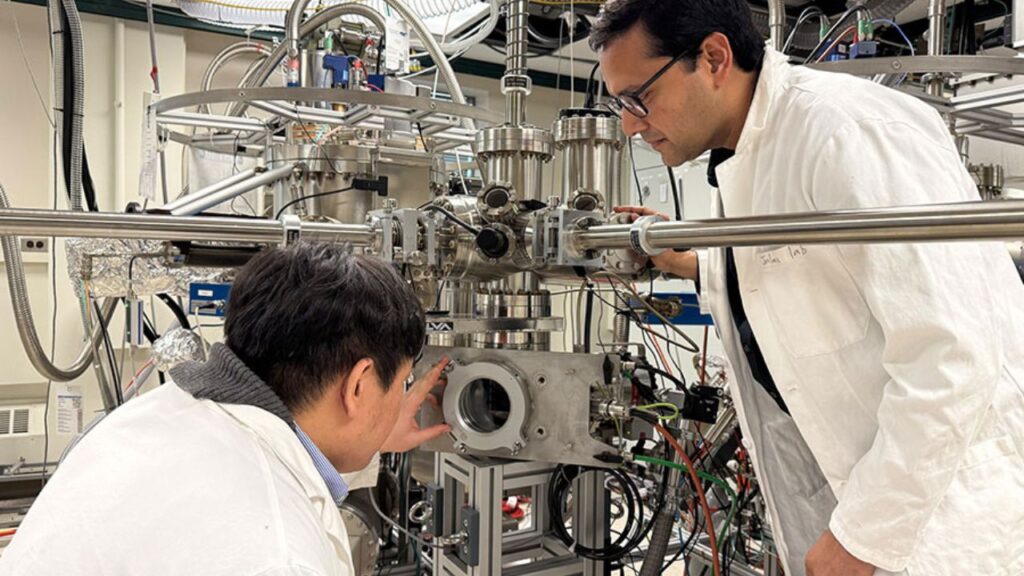
Using electron energy loss spectroscopy (EELS) within a scanning transmission electron microscope, the research team mapped plasmon resonance with near-atomic precision across both films.
The strained TiN film displayed a clear blue shift in plasmon resonance energy, measuring between 0.30 and 0.45 electron volts compared to the unstrained sample. Importantly, the magnitude of this shift closely followed the local distribution of strain within the material.
Both screened and unscreened plasmon modes exhibited similar behaviour, providing compelling evidence that mechanical strain directly alters the metal’s intrinsic electronic response rather than producing secondary effects.
Theory Confirms the Experimental Results
To uncover the underlying mechanism, the researchers performed advanced density functional theory (DFT) simulations.
The calculations revealed that tensile strain lowers the energy required to create nitrogen vacancies within the TiN crystal structure. These vacancies contribute additional free electrons, increasing the electron concentration responsible for plasmonic behaviour. As a result, the plasma frequency rises, producing the experimentally observed blue shift.
The proposed mechanism received further validation through spectroscopic ellipsometry and high-resolution X-ray diffraction analyses, both of which supported the theoretical predictions.
Towards Reconfigurable Optical Technologies
According to Prof. Bivas Saha, Associate Professor at JNCASR and the study’s corresponding author, the discovery introduces a powerful new way to control plasmonic materials.
He noted that mechanical strain can serve as an effective tuning mechanism for the optical properties of CMOS-compatible metals such as titanium nitride. This capability could transform plasmonics from a static technology into an active and programmable platform suitable for dynamic photonic systems.
The advancement could enable future optical devices whose behaviour can be adjusted even after fabrication, opening possibilities for adaptive photonic circuits, tunable metasurfaces, smart optical sensors, and energy-efficient on-chip communication technologies.
International Collaboration Strengthens the Research
The study was led by Diksha Dadhich and colleagues in Prof. Saha’s research group at JNCASR. The work also involved contributions from Dr. Magnus Garbrecht, Vijay Bhatia, and Ashalatha Indiradevi Kamalasanan Pillai from the University of Sydney, Australia, highlighting the value of international collaboration in advancing materials science.
The findings represent a significant milestone in plasmonics research and may pave the way for a new generation of mechanically programmable optical materials. By demonstrating that strain can directly manipulate a metal’s electronic and optical properties, the researchers have expanded the toolkit available for designing future photonic and semiconductor technologies, with potential applications spanning telecommunications, sensing, computing, and healthcare.

Author: Shivam
Shivam Dwivedi is a senior journalist with extensive experience in research-driven journalism, policy communication, and multi-platform storytelling. His areas of interest include international relations, defence, science & technology, education, urban development, agriculture, spirituality, and environmental sustainability. His work focuses on in-depth analysis, public discourse, and impactful narratives across governance and development sectors, with a strong commitment to the Sustainable Development Goals (SDGs). Contact: [email protected]