
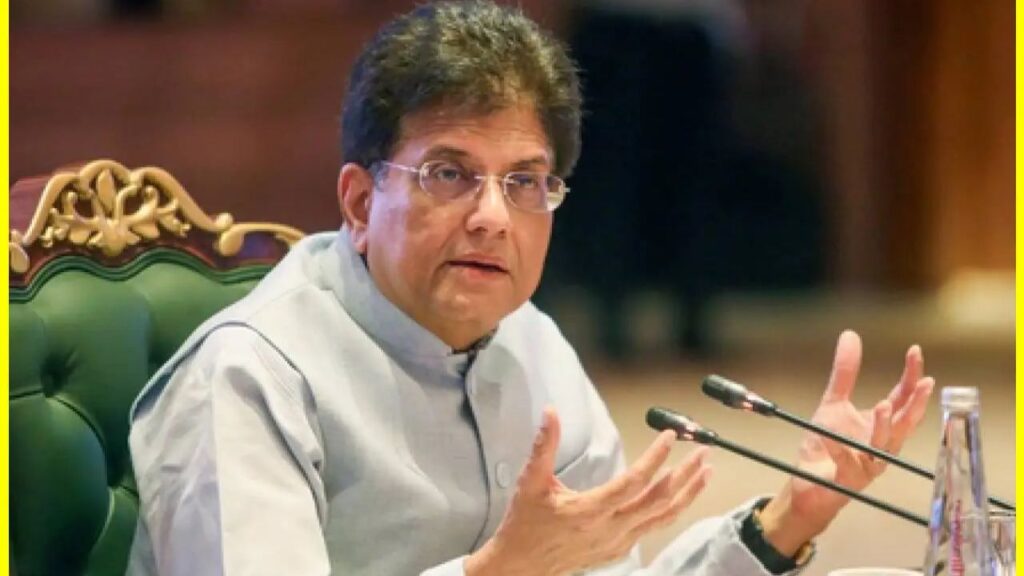

Union Minister of Commerce and Industry Piyush Goyal has underscored the transformative potential of technology-enabled bilingual education, stating that it can bridge the rural-urban divide and make high-quality management education accessible to students from diverse socio-economic backgrounds. Addressing the inauguration of the Indian Institute of Management (IIM) Udaipur’s newly launched online bilingual Bachelor of Business Administration (BBA) programme virtually from New Delhi, the Minister described the initiative as a significant step towards democratizing management education in India.
The online BBA programme, offered in both Hindi and English, has been designed to make IIM-quality education more accessible to students who may face geographical, linguistic or financial barriers. Goyal said the bilingual format would allow a wider section of aspiring learners to benefit from the credibility and academic excellence associated with the IIM brand.
Highlighting India’s expanding digital ecosystem, the Minister noted that the country now has nearly 100 crore internet users, creating an unprecedented opportunity to deliver quality education through digital platforms. He said virtual learning aligns with the objectives of the National Education Policy (NEP), which promotes flexibility, accessibility and the integration of technology into higher education.
According to Goyal, the programme has the potential to reach students from remote regions, enabling aspiring managers from small towns and rural areas to access world-class education using smartphones, laptops or computers. While the teaching will be conducted online, he emphasized that examinations will be held offline to maintain academic integrity and accountability.
The Minister also offered four key recommendations to further strengthen the programme. First, he suggested incorporating regular physical interactions into the hybrid model by organizing monthly faculty visits and regional student meetups. Such engagements, he said, would foster peer learning, networking and interpersonal development, which are essential aspects of management education.
His second recommendation focused on enhancing soft skills alongside academic learning. Goyal stressed the importance of communication abilities, teamwork, cultural awareness, technological proficiency and interpersonal skills, describing them as critical competencies for future business leaders operating in an increasingly global environment.
Third, the Minister advocated greater emphasis on experiential learning. He proposed that students be given opportunities to visit factories, ports, industrial clusters and other business establishments to gain practical exposure to real-world management challenges. Such industry interactions, he said, would complement classroom instruction and improve students’ professional readiness.
His fourth suggestion involved adopting international best practices in management education. Goyal encouraged IIM Udaipur to leverage advanced digital tools, audio-visual learning resources and the credit transfer provisions introduced under the National Education Policy. He also recommended collaborations with reputed national and international institutions for joint academic programmes and highlighted the value of research internships during the fourth year of study to strengthen students’ analytical and research capabilities.
Speaking about India’s growing global engagement, the Minister urged students to prepare themselves for opportunities emerging from the country’s expanding network of free trade agreements. He said India’s manufacturing sector is receiving fresh momentum through these agreements, while innovation and entrepreneurship are becoming increasingly important drivers of economic growth. Students, he noted, should combine academic learning with practical exposure to remain competitive in the evolving global marketplace.
Reflecting on the changing educational landscape, Goyal observed that although the COVID-19 pandemic created numerous challenges, it also accelerated the adoption of digital learning technologies. He said the rapid growth of the EdTech sector during the pandemic demonstrated how technology can effectively connect learners across villages and cities, reducing educational disparities.
The Minister further highlighted how artificial intelligence and other emerging technologies are reshaping management education and employment. As business requirements continue to evolve rapidly, he said educational institutions must embrace dynamic learning approaches that equip students with contemporary skills rather than relying solely on conventional teaching methods.
Drawing a comparison with India’s international trade negotiations, Goyal noted that virtual collaboration across multiple time zones has become an effective tool for conducting complex discussions efficiently. He expressed confidence that IIM Udaipur’s hybrid model, combining online instruction with selected offline engagements, would successfully prepare students for the modern business environment.
Concluding his address, Goyal praised the global reputation of the Indian Institutes of Management, stating that the IIM brand is respected in corporate boardrooms across the world. He expressed confidence that the inaugural batch of the bilingual online BBA programme would create history by demonstrating how technology, accessibility and quality education can together shape the next generation of business leaders and entrepreneurs in India’s journey towards becoming a developed nation.

Author: Shivam
Proficient Writer Contact: [email protected]