
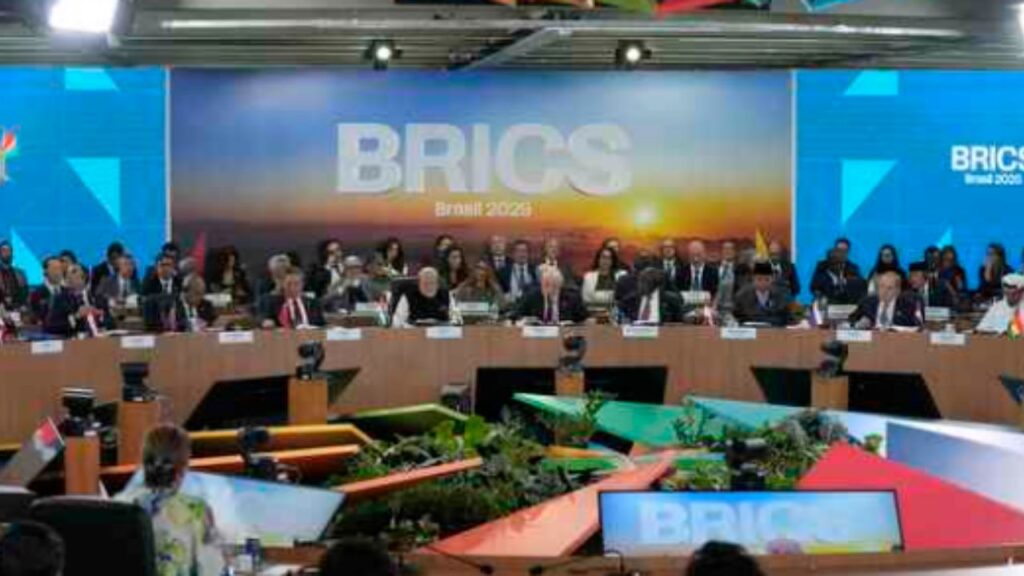

As part of India’s BRICS Presidency 2026, the Indian National Science Academy (INSA) successfully hosted the inaugural meeting of the BRICS Science Academies Forum 2026, bringing together scientific leaders from ten BRICS member and partner nations to discuss the transformative role of Artificial Intelligence (AI) in sustainable development. The virtual meeting was held under the theme “Harnessing Artificial Intelligence for Sustainable Development and Strengthening Global South Cooperation.”
The forum marked a significant step toward strengthening scientific collaboration among BRICS nations and advancing a shared vision for responsible, inclusive, and equitable AI development. Representatives from Brazil, China, Egypt, Ethiopia, Indonesia, Russia, South Africa, Belarus, Nigeria, and Vietnam participated in the discussions, contributing recommendations for a joint declaration on AI-driven scientific progress.
Moderated by Prof. Debashis Mitra, Vice President (International), INSA, the meeting focused on developing a comprehensive framework that addresses the opportunities and challenges associated with AI adoption across developing nations. Prof. Mitra highlighted that the forum forms a key component of India’s BRICS Presidency agenda, which is guided by the theme “Building for Resilience, Innovation, Cooperation and Sustainability.”
A major outcome of the meeting was the review and strengthening of a draft declaration on AI for science and sustainable development. The declaration seeks to promote equitable access to AI technologies while reducing the growing technological divide between developed and developing countries. It emphasizes the need for AI to serve as a catalyst for scientific innovation in fields such as healthcare, climate science, engineering, materials research, and drug discovery.
Presenting the draft declaration, Prof. Ambuj Sagar of IIT Delhi highlighted concerns over the uneven distribution of AI resources and capacities worldwide. He stressed the importance of ensuring that AI-driven advancements benefit countries across the Global South and contribute to inclusive development.
The discussions revealed broad consensus on several priority areas for collaboration. Participating academies endorsed the creation of shared computing infrastructure, collaborative data platforms, multilingual AI models, and open-source scientific resources. They also supported initiatives aimed at improving researcher mobility, developing joint task forces, and expanding international training programs to strengthen AI capabilities.
Country representatives provided diverse perspectives reflecting their national priorities. China emphasized the need for AI readiness benchmarks, open scientific data-sharing systems, and robust mechanisms to address bias and reliability in AI applications. Egypt highlighted AI’s potential to improve food security, healthcare, education, energy systems, and climate resilience, while calling for greater investment in research and capacity building.
Indonesia underlined AI’s role in disaster risk reduction and climate adaptation, particularly in strengthening early warning systems and promoting sustainable agriculture. Ethiopia advocated stronger cooperation in cybersecurity, digital safety, and combating cross-border cybercrime. Vietnam proposed establishing thematic working groups and shared digital public infrastructure to bridge skill gaps and accelerate innovation.
Nigeria stressed the importance of AI in governance and scientific advancement, while South Africa supported open-source AI models and raised concerns about affordability and the inclusion of social science perspectives. Belarus highlighted the need for responsible AI deployment, particularly in healthcare and cybersecurity.
Summarizing the discussions, Prof. Anurag Agrawal, Vice-President (Science Policy), INSA, identified common priorities that emerged across the forum. These included technology sovereignty, energy-efficient data centers, human resource development, multilingual AI systems, and open data ecosystems. Participants also noted the value of smaller, specialized AI models for critical sectors where reliability and precision are essential.
The forum further emphasized that ethical governance, transparent data-sharing practices, and the integration of humanities and social sciences are crucial for building trustworthy AI systems. Experts agreed that technological progress must be accompanied by strong regulatory and ethical frameworks.
Looking ahead, the recommendations from the virtual meeting will be incorporated into a revised draft declaration. The second in-person meeting of the BRICS Science Academies Forum is scheduled to take place at IIT Hyderabad on July 22–23, 2026, where participating nations are expected to finalize the declaration and chart a roadmap for future cooperation.
The meeting also witnessed active participation from CSIR–NIScPR, which contributed to discussions on scientific information policy and technology-driven development. The forum reinforced BRICS’ commitment to leveraging AI as a tool for sustainable growth, scientific innovation, and stronger South-South cooperation in the years ahead.

Author: Shivam
Proficient Writer Contact: [email protected]