
The North Eastern Region has witnessed a significant expansion in scientific infrastructure over the past decade, with the Centre focusing on technology-driven development, disaster preparedness and rural innovation. Union Minister of State (Independent Charge) for Science & Technology and Earth Sciences, Dr. Jitendra Singh, said the transformation reflects the government’s sustained commitment to strengthening scientific capabilities in a region that had long remained underserved despite its strategic importance.
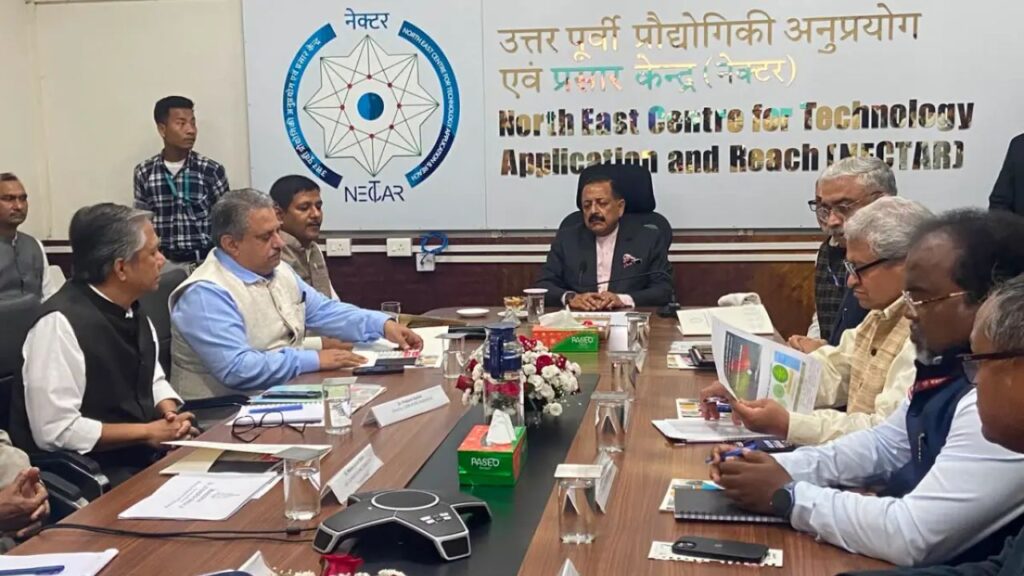
Chairing a comprehensive review meeting of institutions under the Department of Science and Technology (DST) at the North East Centre for Technology Application and Reach (NECTAR) in Shillong, the minister highlighted the remarkable progress made in expanding weather monitoring, seismic observation and advanced technology facilities across the region.
Weather and disaster monitoring receive major upgrade
Dr. Singh pointed out that before 2014, the entire North East had only two weather radars, including one in Meghalaya, despite the region being prone to heavy rainfall and natural disasters. Today, that number has increased to 13 weather radars, greatly improving weather forecasting and disaster preparedness.
Similarly, the number of seismological observatories has more than doubled from 84 to 171, strengthening earthquake monitoring in one of India’s most seismically active regions. The establishment of specialised lightning detection stations in Meghalaya and Tripura has further enhanced the region’s ability to issue timely weather alerts and improve public safety.
According to the minister, these initiatives demonstrate how scientific infrastructure is becoming an integral part of disaster resilience and sustainable regional development.
NECTAR bridges laboratory research with grassroots needs
During the review meeting, heads of various DST institutions presented updates on ongoing research, innovation projects and technology outreach programmes in the North East.
Dr. Singh praised NECTAR for ensuring that scientific innovations move beyond laboratories to directly benefit farmers, entrepreneurs, students and rural communities. He said the institution has emerged as an effective platform for translating research into practical technologies that improve livelihoods and create economic opportunities.
The minister also interacted with scientists, researchers, beneficiary farmers and students while visiting several of NECTAR’s technology facilities.
Mobile food processing unit supports farmers
One of the highlights of the visit was the demonstration of the Mobile Food Processing Unit (MPU), jointly developed by NECTAR and the CSIR-Central Food Technological Research Institute.
Describing it as a “processing on wheels” initiative, Dr. Singh said the mobile facility enables food processing technologies to reach farmers directly at their farms. The system allows small and marginal farmers to add value to their produce, improve product quality and access new income opportunities without requiring large processing infrastructure.
The initiative is expected to strengthen rural entrepreneurship while reducing post-harvest losses across the region.
Technology transforms agriculture and education
Reviewing projects under the PM-DevINE programme, the minister appreciated the establishment of the Vasundhara Soil Organic Carbon Detection Laboratory-cum-Manufacturing Unit using technology transferred from the Bhabha Atomic Research Centre (BARC).
The laboratory provides scientific soil testing and recommendations that help farmers improve soil health and productivity. Around 2,500 farmers have already received soil testing kits, with the initiative expected to create a comprehensive soil health database for the North East.
Dr. Singh also visited NECTAR’s STEM Education Laboratory, where students receive hands-on exposure to robotics, artificial intelligence, coding and 3D printing. Since becoming operational in January 2025, the laboratory has generated strong interest among school students.
In collaboration with IIT Kanpur, NECTAR is establishing 50 STEM laboratories across five North Eastern states, a programme expected to benefit nearly 25,000 students, particularly those living in remote areas.
Advanced geospatial technologies strengthen regional development
The minister inaugurated NECTAR’s new Geo-Informatics Laboratory, equipped with advanced drones, LiDAR and hyperspectral imaging systems, high-performance computing facilities and specialised geospatial software.
The laboratory has already completed projects covering more than 2,000 square kilometres in areas including forest carbon assessment, biodiversity conservation, mining restoration and disaster management. Drone-based mapping has also supported over 700 villages under the SVAMITVA Scheme and scientific organic farming projects involving nearly 25,000 farmers.
Building skills for the future
Dr. Singh highlighted NECTAR’s growing role in developing skilled manpower for emerging technologies. The centre has trained 569 drone technicians, 247 GIS and remote sensing professionals, 107 certified drone pilots and more than 4,500 students in advanced technology disciplines.
These programmes have also generated livelihood opportunities for over 190 young people in the North East while supporting India’s Drone Mission and the vision of an Atmanirbhar Bharat.
Expressing satisfaction over the progress of NECTAR’s permanent campus at New Shillong, the minister said the upcoming facility would further strengthen research, innovation, technology incubation and capacity building. He expressed confidence that NECTAR would continue evolving into a national hub for geospatial science, drone technology, artificial intelligence and technology-enabled rural development, contributing to the vision of Viksit Bharat @2047.

Author: Shivam
Shivam Dwivedi is a senior journalist with extensive experience in research-driven journalism, policy communication, and multi-platform storytelling. His areas of interest include international relations, defence, science & technology, education, urban development, agriculture, spirituality, and environmental sustainability. His work focuses on in-depth analysis, public discourse, and impactful narratives across governance and development sectors, with a strong commitment to the Sustainable Development Goals (SDGs). Contact: [email protected]