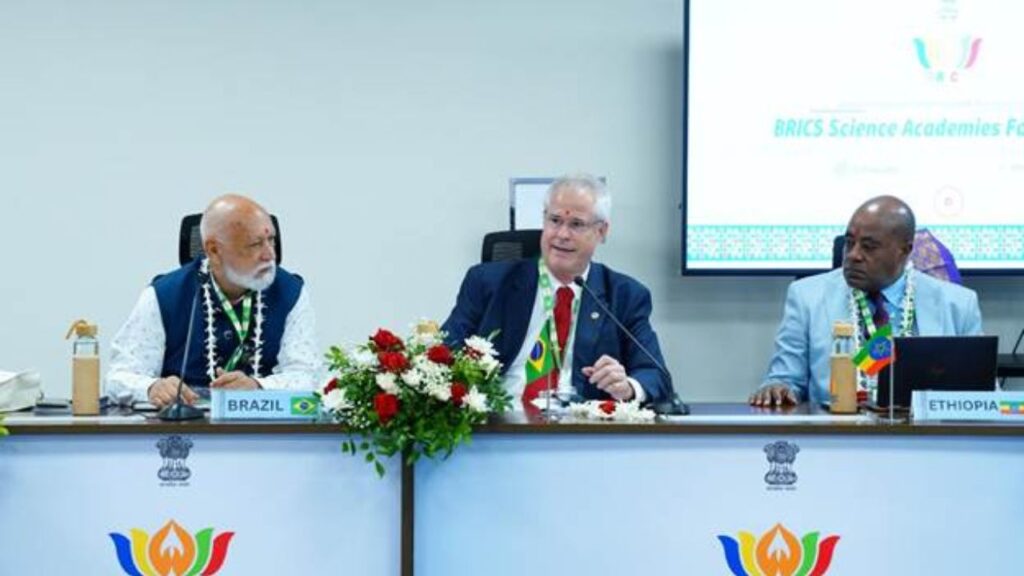

The BRICS Science Academies Forum Meeting 2026 began at the Indian Institute of Technology (IIT) Hyderabad with a strong focus on leveraging Artificial Intelligence (AI) for sustainable development and strengthening scientific cooperation among countries of the Global South. Held under the theme “Harnessing Artificial Intelligence for Sustainable Development and Strengthening Global South Cooperation,” the forum brought together representatives from BRICS member and partner nations to discuss strategies for responsible, inclusive and collaborative AI development.
The meeting highlighted the importance of the 3C approach — Collective, Collaborative and Context-sensitive Artificial Intelligence solutions — aimed at ensuring that AI technologies address diverse socio-economic and developmental challenges faced by nations.
Representatives from eight BRICS member countries — Brazil, China, Egypt, Ethiopia, Indonesia, Russia and South Africa — along with five partner countries including Nigeria, Vietnam, Belarus, Kazakhstan and Malaysia, participated in discussions on building stronger scientific partnerships through AI.
Emphasis on Ethical and Inclusive Artificial Intelligence
Delivering the presidential address of the host academy, Indian National Science Academy (INSA), Prof. Shekhar Mande highlighted the potential of AI in addressing critical global challenges, particularly those affecting developing nations. He stressed that AI systems must be designed to remain ethical, transparent, inclusive and accessible across different sections of society.
Dr. Debashis Mitra, Vice President (International Affairs), INSA, underlined the need for greater international scientific collaboration to address emerging challenges through shared knowledge and innovation. Prof. B. S. Murty, Director of IIT Hyderabad, showcased the institute’s various AI-related initiatives and programmes during the institutional address.
Five Key Areas Identified for AI Cooperation
The forum identified five major sectors where AI-driven interventions could create significant impact:
Advanced Materials and Manufacturing: AI can accelerate materials discovery, improve manufacturing processes, enhance automation and optimize global supply chains.
Healthcare: Discussions focused on AI applications in clinical decision-making, large-scale health screening, disease research and improving healthcare delivery.
Climate Change and Environmental Sustainability: Participants highlighted AI’s role in improving climate forecasting, combining artificial intelligence with scientific models and strengthening disaster risk mitigation strategies.
Agriculture and Food Security: Delegates discussed AI-powered farmer advisories, advanced seed research and the use of digital public infrastructure to improve agricultural productivity and food security.
Disaster Prediction and Management: AI-based forecasting systems, seismic analysis and emergency resource management were identified as important areas for cooperation.
Global Perspectives on AI Development
During the forum, participating science academies shared their national priorities and approaches towards AI. The Brazilian Academy of Sciences emphasized the use of inclusive AI solutions for healthcare, climate resilience and food security. The Chinese Academy of Sciences highlighted the importance of data sharing, validation mechanisms and evidence-based policymaking aligned with Sustainable Development Goals (SDGs).
Egypt’s Academy of Scientific Research and Technology called for greater capacity building and the establishment of a BRICS AI Network, while Ethiopia emphasized preserving linguistic diversity, improving cybersecurity and expanding AI education.
The Indonesian Academy of Sciences highlighted the need for explainable AI systems and addressing ethical concerns, while Russia stressed the development of trusted AI frameworks supported by strong institutional mechanisms. South Africa focused on reducing the digital divide and using AI to tackle challenges related to climate, health and food security.
Partner nations also contributed their perspectives. Nigeria stressed ethical AI and data-driven planning, Vietnam raised concerns regarding employment impacts, local data management and environmental challenges, Belarus highlighted applications in telemedicine and data security, and Kazakhstan emphasized technology accessibility and support for young researchers.
Focus on AI, Green Energy and Future Cooperation
The second day of the forum featured discussions on AI applications in scientific research, materials innovation and sustainable energy solutions. Prof. Indranil Manna, Vice President (Science & Society), INSA, discussed how AI can support materials discovery through data analysis, pattern recognition and predictive modelling.
Dr. Ashish Lele, Director of CSIR-National Chemical Laboratory (CSIR-NCL), highlighted the connection between AI and green hydrogen technologies. He discussed India’s energy transition plans, the role of the National Green Hydrogen Mission and the importance of reducing emissions in logistics and digital infrastructure.
A major highlight of the concluding session was the discussion on the Joint Statement, chaired by Prof. Shekhar C. Mande. Representatives from participating science academies deliberated on a common roadmap for AI cooperation, with the consensus communiqué expected to be endorsed and presented during the upcoming BRICS Science, Technology and Innovation (STI) Ministerial Meeting in August 2026.
Strengthening Science-Led Development
Addressing the closing session, Shri Shambhulingappa Hakki, Joint Secretary (MER & G20) and BRICS Sous Sherpa, emphasized that science remains a crucial foundation for achieving Sustainable Development Goals and developing evidence-based policies.
The forum concluded with a vote of thanks by Dr. Brajesh Pandey, Executive Director, INSA, who acknowledged the contributions of participating academies, delegates, speakers, IIT Hyderabad, the Ministry of External Affairs and the INSA team in successfully organizing the event.
The BRICS Science Academies Forum 2026 reaffirmed the commitment of participating nations to develop human-centric AI solutions and strengthen scientific partnerships to address shared global challenges.

Author: Shivam
Shivam Dwivedi is a senior journalist with extensive experience in research-driven journalism, policy communication, and multi-platform storytelling. His areas of interest include international relations, defence, science & technology, education, urban development, agriculture, spirituality, and environmental sustainability. His work focuses on in-depth analysis, public discourse, and impactful narratives across governance and development sectors, with a strong commitment to the Sustainable Development Goals (SDGs). Contact: [email protected]