
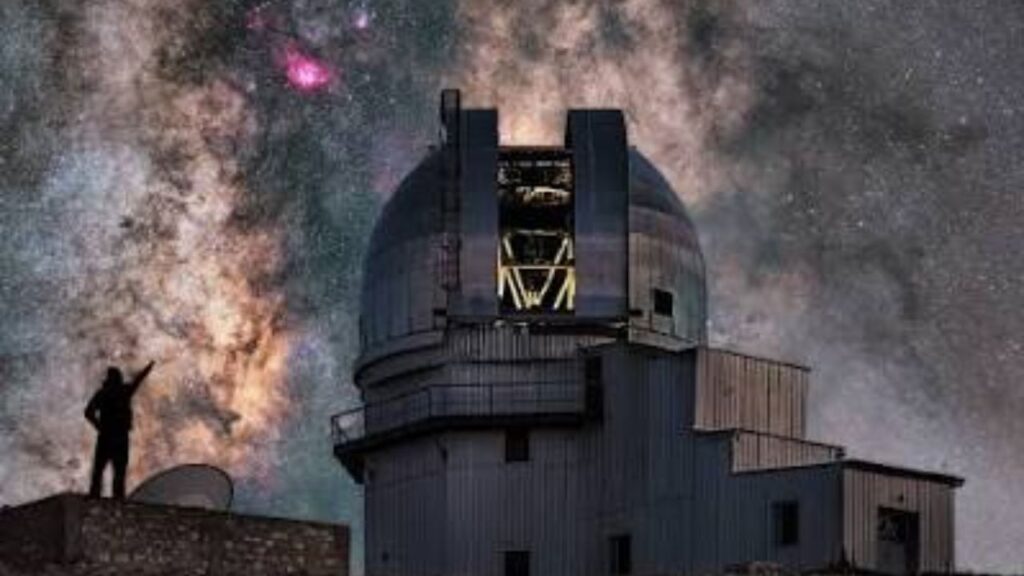

India’s iconic 2-m Himalayan Chandra Telescope (HCT) at Hanle in Ladakh has completed 25 years of successful scientific operations, marking a significant milestone in the country’s journey in optical and infrared astronomy. A three-day conference was organised to celebrate the telescope’s remarkable contribution, highlighting its history, technological achievements, scientific discoveries, engineering challenges, and future expansion plans.
The event brought together astronomers, researchers, and users of the HCT from across the country to discuss the telescope’s scientific legacy and the future of astronomical research in India.
Addressing the inauguration ceremony virtually, Prof. Umesh Waghmare, Secretary, Department of Science and Technology (DST), emphasised the importance of strengthening Hanle’s capabilities following the announcement of an upgraded Himalayan Chandra Telescope in the Union Budget. He described Hanle as India’s premier high-altitude astronomical facility that has played a crucial role in training generations of astronomers.
Prof. Waghmare appreciated the efforts of the Indian Institute of Astrophysics (IIA) in operating and maintaining the world-class facility under extremely challenging environmental conditions at the high-altitude desert of Ladakh.
The HCT has a unique operational model, as it has been remotely controlled in real time from the IIA campus at Hosakote near Bengaluru since June 2001 through a dedicated INSAT-3B satellite communication link provided by ISRO. Located at an altitude of 4,517 metres above sea level, the Hanle site offers more than 250 useful observing nights annually, extremely low atmospheric moisture levels, and exceptionally clear skies, making it ideal for optical and near-infrared astronomy.
According to Prof. Annapurni Subramaniam, Director of IIA, the telescope achieved its first scientific success in 2001 with research on the optical afterglow of a gamma-ray burst. Since then, the facility has contributed extensively to several important areas of astronomical research.
Former ISRO Chairman and Chairperson of the IIA Governing Council, Dr. S. Somanath, highlighted the major scientific achievements made using HCT, including studies on supernovae, stellar spectroscopy, and exoplanets.
During the conference, around 70 HCT users presented their research findings and discussed future developments in astronomy. A special session held on July 28 focused on the telescope’s journey, its achievements, and recognition of individuals involved in establishing and operating the observatory. A coffee table book documenting the history of HCT and a working model of the telescope were also unveiled.
Journey from Vision to Reality
The establishment of an optical telescope in the trans-Himalayan region was a long-standing ambition of India’s astronomical community. Following recommendations from a panel constituted by the Planning Commission, the Indian Institute of Astrophysics was selected in 1989 as the nodal agency to identify suitable locations for optical and infrared observatories.
Beginning in 1993, astronomers surveyed six Himalayan locations before selecting Digpa Ratsa Ri in Hanle, Ladakh, as the ideal site. The region was chosen because of its clear skies, minimal light pollution, low atmospheric water vapour, and protection from monsoon clouds due to the Himalayan ranges.
The foundation stone of the Indian Astronomical Observatory was laid in 1997. The telescope achieved its first light on September 26, 2000, and was dedicated to the nation in August 2001. It was named the Himalayan Chandra Telescope in honour of Nobel Prize-winning physicist Subrahmanyan Chandrasekhar.
Expanding India’s Astronomical Capabilities
Over the years, HCT has hosted advanced instruments including the Himalayan Faint Object Spectrograph Camera (HFOSC), the near-infrared spectrometer and imager uTIRSPEC, and the High Resolution Spectrograph (HESP).
The telescope has supported research on planets, asteroids, stars, galaxies, and other celestial objects. Major scientific contributions include studies of comet spectroscopy, exoplanet atmospheres, star-forming regions, variable stars, binary systems, supernovae, galaxies, and active galactic nuclei.
Hanle has also emerged as a major astronomy hub, hosting several other facilities such as the GROWTH-India Telescope developed with IIT Bombay, gamma-ray telescopes MACE and HAGAR operated with BARC and TIFR, and various atmospheric research instruments.
The recently established Hanle Dark Sky Reserve aims to protect the region’s naturally dark skies and support future astronomical projects.
Looking ahead, India plans to significantly expand its astronomical infrastructure at Hanle. The Union Budget announcement of the 3.7-m upgraded Himalayan Chandra Telescope and the 13.7-m National Large Optical-Infrared Telescope, to be led by IIA, is expected to strengthen India’s position in global astronomy.
With decades of experience gained from HCT, these upcoming facilities are set to open new frontiers in scientific research and establish Hanle as one of the world’s leading astronomical observation sites.

Author: Shivam
Shivam Dwivedi is a senior journalist with extensive experience in research-driven journalism, policy communication, and multi-platform storytelling. His areas of interest include international relations, defence, science & technology, education, urban development, agriculture, spirituality, and environmental sustainability. His work focuses on in-depth analysis, public discourse, and impactful narratives across governance and development sectors, with a strong commitment to the Sustainable Development Goals (SDGs). Contact: [email protected]