
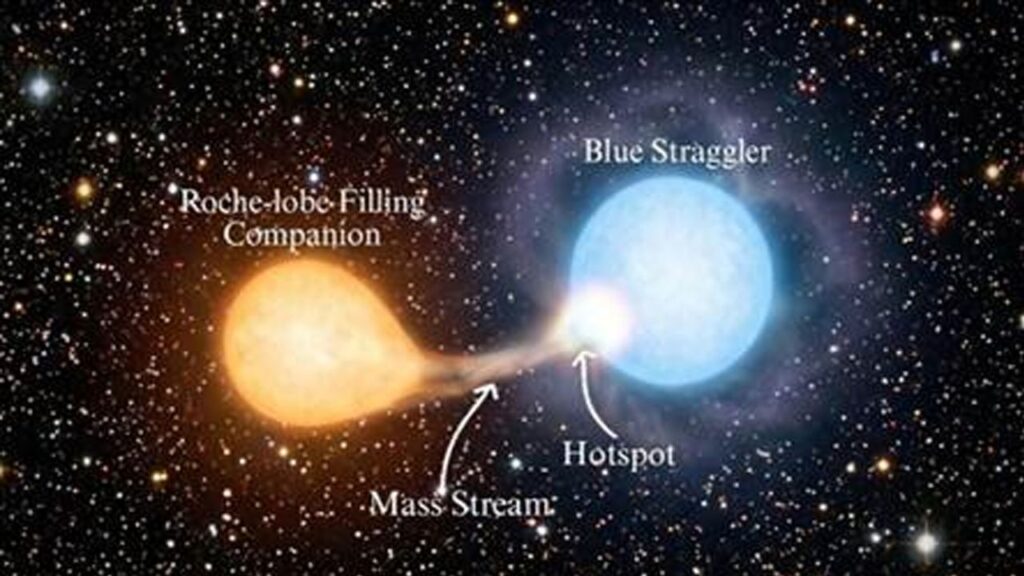

Astronomers from India and their international collaborators have achieved a significant breakthrough in stellar astrophysics by observing a Blue Straggler Star (BSS) in the process of formation. The discovery provides rare and direct evidence supporting the theory that these unusual stars are created through mass transfer between binary star systems.
The research team, led by scientists from the Indian Institute of Astrophysics (IIA), Bengaluru, an autonomous institute under the Department of Science and Technology (DST), Government of India, studied a unique binary star system named TIC 327546480 located in the old open star cluster Collinder 261, nearly 9,500 light-years away from Earth.
Blue Straggler Stars have intrigued astronomers for decades because they appear younger and more energetic than other stars of similar age within star clusters. These stars are typically hotter, brighter and more massive than their surrounding stellar companions, making them appear as though they have been “rejuvenated.”
Scientists have proposed that BSSs are formed when stars acquire additional mass either through collisions with other stars or through the transfer of material from a companion star. However, catching such a process while it is actively happening has been extremely uncommon.
The newly studied system has provided astronomers with one of the clearest examples of this phenomenon. The team identified TIC 327546480 as a potential candidate because its characteristics indicated that the two stars were interacting with each other.
To investigate the system in detail, researchers combined precise observations from NASA’s Transiting Exoplanet Survey Satellite (TESS) with radial velocity measurements collected using the Very Large Telescope (VLT) of the European Southern Observatory in Chile.
The observations revealed that the system is a semidetached binary, where one star has expanded beyond its gravitational boundary, known as the Roche lobe. As a result, material from the smaller companion star is flowing toward the Blue Straggler Star, allowing it to gain mass and increase its energy.
“This discovery gives us a rare opportunity to observe a Blue Straggler Star while it is actively forming,” said Annapurni Subramaniam, faculty member at IIA and co-author of the study. She noted that the findings provide direct observational support for one of the leading explanations behind the origin of these unusual stars.
The researchers also detected strong X-ray activity from the system, further confirming that material transfer is currently underway. X-ray emissions are expected when matter from one star falls onto another and releases large amounts of energy during the accretion process.
According to the study, the newly formed Blue Straggler Star has a mass approximately 1.67 times that of the Sun, while its companion star has a mass around 0.32 times the solar mass. The binary system completes one orbit in just 2.11 days and has a low mass ratio of about 0.19.
The BSS was also found to be rotating rapidly at around 69.55 kilometres per second, likely due to the transfer of angular momentum along with the incoming material. Evolutionary models suggest that mass transfer in the system began nearly 5.46 billion years ago and is continuing today. The host star cluster, Collinder 261, is estimated to be around 7 billion years old.
Ali Hasan Sheikh, a Ph.D. student at Gauhati University and the first author of the study, explained that detailed modelling of the system has helped scientists understand how mass exchange between binary stars can transform an ordinary star into a rejuvenated Blue Straggler.
The discovery represents one of the strongest observational confirmations of BSS formation through mass transfer in binary systems. It offers astronomers a valuable opportunity to test theories related to stellar evolution, binary interactions and the long-term development of star clusters.
Ram Sagar, faculty member at IIA and co-author of the research, highlighted that observing a Blue Straggler Star during its formation phase provides a unique laboratory for studying how stars evolve and interact across the Universe.
The findings have been published in the Astrophysical Journal Letters. The international research team included scientists from Gauhati University, the Indian Institute of Astrophysics, the Inter-University Centre for Astronomy and Astrophysics (IUCAA), the Italian National Institute for Astrophysics (INAF), LUX Observatoire de Paris, France, and the University of North Florida, USA.

Author: Shivam
Proficient Writer Contact: [email protected]