
Anjali T.
UP Targets: The Uttar Pradesh Cabinet has approved procurement policies for paddy and coarse cereals for the Kharif Marketing Season 2026-27. The state plans to set up 4,500 paddy procurement centres, with payments to farmers targeted within 48 hours.
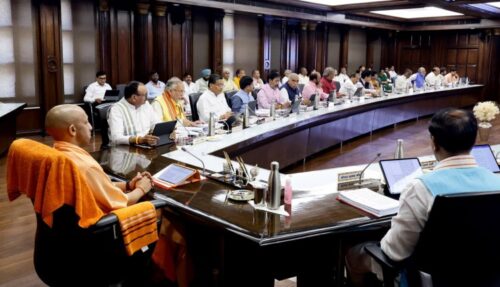
The Uttar Pradesh government has approved its procurement policies for paddy and coarse cereals at Minimum Support Price (MSP) for the Kharif Marketing Season 2026-27. The decision was taken at a Cabinet meeting chaired by Chief Minister Yogi Adityanath on Friday.
The state has set a target of procuring 6.5 million tonnes of paddy this season. Around 4,500 procurement centres will be established across Uttar Pradesh to facilitate the process. Procurement will begin in western Uttar Pradesh on October 12, followed by eastern Uttar Pradesh from November 1.
The Centre has fixed the MSP for common-grade paddy at ₹2,441 per quintal and Grade-A paddy at ₹2,461 per quintal. The support price has increased by 3% compared with the previous year.
Eight Agencies to Handle Paddy Procurement
Eight agencies will be responsible for paddy procurement across the state. These include the Food Department, Provincial Cooperative Federation (PCF), Provincial Cooperative Union (PCU), Uttar Pradesh Sahkari Sangh (UPSS), Mandi Parishad and its associated Farmer Producer Organisations (FPOs) and Farmer Producer Companies (FPCs), National Cooperative Consumers’ Federation of India (NCCF), National Agricultural Cooperative Marketing Federation of India (NAFED), and Food Corporation of India (FCI).
Procurement centres will generally operate from 9 am to 5 pm. District magistrates will have the authority to modify the timings depending on local requirements.
The centres will remain open on working days, local holidays and the second Saturday of each month, except Sundays and gazetted holidays. District magistrates will allocate procurement centres among agencies based on local paddy production and expected arrivals.
Farmer ID to Simplify Paddy Procurement
The government will conduct paddy procurement through an online system using software developed by the National Informatics Centre (NIC). Farmer registration will be linked to Aadhaar, land records and OTP-based mobile verification.
Under the Centre’s AgriStack initiative, farmers who already have a Farmer ID created in Uttar Pradesh will be able to sell their paddy without registering separately on the department’s procurement portal.
The government has also prioritised timely payments. After bank account verification, payments will be transferred through the Public Financial Management System (PFMS), with a target of reaching farmers’ accounts within 48 hours, wherever possible.
To improve transparency in transportation, GPS-enabled vehicles will be mandatory for moving paddy from procurement centres to designated rice mills. In selected districts under a pilot project, QR codes on bags used for Custom Milled Rice (CMR) will help track grain movement and billing.
UP Targets 2.85 Lakh Tonnes of Maize, Bajra and Jowar
Alongside paddy, the Cabinet has approved the MSP procurement policy for maize, bajra and jowar. Procurement of these crops will take place from October 1 to December 31, 2026.
The government has set the following procurement targets:
- Maize: 15,000 tonnes
- Bajra: 2.20 lakh tonnes
- Jowar: 50,000 tonnes
Together, the three crops account for a procurement target of 2.85 lakh tonnes. Procurement centres will be set up in districts where production and market arrivals are expected to be substantial.
Maize Procurement in 25 Districts
The government has proposed 75 procurement centres for maize across 25 districts. These include Bulandshahr, Badaun, Hardoi, Unnao, Mainpuri, Agra, Firozabad, Aligarh, Etah, Kasganj, Hathras, Kanpur Nagar, Kanpur Dehat, Etawah, Auraiya, Farrukhabad, Kannauj, Bahraich, Gonda, Deoria, Ballia, Jaunpur, Mirzapur, Sonbhadra and Lalitpur.
Bajra Procurement in 33 Districts
Bajra procurement will be carried out across 33 districts, with 300 centres proposed for the operation.
The districts include Bulandshahr, Rampur, Sambhal, Amroha, Bareilly, Badaun, Shahjahanpur, Hardoi, Unnao, Agra, Mathura, Firozabad, Mainpuri, Aligarh, Etah, Kasganj, Hathras, Kanpur Nagar, Kanpur Dehat, Etawah, Farrukhabad, Auraiya, Kannauj, Ballia, Jaunpur, Ghazipur, Mirzapur, Prayagraj, Kaushambi, Fatehpur, Jalaun, Chitrakoot and Hamirpur.
Jowar Procurement in 13 Districts
Jowar procurement will be undertaken in Unnao, Hardoi, Firozabad, Kanpur Nagar, Kanpur Dehat, Fatehpur, Mirzapur, Jhansi, Jalaun, Banda, Hamirpur, Mahoba and Chitrakoot. The government has proposed 80 procurement centres for the crop.
Online Procurement and Direct Payments
Procurement of maize, bajra and jowar will also be conducted through NIC-developed software. Farmers will need computerised and verified land records, a photograph-bearing identity document and Aadhaar to sell their produce at procurement centres.
Farmers registered online through the Food and Civil Supplies Department’s website will undergo biometric verification through Electronic Point of Purchase (e-PoP) machines before their produce is procured.
As with paddy, payments for maize, bajra and jowar will be transferred directly to farmers’ bank accounts, with the government aiming to complete payments within 48 hours wherever possible.
The procurement plan is intended to provide farmers with an assured MSP-based marketing channel while improving transparency through digital registration, verification, transport tracking and direct bank transfers.
Read More..Uttar Pradesh Launches ₹20,000 Crore MSME Loan Distribution on World MSME Day