
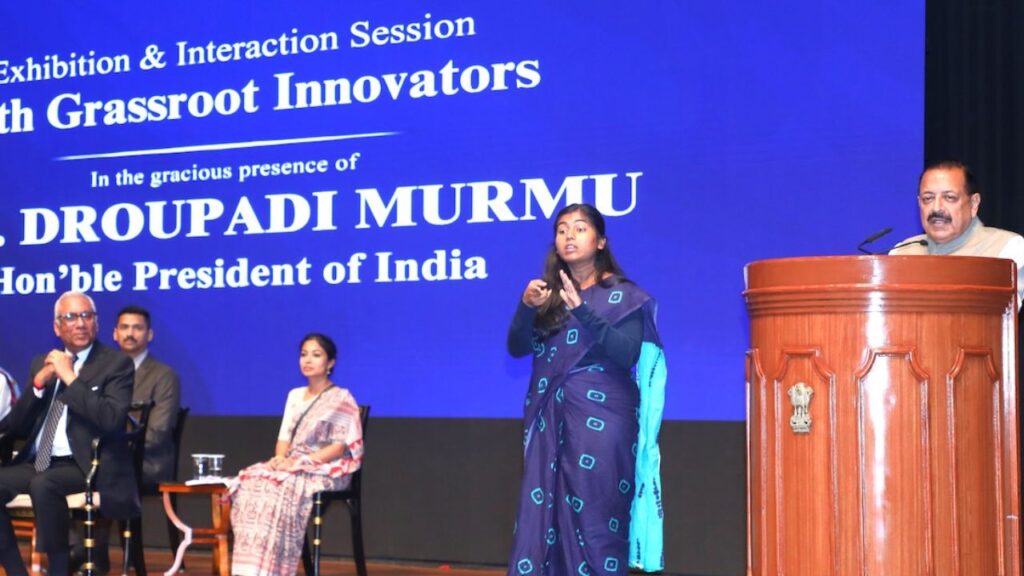

Union Minister of State (Independent Charge) for Science & Technology, Earth Sciences, PMO, Personnel, Public Grievances, Pensions, Atomic Energy and Space, Dr. Jitendra Singh has called for strengthening the connection between grassroots innovators and India’s formal innovation ecosystem, stating that the country’s next phase of development will be powered by ideas emerging from villages, small towns and local communities.
Addressing the Grassroots Innovator Recognition Ceremony 2026 at the Rashtrapati Bhavan Cultural Centre in New Delhi, Dr. Jitendra Singh highlighted that grassroots innovation is central to achieving the vision of Atmanirbhar Bharat and Viksit Bharat@2047. He emphasised that innovative ideas from ordinary citizens must be transformed into scalable solutions through scientific support, technology development, incubation and market integration.
From Local Ideas to National Solutions
Dr. Jitendra Singh said that innovation should not remain limited to recognition alone but must progress through a complete ecosystem that includes validation, prototyping, entrepreneurship support and commercial adoption. According to him, locally developed solutions addressing real-life challenges can become national assets when provided with the right institutional backing.
He noted that the Government, under the leadership of Prime Minister Shri Narendra Modi, has worked towards making science, technology and entrepreneurship accessible across the country. Through initiatives such as the Atal Innovation Mission (AIM), the innovation ecosystem has expanded beyond major cities and premier institutions, enabling innovators from rural, tribal, coastal, hilly and aspirational regions to contribute to India’s growth journey.
The ceremony was attended by President of India Smt. Droupadi Murmu, Principal Scientific Adviser to the Government of India Prof. Ajay Sood, CEO of NITI Aayog Nidhi Chhibber, senior government officials, scientists, incubator representatives and innovators from across the nation.
26 Innovators Recognised for Community-Based Solutions
During the event, 26 grassroots innovators were honoured for developing affordable and practical solutions in diverse areas including agriculture, healthcare, clean energy, assistive technologies, water conservation, circular economy and sustainable livelihoods.
The recognised innovators represented 16 States and 23 districts, with their ages ranging from 24 to 66 years. The group included 11 women innovators, reflecting the growing participation of diverse communities in India’s innovation movement.
Dr. Jitendra Singh said these innovators demonstrate that transformative ideas often emerge from close observation of local problems. Their inventions focus on improving productivity, reducing manual effort, creating employment opportunities and improving the quality of life for farmers, artisans, women and rural communities.
Building Bridges Through Innovation Centres
The Minister highlighted the role of Atal Community Innovation Centres (ACICs) in connecting community-based innovators with technical expertise, mentoring, incubation facilities and market opportunities. He said these centres are helping remove barriers related to geography and limited resources.
Currently, 25 ACICs are operational, while another 25 are under development. These centres have already supported more than 2,500 grassroots innovators by providing them with guidance to refine ideas and develop sustainable enterprises.
Dr. Jitendra Singh stressed the importance of integrating grassroots innovation initiatives with the Department of Science and Technology’s National Initiative for Developing and Harnessing Innovations (NIDHI) programme. Such collaboration would enable innovators to access technology incubators, prototype development facilities, intellectual property support, product testing, certification assistance, financial resources and industry partnerships.
Innovations Addressing India’s Key Challenges
The innovations recognised at the ceremony showcased India’s diverse problem-solving capabilities. These included compact mini rice mills helping farmers process crops locally, tractor-based solutions for restoring uncultivable land, technologies converting agricultural waste into valuable products, AI-powered soil testing services and biodegradable alternatives to plastic products.
Several innovators were also recognised for developing affordable assistive devices for persons with disabilities and decentralised clean energy solutions supporting sustainable rural development.
Citing the example of the Mitticool refrigerator, Dr. Jitendra Singh said grassroots ideas can achieve national recognition when supported through scientific research and institutional mechanisms. The clay-based cooling innovation evolved into a widely recognised product and contributed to the development of standards for such technologies.
Recognition Should Begin a New Journey
Dr. Jitendra Singh called upon scientists, academic institutions, industries, incubators and government organisations to work together in supporting innovators beyond awards. He said every recognised innovation should receive assistance in areas such as design improvement, intellectual property protection, testing, certification and market deployment.
He underlined that recognition should be considered the beginning of an innovator’s journey rather than the final achievement. By creating stronger pathways from ideas to products and enterprises, India can ensure that grassroots innovations contribute meaningfully to national development.
The Minister expressed confidence that with sustained support and collaboration, innovators from every village, district and community will play a crucial role in shaping a self-reliant India and building a developed nation by 2047.
Also Read: TDB Backs RoadGrid to Boost Indigenous Manufacturing of Universal EV Chargers

Author: Shivam
Proficient Writer Contact: [email protected]