
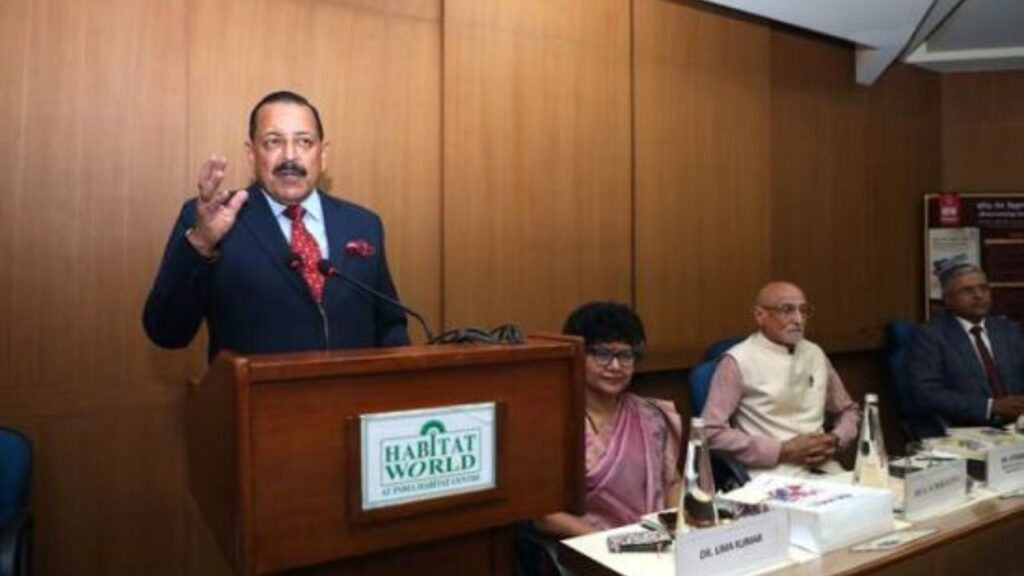

Union Minister of State (Independent Charge) for Science & Technology and Earth Sciences and MoS in the Prime Minister’s Office, Dr Jitendra Singh, has called for a stronger focus on clinically guided medical practice, stressing the importance of early diagnosis, timely intervention and avoiding unnecessary investigations in patient care.
Speaking at the launch of Rheumatology Essentials: A New Frontier for Aspiring Clinicians, Dr Singh said a balanced clinical approach could help reduce unnecessary medication and diagnostic tests, prevent delays in identifying diseases and ensure that patients are referred to the appropriate specialist at the right stage.
Emphasis on Clinical Judgement
Dr Singh, who is also a Professor of Medicine, said modern diagnostic technologies should complement rather than replace clinical judgement. With the growing availability of advanced immunological tests, MRI scans and other investigations, he emphasised that physicians must use such tools appropriately and in accordance with the clinical picture.
He said the three-pronged principle of recognising disease early, avoiding unnecessary investigations and ensuring timely referral could significantly improve the quality and safety of medical care.
The Minister noted that patients suffering from musculoskeletal complaints may sometimes undergo repeated symptomatic treatment or consult multiple doctors without the underlying condition being correctly identified. A clinically oriented approach, he said, can help minimise such delays and prevent avoidable treatment.
Prof Malaviya’s Contribution to Rheumatology
The book has been authored by eminent rheumatologists Prof. Anand N. Malaviya and Dr. Prashant Kaushik. Dr Uma Kumar, Head of Rheumatology at AIIMS, and Dr Shankar Subramaniam were among the senior members of the medical fraternity present at the launch. The book carries a foreword by Dr Vinod K. Paul.
Describing Prof. Malaviya as a “teacher of teachers”, Dr Singh highlighted his pioneering role in developing rheumatology and clinical immunology in India. He recalled that rheumatology was once not widely recognised as an independent super-specialty and credited Prof. Malaviya’s work at AIIMS with helping establish the discipline’s institutional identity.
According to Dr Singh, Prof. Malaviya also helped institutionalise rheumatology through structured courses and training programmes, enabling doctors and medical teachers from across the country to receive specialised training. The subsequent expansion of trained rheumatologists and formal programmes, he said, reflected the enduring impact of his contribution.
Practical Framework for Clinicians
Dr Singh said Rheumatology Essentials offers a practical framework for distinguishing inflammatory rheumatic diseases from mechanical and structural disorders as well as nociplastic pain syndromes. Such differentiation can help doctors move beyond treating symptoms alone and identify patients who may require specialist rheumatological intervention.
The Minister also highlighted the wider impact of musculoskeletal disorders, including impaired mobility and the management of associated conditions such as diabetes. He cautioned that prolonged or inappropriate use of painkillers can have wider health consequences, making accurate diagnosis and suitable referral particularly important for patient safety.
Opportunities for Young Doctors
Welcoming the book’s information on DM, DNB and fellowship programmes in rheumatology across India, Dr Singh said it could serve as a useful resource for medical students and young doctors considering specialised careers in the discipline.
He also stressed the need for quality scientific and medical literature in Hindi and other Indian languages. Language accessibility, he said, should be accompanied by adequate professional literature so that students are not disadvantaged by their medium of instruction.
Designed for undergraduate and postgraduate students, primary-care physicians, general physicians and emergency-room practitioners, the book seeks to provide a practical approach to diagnosing and triaging rheumatic and musculoskeletal conditions.
Congratulating the authors, Dr Singh said Prof. Malaviya had used the book to extend his decades-long contribution to rheumatology to future generations. He expressed hope that the publication would reach clinicians and aspiring specialists across the country and promote more ethical, informed and patient-centred healthcare.

Author: Shivam
Shivam Dwivedi is a senior journalist with extensive experience in research-driven journalism, policy communication, and multi-platform storytelling. His areas of interest include international relations, defence, science & technology, education, urban development, agriculture, spirituality, and environmental sustainability. His work focuses on in-depth analysis, public discourse, and impactful narratives across governance and development sectors, with a strong commitment to the Sustainable Development Goals (SDGs). Contact: [email protected]