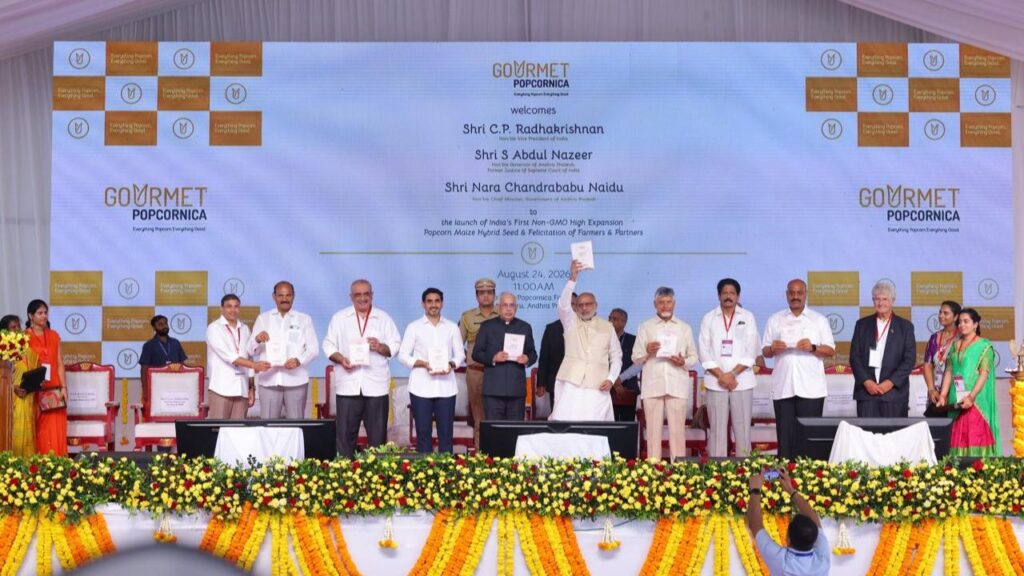

India has taken a significant step towards self-reliance in popcorn production with the launch of Krisna459 and Godari234, the country’s first high-expansion, non-GMO popcorn maize hybrid seeds developed specifically for Indian farming conditions.
Vice-President of India C. P. Radhakrishnan launched the two indigenous hybrids at the Gourmet Popcornica factory in Musunuru, Andhra Pradesh. Andhra Pradesh Governor S. Abdul Nazeer and Chief Minister Nara Chandrababu Naidu were also present at the event, which concluded with recognition of leading farmers and partners from eight states.
Indigenous Genetics for Indian Farmers
The new hybrids represent the culmination of more than a decade of efforts to build a domestic popcorn ecosystem. Gourmet Popcornica initially encouraged farmers to shift from conventional commodity maize to specialised popcorn cultivation through contract farming and assured procurement.
With the introduction of Krisna459 and Godari234, farmers can now access locally developed seed genetics rather than relying on imported hybrid seeds. The varieties have been bred and evaluated over five growing seasons in collaboration with leading Indian maize research institutions.
According to the company, both hybrids have been developed to deliver kernel size and popping expansion comparable with international benchmarks, while also incorporating characteristics suited to Indian agriculture, including shorter crop duration, pest tolerance and improved yield potential.
Boosting Farm Incomes
More than 17,500 farmers across eight states, cultivating nearly 40,000 acres under Gourmet Popcornica’s network, are expected to benefit from the new varieties.
The company said farmers can achieve average yields of around 4.5 tonnes of wet cob per acre, while processor-grade popping quality provides access to assured procurement and contract-based pricing.
The initiative is aimed at giving small and marginal farmers a greater share of the value generated by the specialised popcorn market. It also seeks to create a more stable production and marketing system for popcorn growers.
Vice-President C. P. Radhakrishnan described the development as a step towards the vision of Atmanirbhar Bharat, highlighting the importance of indigenous agricultural technology and locally developed seed varieties.
Reducing Import Dependence
India’s popcorn market has expanded considerably over the past decade. From approximately 50,000 tonnes in 2014-15, the market is estimated to have reached around 1.3 lakh tonnes in 2025-26.
Domestic production currently accounts for nearly 70 percent of the country’s popcorn requirement, marking a substantial change from the sector’s earlier dependence on imports from countries including the United States, Argentina, Brazil and South Africa.
The shift towards domestic cultivation has reportedly saved around ₹810 crore in foreign exchange during 2025-26. With wider adoption of indigenous hybrids, India is targeting the elimination of popcorn imports by 2030.
Strengthening Andhra Pradesh’s Agriculture Vision
Chief Minister Nara Chandrababu Naidu said the innovation reflects the state’s vision of using technology to strengthen agriculture while keeping farmers at the centre of development.
The development is also expected to reduce the popcorn supply chain’s exposure to international freight costs, tariffs and disruptions. For consumers, the change is unlikely to affect the familiar taste and texture of popcorn, but its source could increasingly be an Indian farm using Indian-developed genetics.
The launch of Krisna459 and Godari234 therefore represents more than the introduction of two new seed varieties. It signals India’s growing capacity to develop specialised agricultural genetics domestically, strengthen farmer incomes and build a competitive popcorn industry capable of meeting domestic demand while eventually exploring global markets.
As India moves towards greater agricultural self-reliance, the new hybrids could become an important example of how indigenous research, private-sector innovation and farmer participation can work together to build value-added agricultural industries.
Also Read: India-Morocco Economic Ties Set for Fresh Push as Jitin Prasada Co-Chairs Joint Commission