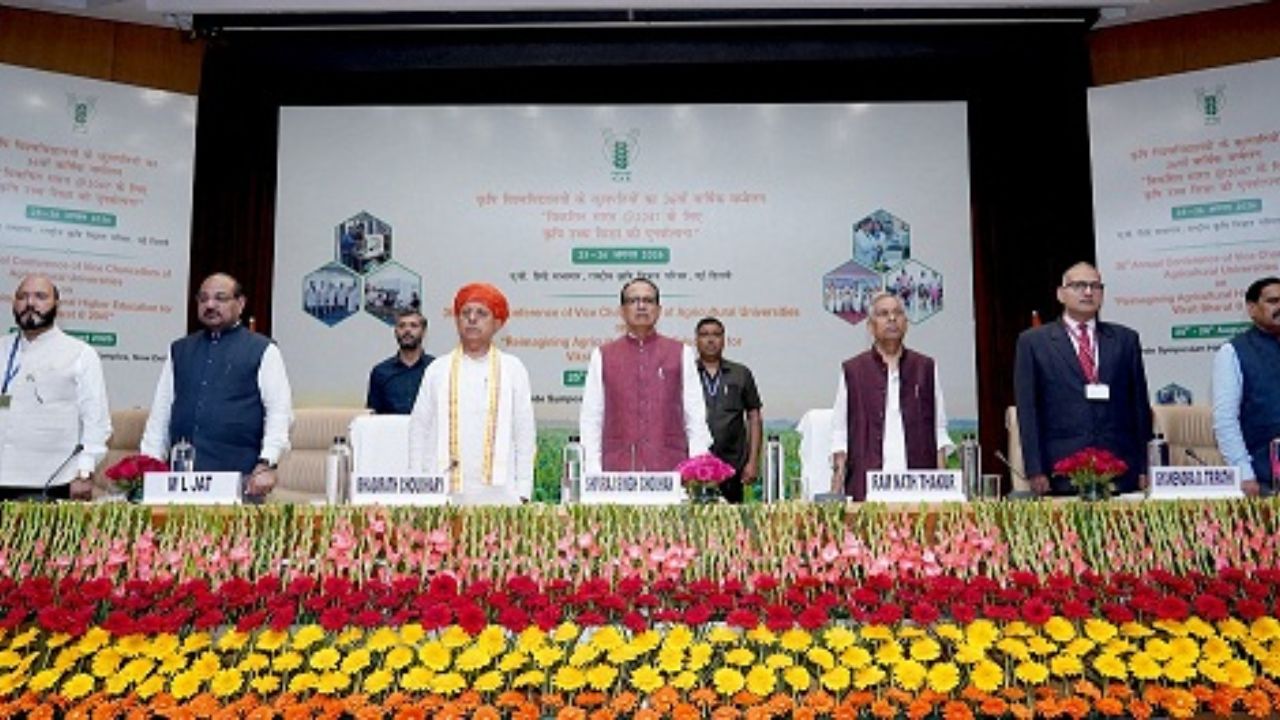
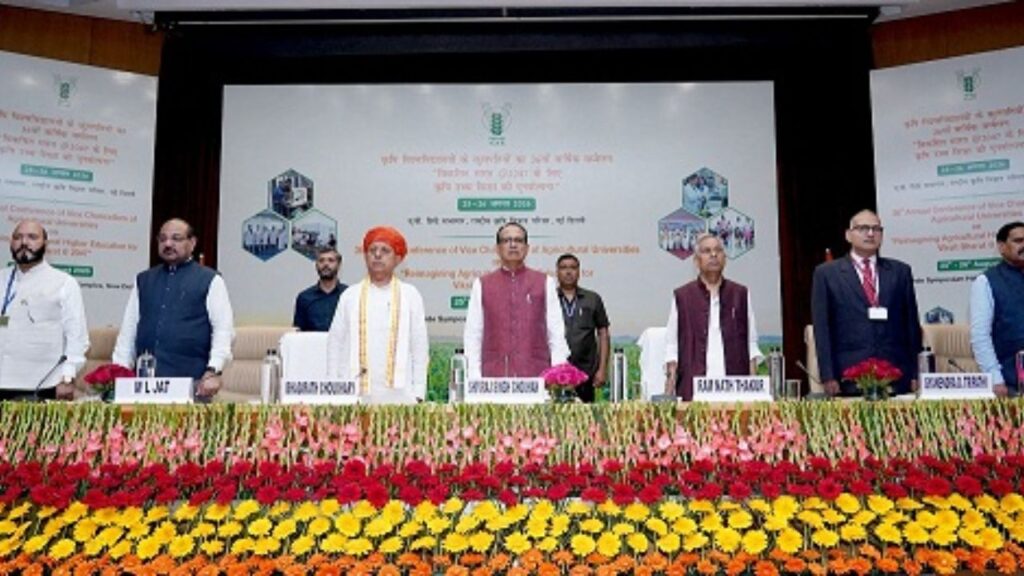

Union Agriculture and Farmers’ Welfare Minister Shri Shivraj Singh Chouhan inaugurated the 36th Annual Conference of Vice Chancellors of Agricultural Universities in New Delhi, calling for a major transformation of agricultural education to make it practical, technology-driven and closely connected with farmers’ needs.
Held on August 25–26 under the theme “Reimagining Agricultural Higher Education for ViksitBharat@2047,” the two-day conference brought together Vice Chancellors of Agricultural Universities, senior officials of the Department of Agricultural Research and Education (DARE) and ICAR, scientists and other stakeholders to discuss reforms needed for a future-ready agricultural education system.
Addressing the gathering, Shri Chouhan said the effectiveness of agricultural education should not be judged merely by the number of degrees awarded. Instead, institutions must focus on creating knowledge and skills that generate measurable improvements in farmers’ lives. He stressed the importance of taking research from laboratories to fields through stronger cooperation among agricultural universities, ICAR, Krishi Vigyan Kendras, Farmer Producer Organisations, industry and farming communities.
The Minister urged universities to establish clear objectives, prepare actionable roadmaps and assess outcomes so that deliberations result in concrete reforms. He said agricultural education must contribute to creating a resilient, modern and prosperous agricultural sector capable of supporting the vision of Viksit Bharat.
Minister of State for Agriculture and Farmers’ Welfare Shri Bhagirath Choudhary highlighted the central role of a strong agriculture sector and empowered farmers in achieving a developed India. He noted that India’s progress from food scarcity to self-sufficiency was made possible through the combined efforts of farmers, scientists, teachers and institutions. He called for greater use of technology, innovation, research and entrepreneurship to attract young people towards agriculture.
Minister of State Shri Ram Nath Thakur also stressed the need to modernise agricultural education and equip students with skills to address emerging challenges. He called for stronger links between research and field-level requirements, while encouraging universities to promote innovation, entrepreneurship and sustainable agricultural practices.
DARE Secretary and ICAR Director General Dr M. L. Jat said agricultural higher education must move towards a skill-oriented, innovation-led and future-ready model. He emphasised stronger industry-academia partnerships, demand-driven research, effective accreditation and data-based decision-making. According to him, education, research and extension must work together to ensure that scientific advances translate into practical solutions for farmers.
The conference covered five sessions and 14 agenda items dealing with student-centric reforms, higher education, faculty development, institutional strengthening, quality enhancement, research, innovation and academic excellence.
Participants reviewed admission procedures, research fellowships and the 40% state/category-wise restriction in seat allocation. Measures relating to timely ICAR-AIQ counselling and verification, separate Ph.D. counselling in Veterinary Sciences and improved undergraduate eligibility for agriculture-qualified and Hindi-medium students were also discussed.
The deliberations further focused on aligning JRF and SRF research with national priorities, strengthening accreditation and quality assurance, improving financial accountability and introducing performance-oriented funding mechanisms. Greater industry participation through internships and apprenticeships, curriculum updates, dual and joint degree programmes and academic exchanges also received attention.
Faculty development emerged as another key priority. Discussions included degree equivalence in agriculture and allied sciences, training requirements, expert mapping and the proposed introduction of Professors of Practice to bring professional expertise into agricultural universities.
The conference also considered creating a comprehensive agricultural education data ecosystem for evidence-based planning and monitoring. Strengthening Rural Agricultural Work Experience (RAWE), improving impact assessment and encouraging student participation in Agriunifest and Agrisports2026 were among the other issues examined.
Research and innovation discussions included implementation of UGC Ph.D. regulations, promotion of Technology Readiness Levels among State Agricultural Universities and improving institutional performance in NIRF rankings.
The conference concluded that agricultural universities must evolve into technology-enabled, outcome-oriented institutions integrating education, research, innovation, industry engagement and rural development to prepare India’s agricultural workforce for the challenges and opportunities ahead.
Also Read: APEDA-FairPrice Initiative Opens New Export Opportunities for Indian Agri-Food Products in Singapore

Author: Shivam
Shivam Dwivedi is a senior journalist with extensive experience in research-driven journalism, policy communication, and multi-platform storytelling. His areas of interest include international relations, defence, science & technology, education, urban development, agriculture, spirituality, and environmental sustainability. His work focuses on in-depth analysis, public discourse, and impactful narratives across governance and development sectors, with a strong commitment to the Sustainable Development Goals (SDGs). Contact: [email protected]