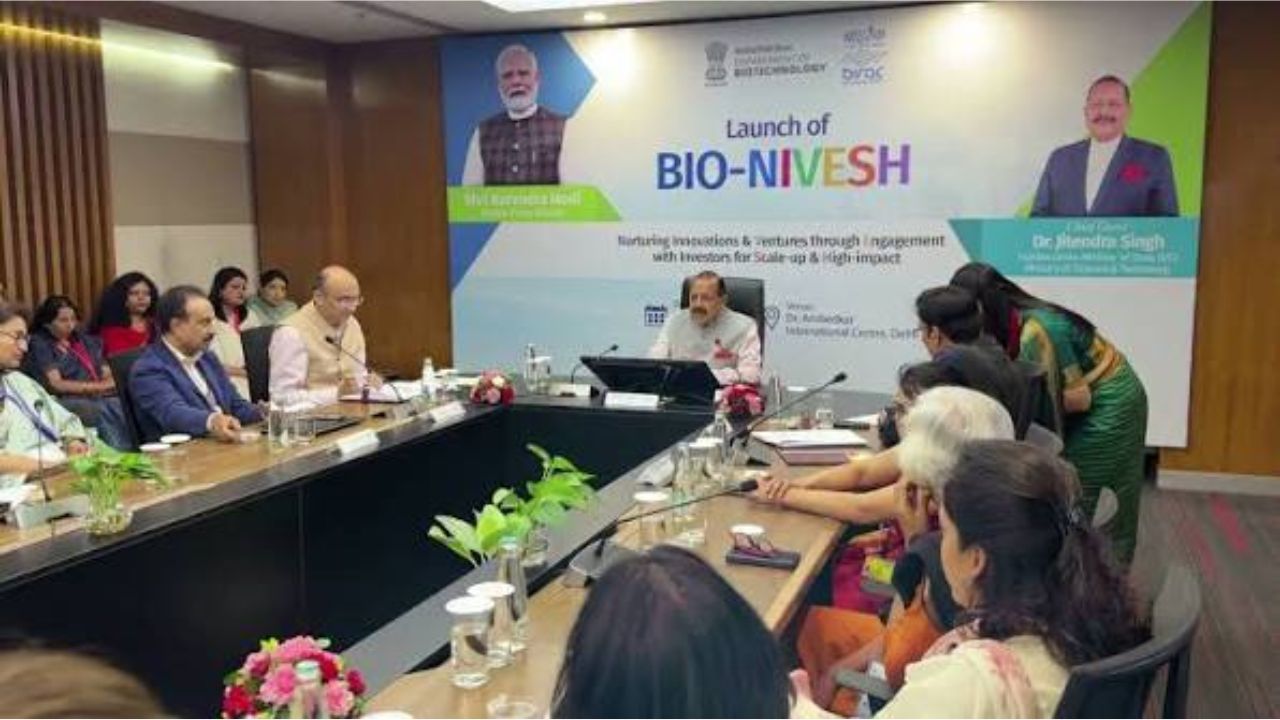

Union Minister of State (Independent Charge) for Science & Technology and Earth Sciences, and Minister of State in the PMO, Personnel, Public Grievances & Pensions, Atomic Energy and Space, Dr. Jitendra Singh, has launched BIO-NIVESH, a strategic platform designed to strengthen collaboration between biotechnology startups and investors and accelerate the flow of private capital into high-potential innovations.
The platform was unveiled during a joint roundtable involving biotechnology startups and investors, where the Minister emphasised the importance of connecting scientific innovation with financial resources, industry expertise and market opportunities.
Innovation Needs Investment to Achieve Scale
Dr. Jitendra Singh said innovation cannot reach its full potential without investment, while investment itself requires a strong pipeline of innovative ideas. He stressed that closer coordination among innovators, investors, industry and the Government would be crucial for the next phase of India’s biotechnology growth.
According to the Minister, BIO-NIVESH is intended to bridge the gap between research and entrepreneurship on one side and industrial-scale production and commercial markets on the other.
During the interaction, he proposed exploring a “Big Five in Five Years” approach for biotechnology. Drawing on a similar concept discussed with space-sector investors and entrepreneurs, he suggested that concentrating resources on a few potential anchor companies could create larger enterprises while simultaneously generating opportunities for other startups to grow around them.
Focus on Commercialisation and Global Competitiveness
Dr. Jitendra Singh said the objective should be to create an ecosystem where science meets capital, innovation meets industry and research meets the market. While government support can help reduce early-stage risks and create enabling conditions, he noted that private investment would be essential for sustained expansion and commercialisation.
The Minister said biotechnology has the potential to drive the next industrial revolution and India should avoid repeating the experience of entering the information technology revolution relatively late. Initiatives such as BIO-NIVESH, he said, are intended to position India to take advantage of emerging technology-led opportunities.
He also highlighted the importance of a “whole of government plus whole of nation” approach, noting that biotechnology innovation involves several ministries, industries and stakeholders. He congratulated the Biotechnology Industry Research Assistance Council (BIRAC) and the Department of Biotechnology team for developing a platform that extends beyond conventional government-led support mechanisms.
Encouraging Corporate and Private Sector Participation
The Minister called for deeper engagement between biotechnology companies and the corporate sector, while urging both sides to develop a better understanding of the sector’s unique requirements.
Biotechnology innovations often involve lengthy development cycles, complex regulatory processes and substantial capital requirements. However, successful technologies can create significant long-term value and deliver transformative benefits to healthcare, society and the wider economy.
He encouraged investors to assess opportunities beyond immediate funding rounds by examining intellectual property, technology maturity, regulatory pathways, market prospects and the potential to build globally competitive companies from India.
At the same time, startups were advised to engage with investors at an early stage. The right investor, Dr. Jitendra Singh said, can provide more than financial support, including strategic expertise, manufacturing capabilities, partnerships, market access and international networks.
RDI Fund to Support Biotechnology Innovation
The Minister also highlighted the Research, Development and Innovation (RDI) Fund, which has an outlay of ₹1 lakh crore. BIRAC has been designated as a Second-Level Fund Manager for biotechnology and allied sectors under the framework.
He said the initiative could provide long-term, patient capital to technology developers, startups and companies working in strategic biotechnology areas, particularly those moving towards technology translation, scale-up and innovation-driven manufacturing.
20 Startups and Around 50 Investors Participate
The inaugural BIO-NIVESH edition brought together 20 high-potential biotechnology and deep-tech startups with around 50 investors. The platform is designed as a two-way engagement mechanism rather than merely another startup pitching or investor-connect event.
The first session focused on direct startup-investor interactions, with participating companies selected on the basis of innovation, development stage, scalability, market potential and regulatory preparedness. A second session provided an opportunity for the Minister to interact with startups and investors on issues related to funding, commercialisation, scale-up and policy support.
Dr. Jitendra Singh said the success of BIO-NIVESH should ultimately be measured through partnerships formed, investments mobilised, technologies scaled and products successfully brought to market.
Envisioned as a recurring initiative, BIO-NIVESH is expected to be organised in different cities in the future, expanding participation and connecting regional biotechnology ecosystems with national and global investment networks.

Author: Shivam
Shivam Dwivedi is a senior journalist with extensive experience in research-driven journalism, policy communication, and multi-platform storytelling. His areas of interest include international relations, defence, science & technology, education, urban development, agriculture, spirituality, and environmental sustainability. His work focuses on in-depth analysis, public discourse, and impactful narratives across governance and development sectors, with a strong commitment to the Sustainable Development Goals (SDGs). Contact: [email protected]