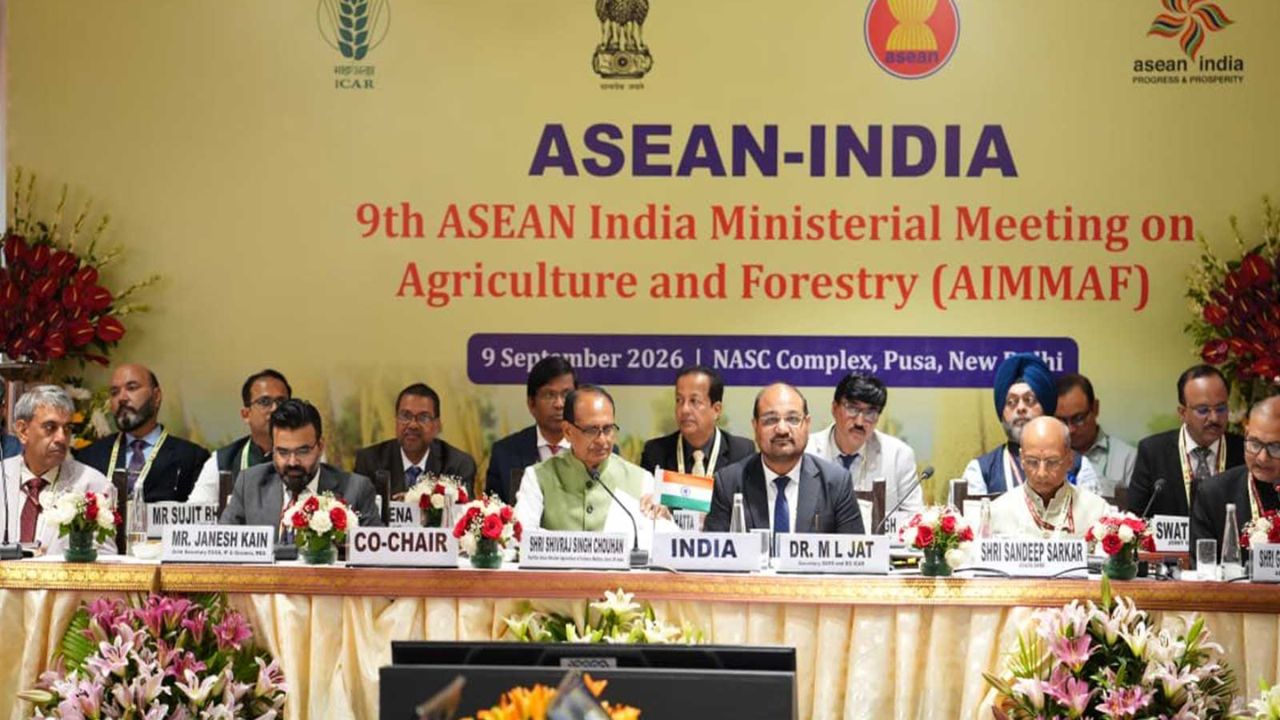
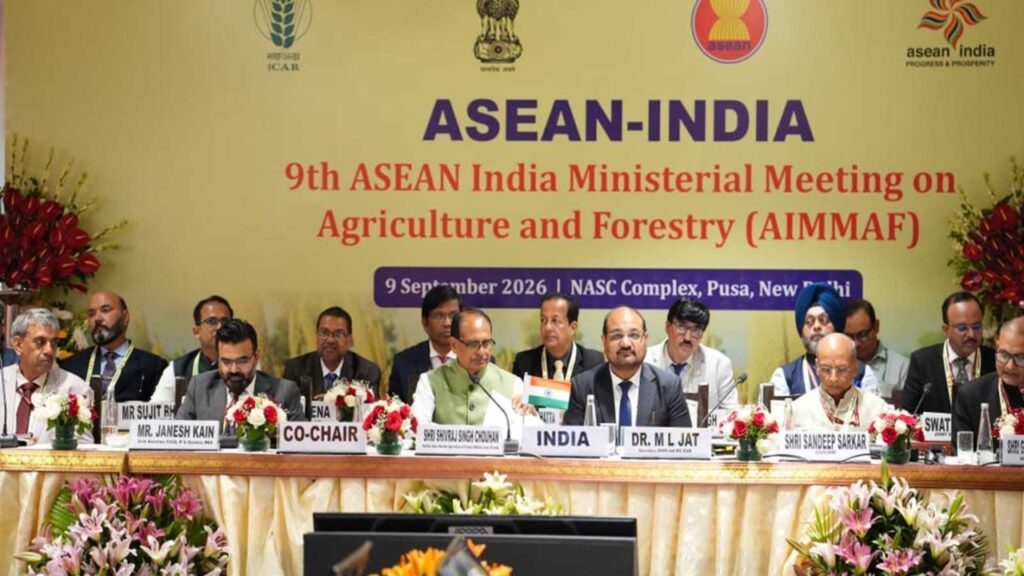

The 9th ASEAN–India Ministerial Meeting on Agriculture and Forestry, held in New Delhi on September 9, 2026, highlighted the growing partnership between India and ASEAN in building a food-secure, sustainable and climate-resilient agricultural sector. The meeting focused on practical cooperation aimed at benefiting farmers while strengthening collaboration in agriculture and forestry.
The meeting was co-chaired by India’s Union Minister for Agriculture and Farmers’ Welfare, Shri Shivraj Singh Chouhan, and H.E. Francisco P. Tiu Laurel, Secretary of the Department of Agriculture, The Philippines. The Ministers reaffirmed their commitment to deepening the ASEAN–India Comprehensive Strategic Partnership through greater cooperation in agricultural research, technology, innovation and capacity building.
Focus on Sustainable Agricultural Development
The Ministers welcomed “ASEAN 2045: Our Shared Future” and the ASEAN Food, Agriculture and Forestry Sectoral Plan 2026–2030 as important frameworks for achieving sustainable and resilient growth. They also expressed support for the forthcoming ASEAN–India Medium-Term Plan of Action for Cooperation in Agriculture and Forestry for 2026–2030.
The proposed plan is expected to promote policy dialogue, digital technologies, joint research, technology exchange, capacity building and farmer-to-farmer interactions. The approach seeks to create stronger institutional and grassroots partnerships between India and ASEAN countries.
Climate-resilient farming, low-emission rice cultivation, improved water productivity, artificial intelligence-based digital agriculture and soil health were identified as major areas for cooperation. The discussions also covered food safety, post-harvest management, circular bioeconomy, agroforestry and the development of resilient agricultural value chains.
Strengthening Innovation and Market Connectivity
The Ministers stressed the importance of connecting research organisations, technology developers, extension agencies, private companies and farmers. Such partnerships, they noted, can help accelerate the adoption of innovative agricultural solutions and make new technologies more accessible to farming communities.
Greater cooperation was also emphasised in market connectivity, value addition and logistics related to agriculture and forestry. The countries recognised that farmers and agricultural supply chains face increasingly complex challenges, including climate change, extreme weather events, geopolitical uncertainties, fluctuating input markets, trade disruptions and the spread of transboundary pests and diseases.
A key feature of the Ministerial Meeting was the unveiling of the ‘India–ASEAN Friendship Spike for Agriculture and Forestry’. The initiative symbolises the longstanding relationship between India and ASEAN and their shared vision for stronger cooperation in agriculture and forestry.
ASEAN Delegation Visits ICAR-IARI
As part of the programme, the visiting Ministers and delegates toured the ICAR–Indian Agricultural Research Institute (IARI) at Pusa. The delegation visited the Centre of Protected Cultivation, pearl millet and rice fields, the Nanaji Deshmukh Phenomics Facility and the Gene Bank of the ICAR–National Bureau of Plant Genetic Resources (NBPGR).
The visit provided the delegates an opportunity to observe India’s work in modern crop research, advanced agricultural practices and the conservation of plant genetic resources. The delegation was led by Dr M.L. Jat, Secretary, DARE and Director General, ICAR.
The ASEAN Ministers and Heads of Delegation also interacted with Indian scientists, researchers and representatives from business and industry. The discussions were aimed at promoting research partnerships, technology exchange, innovation and stronger industry linkages.
Agriculture Working Group Meeting
The 10th ASEAN–India Agriculture Working Group Meeting was held in New Delhi on September 8, bringing together 45 delegates from 11 ASEAN Member States. Co-chaired by India and the Philippines, the meeting focused on expanding cooperation in agriculture and forestry.
An exhibition organised alongside the Ministerial Meeting showcased a range of ICAR technologies covering natural resource management, information and communication technology, animal science, fisheries and horticulture.
The exhibition highlighted soil-health solutions, resilient farming technologies and Kisan Sarathi, which provides agricultural advisory support to 3.03 crore registered farmers across more than 3.5 lakh villages in 13 Indian languages.
Other showcased innovations included an indigenous African Swine Fever vaccine, disease-forewarning systems, advanced fisheries technologies and a 40–50-tonne shrimp farming model designed for a 120-day production cycle. Horticultural technologies featured diversified crops, spices, value-added products and virus-free potato seed production using aeroponics.
A cultural programme held on September 8 also showcased India’s diverse cultural heritage. The meeting concluded with an agreement to convene the 10th ASEAN–India Ministerial Meeting on Agriculture and Forestry in 2028, marking the continuation of cooperation towards a more resilient and sustainable agricultural future.
Also Read: Centre Pushes States to Accelerate Strengthening of 300 Krishi Vigyan Kendras by 2027

Author: Shivam
Shivam Dwivedi is a senior journalist with extensive experience in research-driven journalism, policy communication, and multi-platform storytelling. His areas of interest include international relations, defence, science & technology, education, urban development, agriculture, spirituality, and environmental sustainability. His work focuses on in-depth analysis, public discourse, and impactful narratives across governance and development sectors, with a strong commitment to the Sustainable Development Goals (SDGs). Contact: [email protected]