
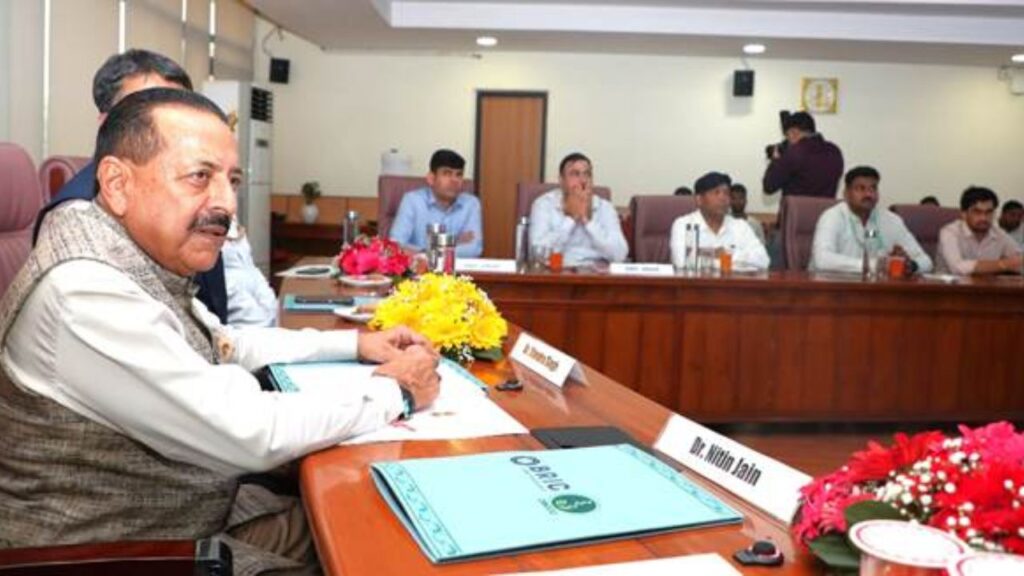

Union Minister of State (Independent Charge) for Science & Technology and Earth Sciences and MoS in the Prime Minister’s Office, Dr. Jitendra Singh, inaugurated the SpeedSeed Phenotyping and Resource Optimization for Unified Trait Analysis (SPROUT) facility at BRIC-National Institute of Plant Genome Research (BRIC-NIPGR), New Delhi.
The Minister described the facility as an important indigenous capability that can support the development of climate-resilient crop varieties suited to India’s diverse agro-climatic conditions. He said that with the country experiencing varied weather patterns across regions, the ability to evaluate crops under controlled and different environmental conditions is increasingly important for strengthening agricultural resilience.
SPROUT is a season-independent, controlled-environment facility designed for high-throughput phenotyping, precision stress screening and germplasm evaluation. It can be used to study breeding populations, mutants, transgenic lines and genome-edited crops. Chickpea is among its major focus areas.
The facility is expected to help bridge the gap between genomic discoveries and practical crop improvement. By enabling precise evaluation of traits, SPROUT can support researchers in moving more efficiently from gene discovery and validation to breeding and development of improved crop varieties.
Dr. Jitendra Singh said the initiative reflects the broader biotechnology push under the BioE3 policy, which identifies climate-resilient agriculture as one of its strategic areas. He noted that India is witnessing advances simultaneously in plant biotechnology, human biotechnology, genomics and other emerging scientific fields.
The Minister also highlighted the importance of converting laboratory-based scientific advances into technologies that address practical agricultural challenges. According to him, developments in genomics, gene technologies, precision phenotyping and accelerated breeding can play an increasingly important role in helping farmers respond to changing climatic conditions.
A complementary technology developed by NIPGR, SpeedSeed, is aimed at accelerating crop generation advancement. In chickpea, optimised protocols can bring the generation cycle down to around 40 days, significantly reducing the time required for conventional breeding and research. When used alongside SPROUT, the technology can help researchers rapidly evaluate and advance promising crop traits.
The Department of Biotechnology (DBT) has supported the expansion of India’s agricultural biotechnology ecosystem over the past 12 years. Between 2014 and 2026, more than 300 projects were supported in agriculture biotechnology and allied areas. More than 50 improved varieties covering crops such as rice, wheat, chickpea, mustard, vegetables and forestry species have reportedly been developed with enhanced tolerance to drought, floods, salinity, pests and diseases.
One significant outcome has been the development of 17 climate-resilient rice varieties through a genomics-assisted breeding programme. These varieties are currently cultivated across nearly 15 lakh hectares, illustrating how advanced molecular breeding can contribute to agricultural productivity, climate adaptation and food security.
During the programme, Dr. Jitendra Singh also planted a sapling under the “Ek Ped Maa Ke Naam” campaign and interacted with scientists and officials at BRIC-NIPGR. Prof. Manoj Prasad, Director, BRIC-NIPGR; Dr. Senthil K. Muthappa, BRIC-NIPGR; and Dr. Nitin Jain, Scientist-H, DBT, were among those present.
The Minister further emphasised the need for stronger communication between scientific institutions, farmers, industry and other stakeholders. He called for greater use of short films, workshops and professionally produced visual content to explain complex technologies and demonstrate their practical benefits.
He also encouraged scientific institutions to bring farmers and industry representatives into regular interactions and provide them opportunities to understand research activities firsthand. Such engagement, he said, can improve public understanding of biotechnology and create avenues for collaboration.
Dr. Jitendra Singh stressed that scientific achievements should not remain confined to laboratories. Greater visibility and effective science communication, he said, are necessary to demonstrate how Indian scientific capabilities are contributing to agriculture, industry, sustainability and society.
The SPROUT facility represents another step towards strengthening India’s indigenous agricultural biotechnology infrastructure. By combining accelerated generation advancement with precision phenotyping, the initiative is expected to support faster crop research and contribute to the development of productive, climate-resilient varieties in line with the broader vision of Viksit Bharat 2047.
Also Read: CAQM Intensifies NCR Air Pollution Enforcement, Reviews 150 Inspections and Compliance Actions

Author: Shivam
Shivam Dwivedi is a senior journalist with extensive experience in research-driven journalism, policy communication, and multi-platform storytelling. His areas of interest include international relations, defence, science & technology, education, urban development, agriculture, spirituality, and environmental sustainability. His work focuses on in-depth analysis, public discourse, and impactful narratives across governance and development sectors, with a strong commitment to the Sustainable Development Goals (SDGs). Contact: [email protected]